

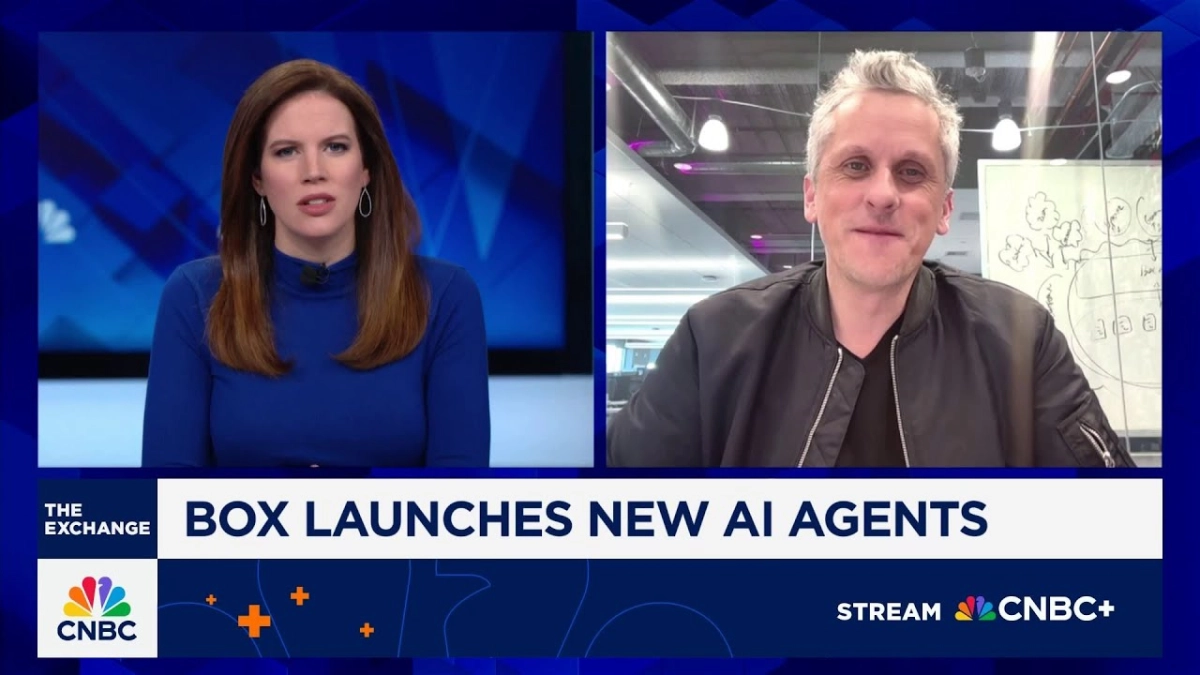
"The future of enterprise AI will be defined by intelligent agents that can work together across systems," declared Aaron Levie, Box Co-founder and CEO, highlighting a profound shift in how businesses will leverage artificial intelligence. This vision, articulated during a recent interview on CNBC's 'The Exchange', moves beyond the familiar chatbot paradigm to a future where AI performs complex, multi-step tasks autonomously, fundamentally reshaping organizational workflows and unlocking unprecedented productivity across the enterprise.
Aaron Levie, Box Co-founder and CEO, spoke with Kelly Evans on CNBC's 'The Exchange' about the company's latest innovation: a suite of AI agents designed to revolutionize enterprise work by tackling long-running, data-intensive tasks across various business functions. His commentary provided a sharp analysis of the evolving AI landscape and Box's strategic positioning within it.
Levie distinguished these new AI agents from earlier iterations of generative AI, which largely functioned as sophisticated chatbots or assistants. While initial AI models excelled at responding to simple queries, the next frontier, according to Levie, involves AI systems capable of executing comprehensive projects. "You'll be able to send them long-running tasks to go work on and then come back to you with a complete solution, a complete answer, or ultimately execute a project for you," he explained. This evolution marks a significant leap beyond simple conversational AI. These agents are designed for independent, multi-stage problem-solving.
Box's new AI agents are tailored to perform deep research, general search across organizational data, and intricate data extraction. Levie offered a compelling scenario: imagine a bank needing to conduct due diligence on a company slated for acquisition. Instead of human analysts sifting through thousands of documents, contracts, marketing assets, research papers, financial statements, an AI agent could be tasked with this monumental undertaking. "I have a collection of assets in my enterprise... I want to have the AI go and read through all of that data and come to some type of conclusion or generate some type of report or analysis on that information," Levie elaborated. Such an agent would process vast datasets through the specific lens of a due diligence project, subsequently delivering a finalized, comprehensive report. This capability promises to accelerate critical business processes that were previously bottlenecked by manual, labor-intensive efforts.
A core insight from Levie's discussion was the transformative impact these agents will have on human labor, not necessarily through replacement, but through augmentation and the unlocking of previously unfeasible tasks. He noted that Box has engaged in over a hundred customer interactions in Q1 alone, and "the vast majority of those customer conversations are conversations where the enterprise is deploying AI at use cases where humans were not doing the work before." This suggests a significant expansion of what's possible, rather than a direct substitution of existing roles. Many tasks, such as meticulously reviewing every contract in an organization or analyzing every document for a specific project, were simply "too expensive to send people to go off and look through" prior to the advent of these sophisticated AI agents. This perspective offers a nuanced view on AI's impact on employment, emphasizing the creation of new value and the ability to address latent demand for complex analytical work.