

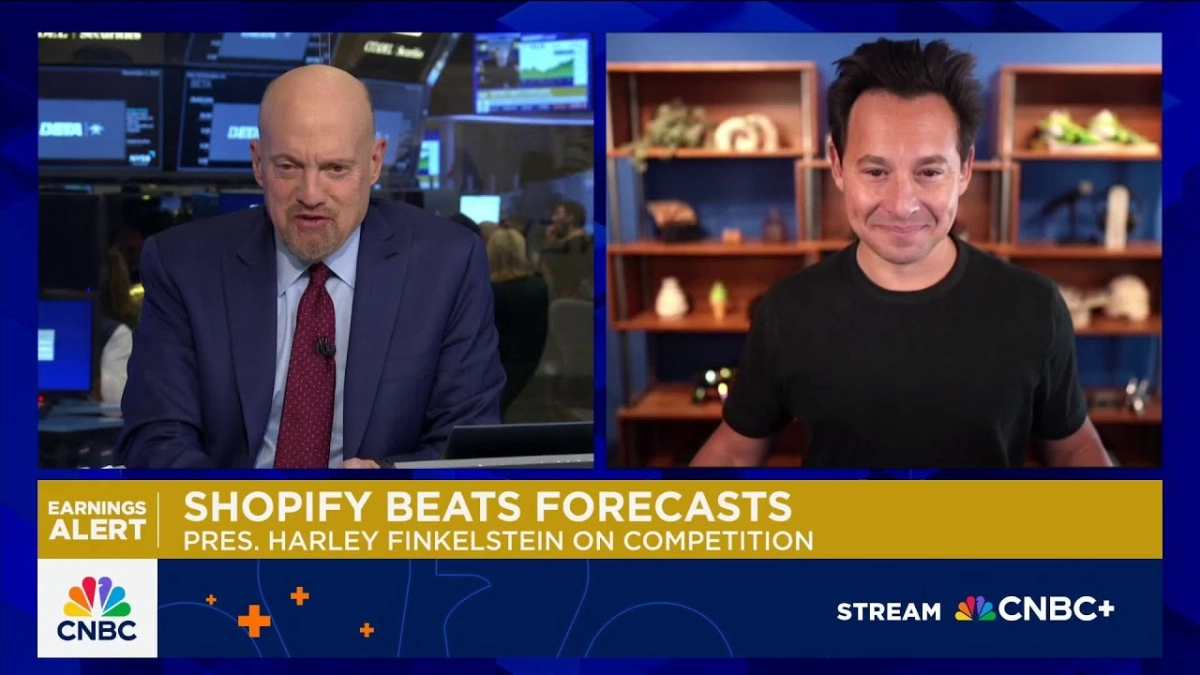
"We're laying the rails for agentic commerce," stated Harley Finkelstein, president of Shopify, during a recent appearance on CNBC's 'Squawk on the Street.' Finkelstein spoke with Jim Cramer about the company's latest quarterly performance, its strategic integration of artificial intelligence, and the broader landscape of e-commerce. Shopify's recent earnings report showcased robust growth, with revenue increasing by 32% and significant merchant acquisition. This performance underscores Shopify's continued momentum in empowering entrepreneurs.
Shopify's core value proposition, as articulated by Finkelstein, is its ability to democratize commerce. "Every 26 seconds, a brand new entrepreneur gets their first sale on Shopify," he noted, highlighting the platform's accessibility. This accessibility is crucial for fostering entrepreneurship, allowing individuals to bypass the complexities traditionally associated with starting a business. The company's infrastructure is designed to be a comprehensive solution, enabling small to medium-sized businesses to compete effectively.
A key insight from the discussion was Shopify's proactive embrace of artificial intelligence. Finkelstein emphasized that AI is not merely an add-on but a fundamental component of their strategy. "We're building this infrastructure to build shopping into AI, and AI into shopping," he explained. This vision suggests a future where AI agents can seamlessly manage various aspects of a merchant's online presence, from product creation to customer interaction and sales. The goal is to make commerce more efficient and accessible, not just for startups but for larger enterprises as well.
Finkelstein addressed the perception that large companies might be hesitant to adopt new platforms, particularly when they have existing infrastructure. He countered this by explaining that many of these larger brands are seeking to modernize and streamline their operations. "They don't want to build their own tech stack anymore; they want to leverage a platform," Finkelstein asserted. This sentiment reflects a growing trend where established businesses are looking to external solutions for agility and scalability, rather than investing heavily in proprietary systems that can become outdated or burdensome to maintain. Shopify's comprehensive suite of tools and its AI capabilities position it as an attractive partner for these enterprises.
The interview also touched upon the competitive landscape, with Finkelstein drawing parallels between Shopify's growth and the success of other major tech players. He highlighted that companies like Amazon, Costco, and Home Depot, despite their scale, benefit from robust platforms that simplify operations and enhance customer reach. Shopify aims to provide a similar, albeit e-commerce-focused, ecosystem. "What we're seeing is that many of these very large enterprise brands, they don't want to build their own stacks anymore. They want to modernize, they want to effectively come to Shopify to let us handle their commerce, their retail," he explained. This indicates a strategic shift where even established businesses are outsourcing complex operational elements to specialized platforms.