

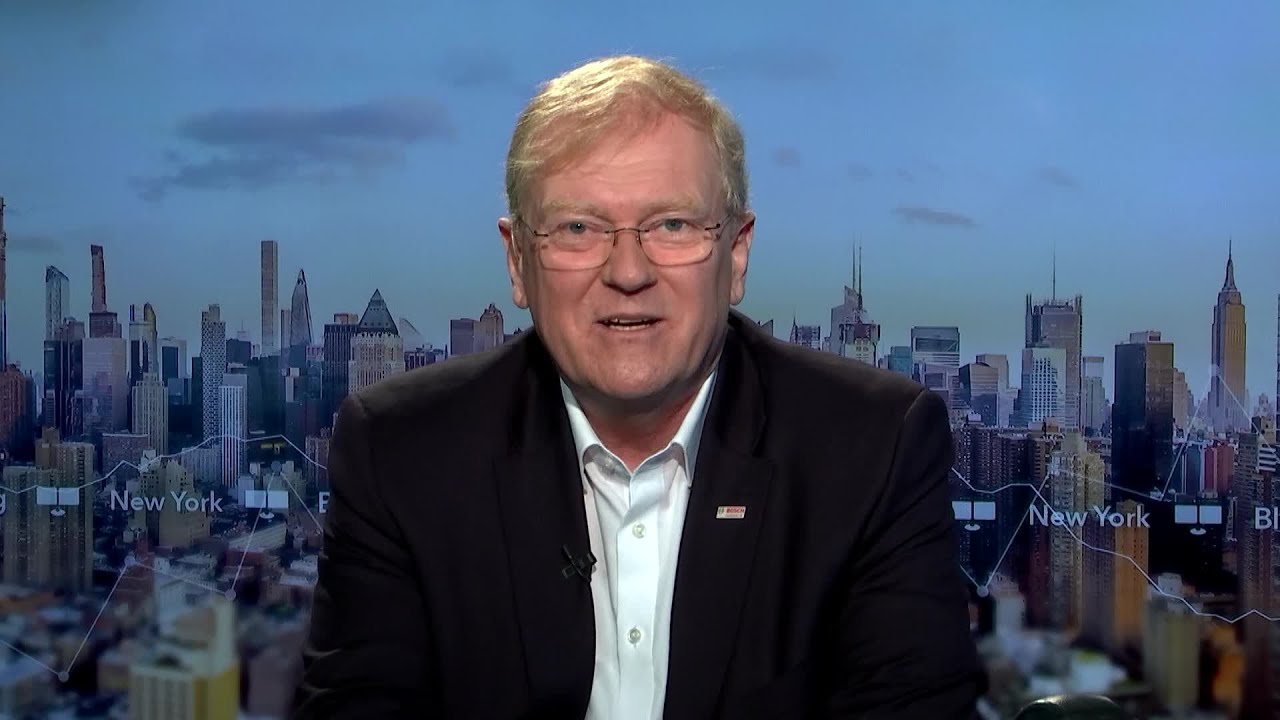
In a recent broadcast, Bosch executive, Mr. Klaus Maerker, discussed the dynamic interplay between artificial intelligence, electrification, and supply chain resilience within the automotive sector. Maerker, who leads Bosch's activities in the Middle East, highlighted the company's strategic focus on leveraging AI to enhance vehicle safety, efficiency, and the overall driving experience, while navigating the complexities of global supply chains.
The full discussion can be found on Bloomberg Technology's YouTube channel.
Understanding the Current Automotive Landscape
Maerker began by framing the current geopolitical situation, including the conflict in Iran, not merely as a geopolitical crisis but as a significant stress test for global supply chains across various industries. He noted that the automotive sector, alongside heavy industries, consumer technology, and energy, is particularly susceptible to these disruptions. He specifically pointed to the automotive industry's reliance on semiconductors, stating, "There is probably not a company that is as well-placed to give the assessment of what's happening then Bosch."
He acknowledged that while the initial impact of semiconductor shortages was severe, the situation has stabilized somewhat. However, he cautioned that the demand for these critical components is expected to remain high, especially with the increasing integration of AI in vehicles. "We have managed to throw that, and actually we were quite happy that beginning of this year the supply chain looked quite stable to go ahead," Maerker stated, adding, "Obviously with some issues which we all know, like RAMs and DDR6, DDR5 RAMs becoming critical because of the AI investments, but in general, supply chains were kind of ok-ish going forward."
Regional Operations and Supply Chain Management
The discussion then shifted to Bosch's regional operations, with a specific focus on the United Arab Emirates and Dubai. Maerker elaborated on how the company is managing its operations in these regions, noting that the geopolitical situation has had some localized impacts. "For us, the most important aspect is that our people are in the UAE and in Dubai, and in the Arabian states, so those people are affected, some of our employees are also stuck on leisure, and some are afraid that it impacts the lives, but operationally so far, impacts are limited," he explained.
When asked about specific disruptions in the UAE, Maerker identified a broader challenge affecting air cargo and freight. He explained that the situation has led to fewer planes being available, impacting the capacity for transporting goods. "The biggest impact for us is that the airplanes in the UAE are stuck and there is a lot of relationship from Europe to Asia and Europe to other regions, so with less capacity, that means that for sure we see more difficult situations," he said.
The Role of AI and Technology in Automotive Future
Maerker emphasized Bosch's commitment to innovation, particularly in the realm of AI and its application in vehicles. He highlighted the increasing demand for AI-powered features, such as advanced driver-assistance systems (ADAS) and predictive maintenance. "We see that EVs are having the first wave and that wave was not as big as we expected, especially in the US," he commented, "so now a second wave comes in with EVs but also plug-in hybrid vehicles or range-extended vehicles, which you also see in China, which are also very important for us, because of the AI build up, because AI demands higher amount of RAMs, right."
He further elaborated on the strategic importance of integrating AI into automotive systems. "We are more on the focus on the long-term aspect of business because I believe that the more important aspects than these medium-term disruptions made probably be the technology things which are in front of us," he stated. He suggested that AI will play a crucial role in making vehicles safer and more efficient, citing applications like automated driving and predictive safety features. "We are implementing AI in a massive volume, so that means that the AI infrastructure is used in household appliances and in cars," he added.
Navigating Market Demands and Technological Shifts
Maerker addressed the varying market demands and technological preferences across different regions. He noted that while the global automotive market is moving towards electrification, the pace of adoption varies. "There is a different market demand in India which is strong growing, in China with their different consumers and in the US," he explained. He also touched upon the increasing demand for advanced driver-assistance systems (ADAS) and the role of semiconductors in these technologies.
He concluded by emphasizing that Bosch is well-positioned to adapt to these evolving market dynamics. "Bosch is doing this work because we have kept our capability in engine work, ICE work, and we can combine these two into the plug-in and hybrid vehicles or even in cars," he stated. He also highlighted the company's focus on developing solutions that cater to both traditional and electrified powertrains, ensuring continued relevance in the transitioning automotive landscape.


