

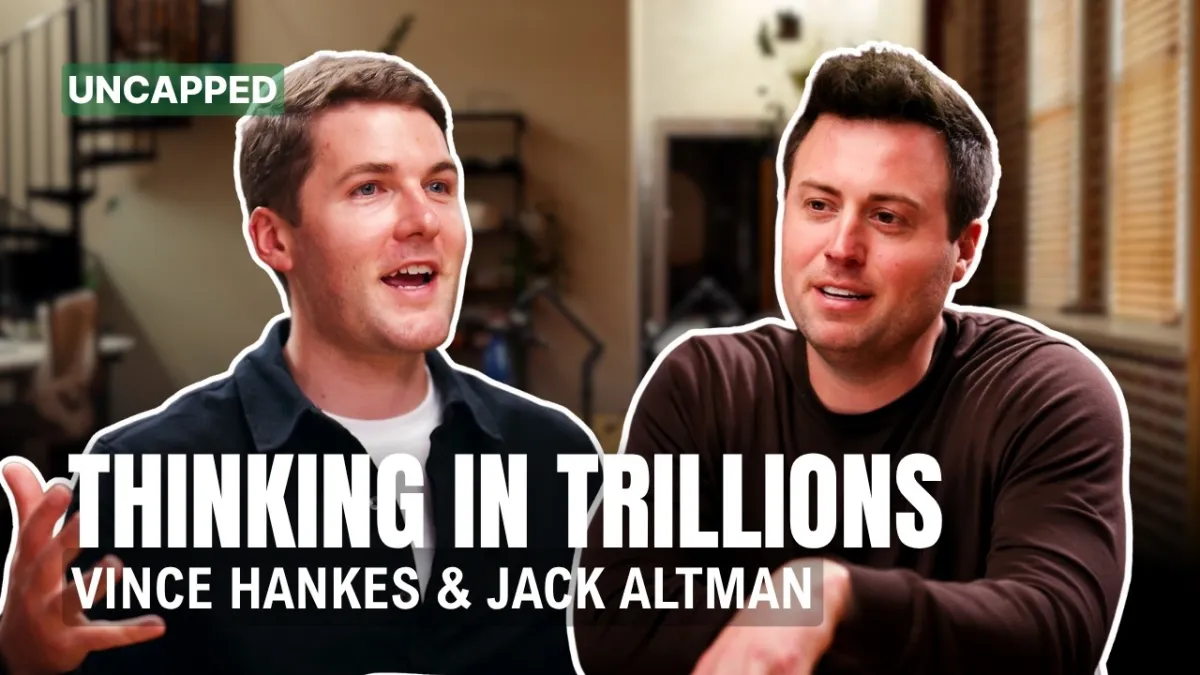
Vince Hankes, Partner at Thrive Capital, emphasizes the importance of conviction when investing billions into a company: "You have to have almost dogmatic conviction it's going to work."

Jack Altman spoke with Vince Hankes at Uncapped about Thrive Capital's evolution, their investment strategies, and the impact of AI on the market. The conversation delved into the firm's history, its approach to non-consensus investing, and its perspectives on emerging technologies.
Thrive Capital, founded in 2009 with a mere $10 million fund, has grown into a $5 billion powerhouse. This remarkable ascent, as Altman notes, "skyrocketed into new echelons." Hankes, who joined in 2019 when Thrive had just raised a billion-dollar fund, recalls feeling the firm was still "small" at the time, especially coming from Tiger Global.
One of the core insights gleaned from the conversation is Thrive's ability to identify and back companies with long-term potential, even if the market doesn't immediately recognize their value. Hankes illustrated this point by citing Stripe, where Thrive made its first investment "almost 10 years before we made this big $2 billion investment." This patience and foresight are key to their success.
Another key theme was Thrive's emphasis on qualitative analysis before quantitative. Hankes explained that they spent "18 months getting to know" a company called Isomorphic before investing. This deep dive allows them to build the "dogmatic conviction" necessary for writing those billion-dollar checks.
The conversation also touched on the impact of AI on the market. Hankes noted that the best companies benefit from scale, and that includes leveraging AI to improve their operations. "With the tailwinds of AI," companies are poised to become even bigger.
"The power of compounding," said Hankes, "is really what it all boils down to." He also notes, as he is discussing the difficulty for a lot of investors to have the conviction to put money into Carvana, that "you can't be on the fence about is this going to work or not. You have to have almost dogmatic conviction it's going to work." This conviction, built over long periods of research and relationship-building, is what sets Thrive apart.
Hankes also highlighted a unique aspect of Thrive's culture: its origin as a New York-based firm founded by a 26-year-old. This outsider perspective, he argued, allowed them to "do something that was unobvious at the time."
The discussion also touched on the challenges of maintaining a contrarian mindset as a firm grows. As Altman observed, "becoming consensus sort of de facto as you scale like this." Hankes acknowledged that "it's harder" to find contrarian-minded people as Thrive's brand recognition increases. The firm's solution is to "go seek them out" rather than relying on inbound applications.
Related Reading
- Agentic AI and Infrastructure Drive the Next Wave of Tech Investment
- AI's Enduring Market Dominance and the Unseen Infrastructure Boom
- Enterprise AI: Adoption Soars, ROI Lags
The ability to manage conflicts of interest is also crucial for Thrive, given its concentrated investment strategy. Hankes pointed out, however, that "because we're not doing a lot, we implicitly are making kind of a commitment to the companies that we are all in on your company." This alignment of interests is essential for building trust and fostering long-term partnerships.
The conversation concluded with a discussion of the power law and the importance of concentrating capital in the most promising companies. Hankes noted that "it's easier to catch a company that's really established going to $100 billion or $200 billion than it is to try to pick the breakout company from a pack of a few thousand."

