

Anthropic’s latest Economic Index introduces a new set of metrics to track AI’s real-world impact, revealing that while Claude excels at accelerating high-skill work, this capability may be setting the stage for a structural deskilling of many white-collar jobs.
The Productivity Paradox: Faster, But Simpler
Anthropic is attempting to move beyond the hype cycle of generative AI by introducing a rigorous new framework for measuring its real-world economic impact. In the fourth edition of the Anthropic Economic Index, released this week, the company details a set of five "economic primitives" designed to track everything from task complexity and AI autonomy to success rates across millions of conversations on Claude.ai and its enterprise API.
The resulting data, based on usage in November 2025, paints a picture of AI adoption that is both highly effective for specific tasks and deeply uneven across the global workforce.
The most immediate finding confirms the prevailing narrative that AI is a tool for the highly educated. Anthropic found that Claude provides the greatest productivity gains on the most complex tasks. Tasks requiring a college degree (16 years of schooling) saw a speedup factor of 12 on Claude.ai, significantly outpacing tasks requiring only a high school education (12 years), which saw a speedup factor of 9. This suggests that the current wave of AI productivity is accruing heavily to white-collar professionals.
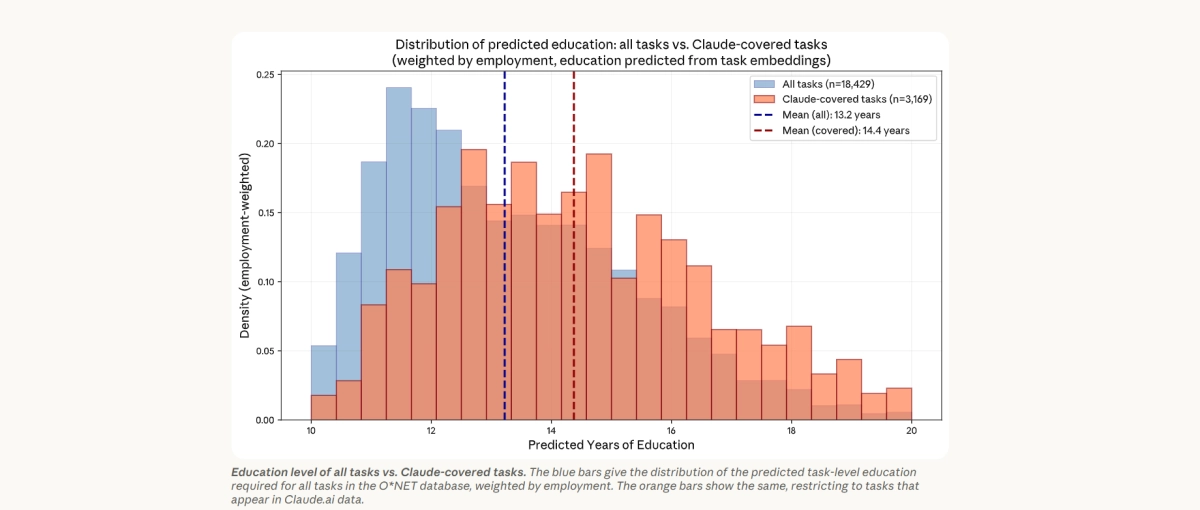
However, this efficiency comes with a structural warning. Anthropic analyzed the skill level of tasks that users bring to Claude, finding that the AI is disproportionately covering tasks that require higher education levels—specifically, those requiring an average of 14.4 years of education (roughly an associate’s degree). This is notably higher than the economy-wide average of 13.2 years.

If AI were to fully automate the tasks it currently supports, Anthropic estimates this would result in a net deskilling effect on average jobs. Professions like technical writers, travel agents, and teachers would see the higher-skilled components of their roles removed first, leaving behind a simpler, less complex task composition. While Anthropic cautions this isn't a direct prediction of job loss, it offers a crucial signal about the immediate structural shifts AI is imposing on occupations.
The report also provided a necessary reality check on the massive productivity forecasts that have dominated the AI conversation. In earlier research, Anthropic estimated that widespread AI adoption could boost US labor productivity growth by 1.8 percentage points annually.
When the new economic primitive of *task success* is factored in, that estimate drops significantly. Accounting for the probability that Claude successfully completes a task (which ranges from 66% to 70% depending on complexity), the estimated annual productivity boost falls to 1.2 percentage points for consumer use and 1.0 percentage points for the more challenging tasks handled via the API.
Even a 1 percentage point increase is substantial, returning US productivity growth to the rates seen in the late 1990s. But the adjustment highlights that reliability and failure rates are a major friction point preventing AI from delivering its maximum theoretical economic benefit.
The Anthropic Economic Index also tracked the continuing uneven distribution of AI adoption globally. In countries with higher GDP per capita, Claude is primarily used for work or personal tasks. Conversely, lower-income countries show a large share of AI use dedicated to educational coursework, fitting an "adoption curve" where AI literacy precedes broader professional integration.
On the platform level, the report noted a slight reversal in user behavior on Claude.ai: augmentation (52% of conversations) has temporarily overtaken automation (45%) as the most popular interaction pattern, though the long-term trend still points toward a slow rise in automation’s share.
Furthermore, the data shows a massive discrepancy in task time horizons between platforms. While the METR benchmark suggests Claude Sonnet 4.5 achieves a 50% success rate on tasks taking two hours, Anthropic’s own API data shows 50% success on tasks taking 3.5 hours. Crucially, the consumer-facing Claude.ai platform sees 50% success on tasks taking nearly 19 hours. Anthropic attributes this massive difference to user selection bias and the ability of consumers to break down complex problems into iterative steps, creating a real-time feedback loop that boosts effective performance far beyond controlled benchmarks.
As AI models continue to improve—the data was collected just before the release of Opus 4.5—Anthropic expects the task composition to shift further. The key takeaway from this latest Anthropic Economic Index is that AI is already deeply integrated into the most complex parts of white-collar work, but its true economic impact will be defined by how quickly it can overcome reliability issues and how the labor market responds to the removal of its most intellectually demanding tasks.


