

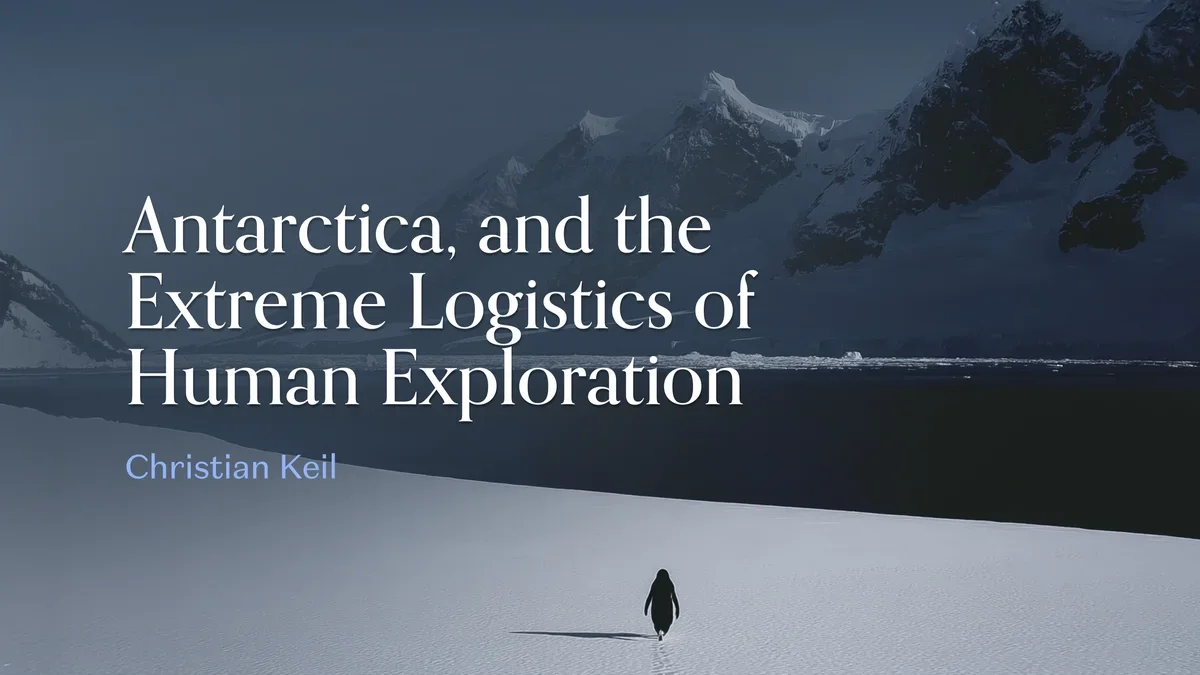
Antarctica, a continent defined by its harshness, presents humanity's most extreme test of logistics. The Amundsen-Scott South Pole Station, arguably more isolated than the International Space Station, demands an unprecedented supply chain to sustain its year-round scientific operations.
Unlike orbital missions, which benefit from a relatively lower cost of transport, sustaining life at the South Pole requires a terrestrial analogue to the complexities of space mission supply chain. The extreme isolation means no continuous access to the infrastructure the modern world takes for granted.
The Deep Freeze Operation
Each year, the entire US Antarctic Program relies on a single cargo ship and fuel tanker docking at McMurdo Research Station. These vessels carry hundreds of shipping containers and millions of gallons of fuel, a process known as the "Deep Freeze" mission.
The journey from Port Hueneme, California, through New Zealand, and into the Antarctic ice is a months-long endeavor. Once landed, all supplies must be processed and stored before the brief Antarctic summer window closes.
Air and Overland Transport
During the four-month summer, specialized LC-130 aircraft, equipped with skis and rocket boosters, shuttle supplies from McMurdo to the South Pole Station. These planes use a specially adapted fuel, AN-8, to withstand temperatures as low as -72°F.
For bulkier cargo and fuel, the South Pole Traverse (SPoT) utilizes a tractor-train over a compacted snow highway. This overland route, though slow, can carry the equivalent of 33 C-130 flights per trip, delivering hundreds of thousands of gallons of fuel annually.
Power and Heating Challenges
The Amundsen-Scott Station's power plant has multiple layers of redundancy, relying on diesel generators. Geothermal and solar power are impractical due to the continent's ice sheet and six months of darkness.
Nuclear power was attempted in the 1960s at McMurdo but proved unreliable and hazardous. While wind energy is used elsewhere, it demands extensive maintenance in Antarctic conditions.
Diesel, despite its cost, remains the most reliable option for expeditionary missions globally, from remote cell towers to military bases.
Sustaining Life: Water and Food
Freshwater is obtained by melting snow using a "Rodwell" system, a process that consumes significant energy. Each gallon of water requires about 620 watt-hours of electricity.
Food is preserved in the natural sub-zero environment, acting as a massive freezer. A small greenhouse supplements the stored food with fresh produce during the winter months.
Maintaining Sanity
A significant portion of the station is dedicated to recreation, including a gym, game rooms, and a basketball court. This is crucial for maintaining morale during the long, dark winters.
Internet access is limited, relying on intermittent satellite connections that can interfere with scientific equipment. This mirrors the isolation challenges faced in space mission supply chain operations.
The geopolitical landscape is also complex, governed by the Antarctic Treaty, which mandates peaceful scientific cooperation.
