

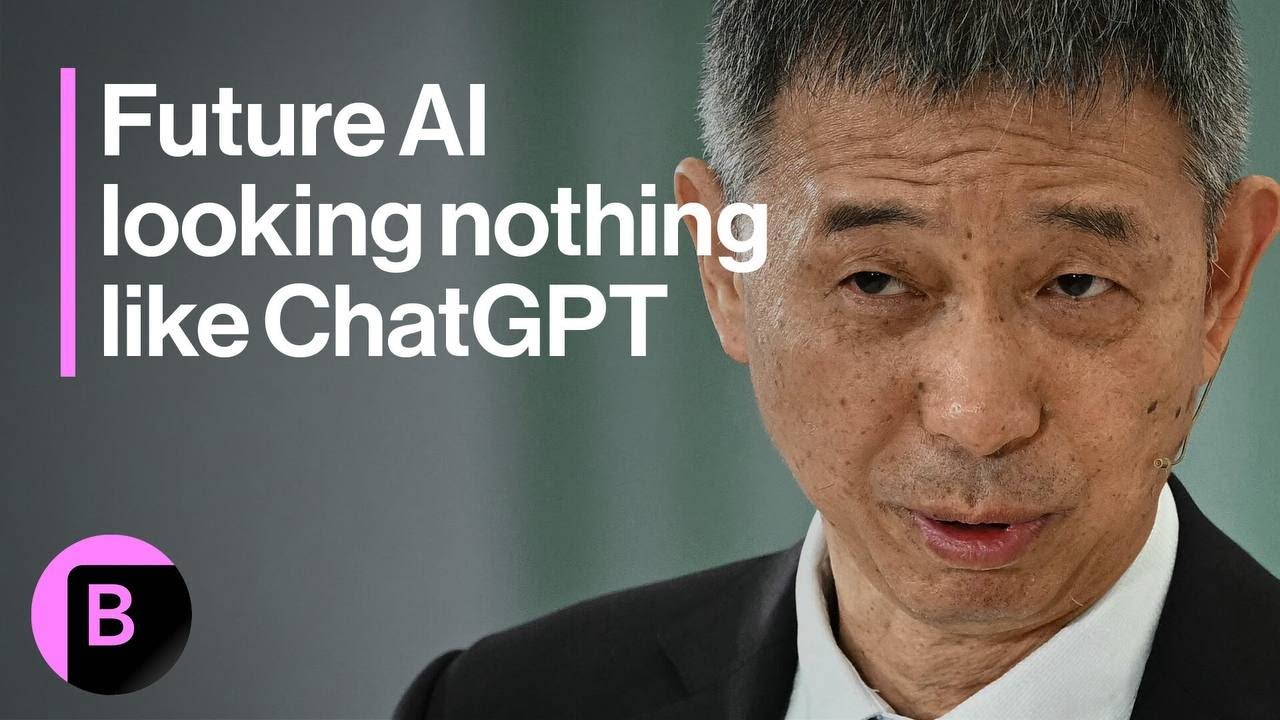
The era of artificial intelligence solving mere "toy problems" is over. As Dr. Wang, former head of Alibaba Cloud, articulated in a recent interview with Bloomberg, "The technology is getting real, and the problem we're trying to solve is really the hard, it's a real problem." This sentiment encapsulates a profound shift in AI's trajectory, moving beyond theoretical exercises to tackle complex, real-world challenges. Dr. Wang, a veteran in the AI field with a psychology background, spoke with Bloomberg’s interviewer, offering a candid assessment of AI's evolution and China's unique position within it.

Dr. Wang emphasized that AI's impact extends beyond mere computational power; it fundamentally alters our approach to problem-solving. He drew a compelling analogy: "If I give you a bike, you have your own way of thinking about how you get from Hong Kong to Shanghai... But if I give you an airplane, that's another story." This illustrates how a significant leap in capability, whether in transportation or AI computing power, compels a complete re-evaluation of strategies and possibilities. He dismissed the popular classifications of AI, AGI, and ASI, viewing them simply as a continuous evolution of capability rather than distinct, definable stages.
This evolution is profoundly shaping China's AI landscape, which Dr. Wang characterizes as a massive "testbed" for new technologies. "Today actually, China market has a very, very important function: is how to make a technology matured," he stated. This environment fosters rapid iteration, allowing technologies to be deployed, tested, and refined at an unprecedented pace.
The sheer scale of the Chinese market and its population create a unique feedback loop that accelerates development, pushing innovations to maturity faster than in more traditional markets. The focus on embodied AI and robotics, as evidenced by humanoid robots and automated systems, is a fascinating phenomenon. Dr. Wang views AI as the "engine" for robotics, enabling sophisticated behaviors, but maintains that robotics itself remains a distinct fundamental discipline. He cautioned against a narrow focus on applications that merely mimic existing successes, particularly lamenting the widespread perception that "Everybody saw the ChatGPT is the only application they can think about." This singular focus risks stifling the diverse and creative applications that AI could unlock.
The biggest challenge for building AI models in China, according to Dr. Wang, is not necessarily talent shortage in general, but rather finding the *right* talent with the creativity to envision novel applications. He noted that while there's a strong collective drive, a single organization or individual cannot sustain rapid progress indefinitely. The competitive environment, however, pushes teams to constantly innovate and iterate, fostering a dynamic and healthy ecosystem. Dr. Wang believes this collective, iterative approach allows China to maintain a rapid pace in AI development.