

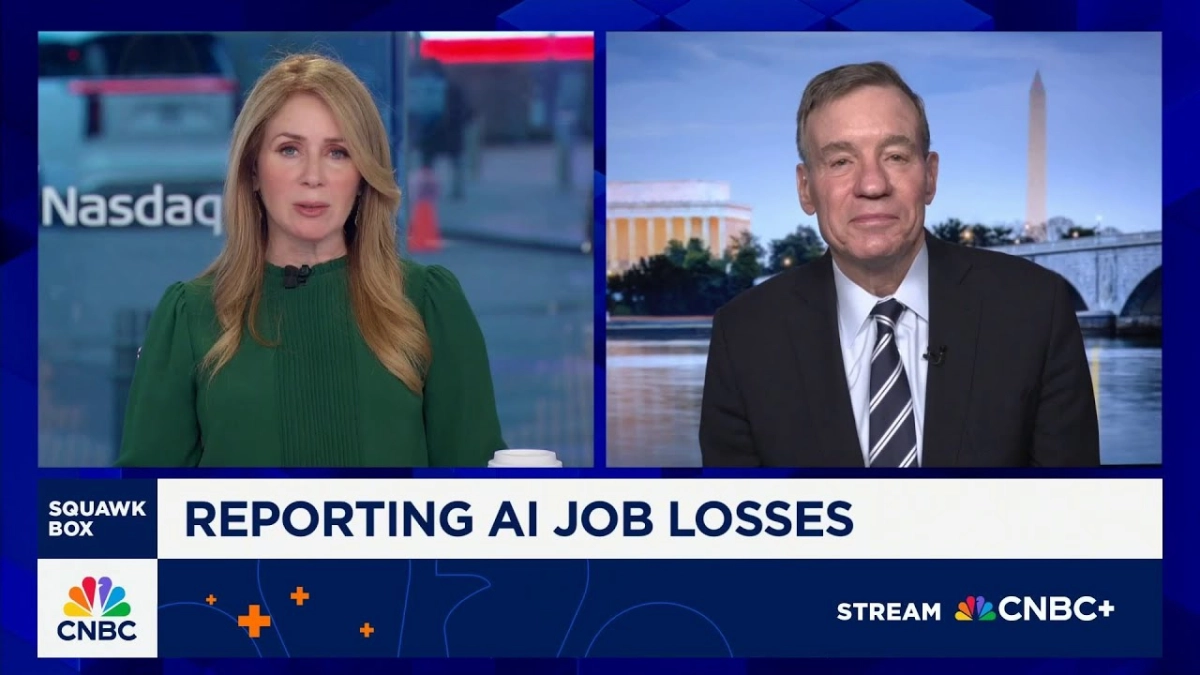
Senator Mark Warner (D-Va.) recently voiced a stark warning on CNBC's Squawk Box: if left unaddressed, the rapid proliferation of artificial intelligence could catapult recent college graduate unemployment rates to a staggering 25%. This alarming projection underscores a critical, often understated, facet of the AI revolution: its profound, disruptive impact on the labor market, particularly for those just entering the workforce. Warner’s interview with Becky Quick and Andrew Ross Sorkin illuminated his legislative efforts to confront this challenge head-on, pushing for greater transparency and shared responsibility from the very industry driving this transformation.
The Virginia senator engaged in a candid discussion about a bipartisan bill he introduced with Senator Josh Hawley (R-Mo.), which aims to mandate that major companies and federal agencies report AI-related job data, including losses, to the Department of Labor. Warner emphasized that while AI is undeniably a powerful engine for economic transformation, capable of both eliminating and creating jobs, the immediate concern lies in the "five-year gap" where job destruction outpaces creation. This interim period, he argued, poses a significant threat to economic stability and social mobility, especially for those at the beginning of their careers.
His concern is particularly acute for entry-level positions, which are often the first to be automated or augmented by AI. "We're already at 9% recent college graduate unemployment," Warner noted, adding, "I think that number will go to 25% very shortly" if proactive measures aren't taken. Such a scenario would not only devastate young graduates burdened with student debt but also ripple through the economy, impacting their families and the broader financial ecosystem. This impending crisis, he believes, necessitates immediate action and a collaborative approach.
A core tenet of Warner's proposed legislation is the insistence on robust data. "You gotta start with good data. We don't have any of that data right now," he asserted. Without clear metrics on how AI is affecting employment across various sectors and demographics, policymakers are effectively flying blind, unable to design effective interventions. The bill seeks to rectify this informational void, providing the foundational knowledge required to understand the scope and nature of AI-driven job displacement.
Beyond data collection, Warner also challenged the AI community directly, advocating for their active participation and financial contribution to solutions. He urged them to "help us figure out in the interim, and help pay by the way in the interim, for how we do this kind of training for jobs that are AI-centric." This sentiment sparked a brief but revealing exchange with Becky Quick, who pressed on whether "pay" implied a tax, suggesting it might disincentivize companies from being transparent. Warner clarified, emphasizing a collaborative "contribution" model, born from a shared understanding of the economic shifts.
