


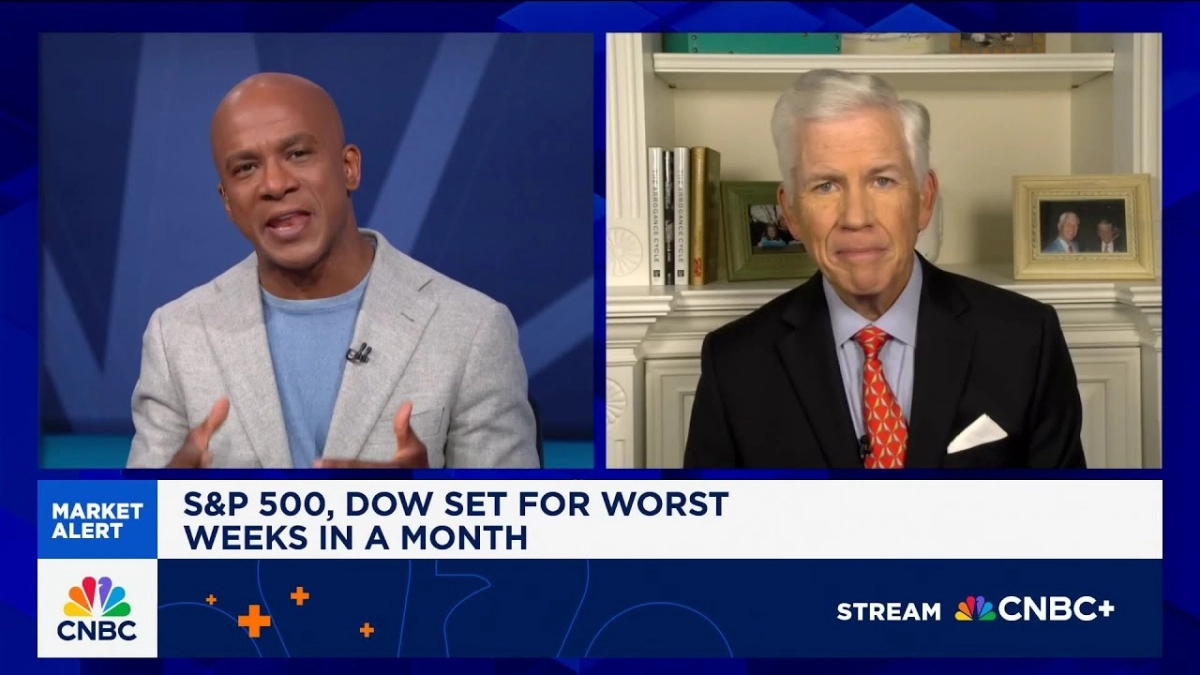
Michael Farr, President and CEO of Farr, Miller & Washington, offered a sobering perspective on the current state of artificial intelligence stocks, asserting that "the pricing of AI and the expectation for AI has gotten a little ahead of itself." This statement, delivered during his appearance on CNBC's 'Closing Bell Overtime', underscored a critical market dynamic that tech insiders and investors must heed. Farr spoke with hosts Jon Fortt and Sara Eisen, delving into the day's market action, the precarious valuations of high-flying tech stocks, and the Federal Reserve's unwavering monetary policy.
Farr highlighted the significant gains in certain tech companies, noting that "some of these companies that are up 100% in a year, they've got a lot of air underneath them." This observation suggests that while the long-term promise of AI remains undeniable, the short-term market enthusiasm has potentially inflated valuations beyond sustainable levels. The rapid ascent of these stocks has, in many cases, decoupled their prices from immediate fundamental realities, thereby setting the stage for a necessary market correction or a period of consolidation. This exuberance, while a testament to AI's perceived potential, introduces considerable risk as the market seeks a more rational equilibrium.
The discussion further illuminated the concentrated nature of the S&P 500, with a substantial portion of the index's performance currently tied to a handful of "Mag 7" tech stocks. Farr pointed out that "25-30% of the whole index is in these very few names," a statistic that reveals a distinct lack of broad market diversification. This concentration amplifies systemic risk, as any significant downturn or repricing in these key players could disproportionately impact the wider market, dragging down indices even if other sectors remain stable. Such narrow leadership, while contributing to overall index gains, creates a fragile foundation that is susceptible to shifts in sentiment or economic data.
This market narrowness, coupled with what Farr perceives as inflated AI expectations, necessitates a period of "settling, repricing, and probably testing of the right level, the right prices for those stocks." This isn't a dismissal of AI's transformative power or its eventual economic impact, but rather a pragmatic call for market rationality to catch up with speculative fervor. For founders and VCs evaluating new ventures or existing portfolios, this implies a renewed focus on fundamental value and sustainable growth metrics rather than purely speculative momentum. The current environment demands a clear-eyed assessment of where true value resides and where potential overextension has occurred.
The Federal Reserve's consistent messaging further complicates the investment landscape for high-growth tech. Farr emphasized that "the Fed is saying what the Fed said they were going to say," indicating a steadfast commitment to their current monetary policy. The central bank is actively "adjusting rates to find the right level," not seeking to ease conditions or stimulate the economy. This data-dependent, non-accommodative stance means that the market cannot rely on a swift pivot to lower interest rates to buoy valuations, particularly for companies whose future growth is heavily discounted into current prices. Higher interest rates inherently reduce the present value of future earnings, making richly valued growth stocks more vulnerable.
Crucial insights into the broader economic health and consumer resilience are being provided by earnings reports from diverse consumer-facing companies. Farr cited examples such as Affirm, Wynn, Block, Expedia, and Airbnb. These reports offer a granular view of consumer spending habits, differentiating between those "spending money they don't have" and those allocating discretionary dollars. The ongoing strength or weakness of the consumer, being the primary driver of economic activity, will be a significant factor in how the market, and particularly the Fed, navigates the coming months.
Related Reading
- Michael Burry’s AI Shorts Spark Debate Amidst Bullish Market
- AI upside remains missing in latest earnings spate
- AI Infrastructure and Connectivity Drive Shifting Investor Focus
Farr’s overarching advice was unequivocal: "I don't think this is a time for risk-taking, it's clearly a time for caution." This sentiment resonates strongly for startup ecosystem leaders and tech investors who have witnessed periods of aggressive growth fueled by readily available capital. The current juncture demands a prudent investment posture, prioritizing stability, robust business models, and reasonable multiples over speculative plays.
The confluence of elevated AI valuations, a concentrated market, and a steadfast Federal Reserve dictates a discerning and deliberate investment approach.

