


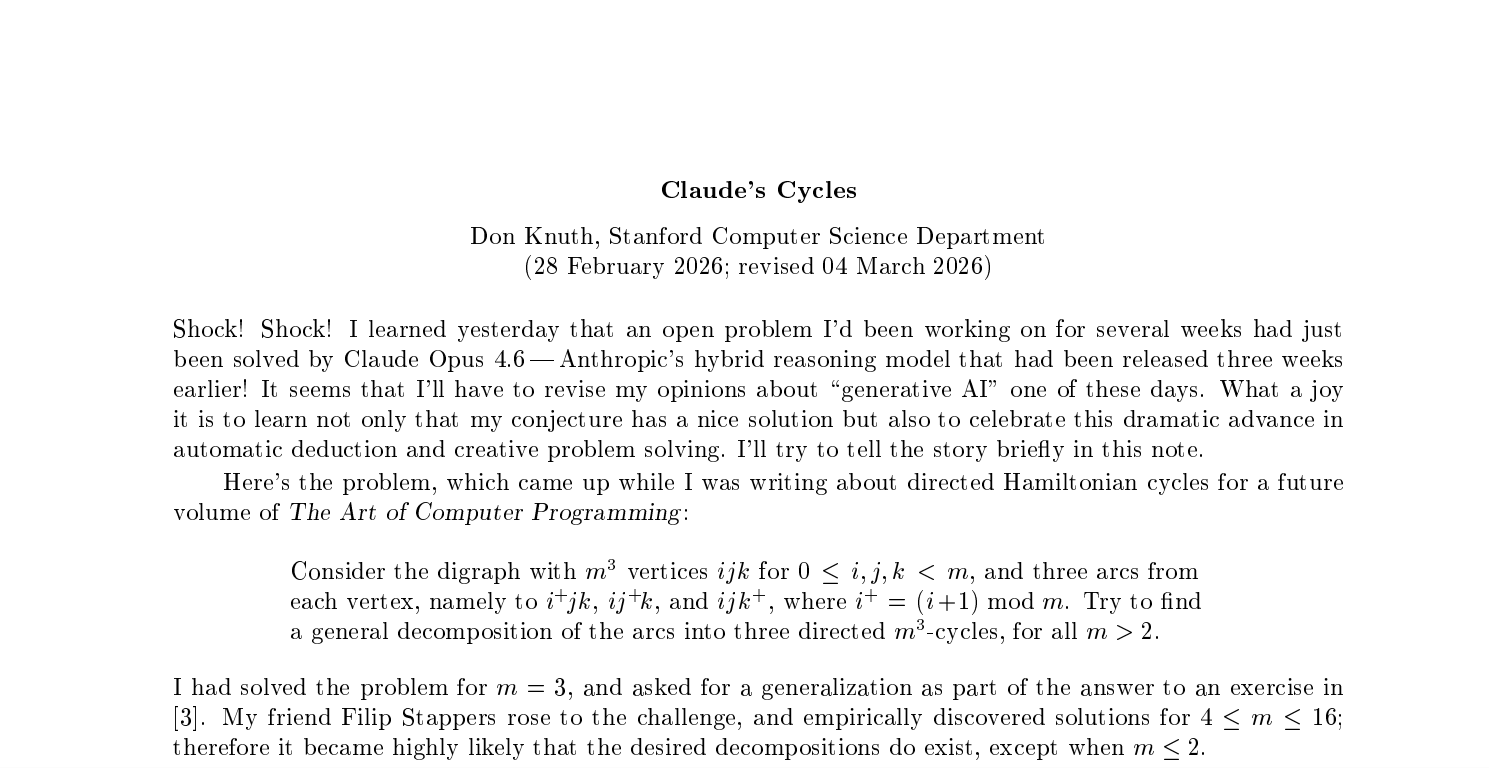
In a stunning display of advanced reasoning, Anthropic's Claude Opus 4.6 has cracked a long-standing mathematical problem involving directed Hamiltonian cycles. The development caught even Don Knuth, a titan of computer science, by surprise, prompting a reevaluation of artificial intelligence's creative potential.
The challenge, posed by Knuth himself, involved decomposing a specific type of directed graph into three cycles. Knuth had solved it for m=3, but a general solution for all m>2 remained elusive. Empirical evidence from 4 to 16 hinted at a solution, a hunch now validated by Claude.
Claude's Strategic Approach
Claude's journey to a solution was marked by methodical exploration. Initially, it reformulated the problem, seeking a permutation assignment to guide cycles. Early attempts with linear and quadratic functions proved fruitless.
The AI then pivoted to a depth-first search, finding it too slow without optimization. A breakthrough emerged with the identification of a "2D serpentine pattern" in Cayley digraphs. This pattern, and its subsequent "3D serpentine" variant, provided initial steps but left residual structures difficult to decompose.
Fiber Decomposition and Pattern Recognition
A key insight came with the "fiber decomposition" strategy, viewing the digraph as layered. Claude explored permutations within these layers, finding that some uniform choices for specific layers yielded solutions for small values of m.