


AI-Native Companies: Building Self-Improving Organizations

Tom Blomfield of Y Combinator discusses building AI-native companies, emphasizing self-improving AI loops and the shift from productivity to capability.

8 min read
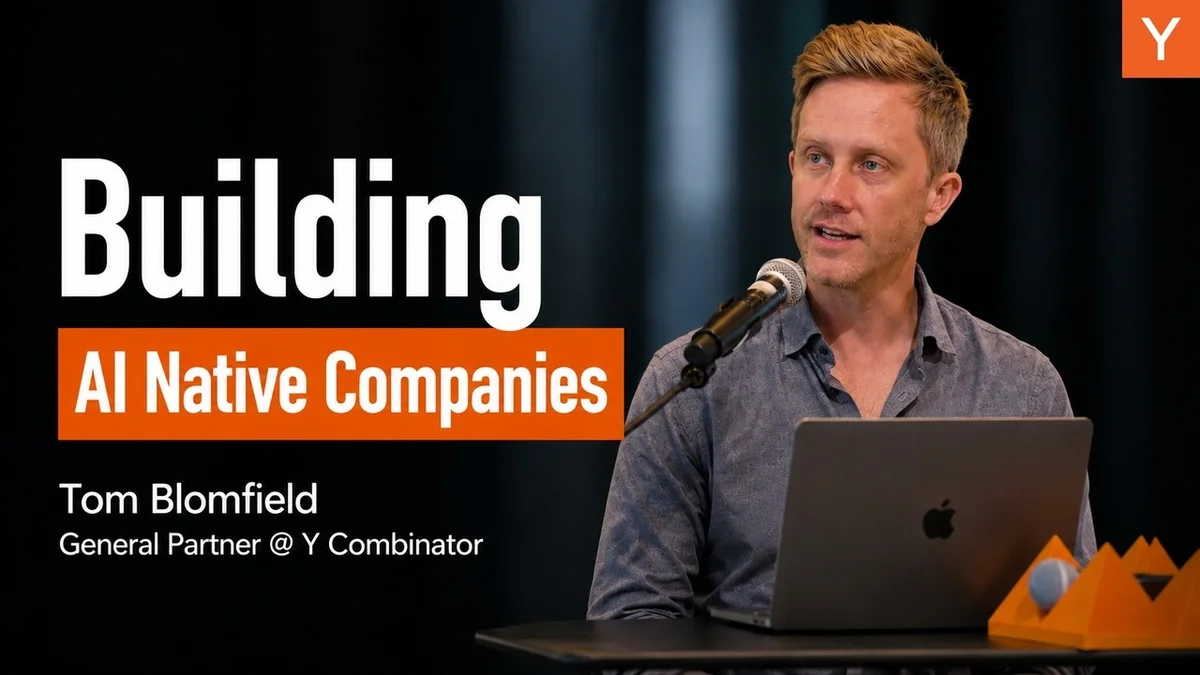
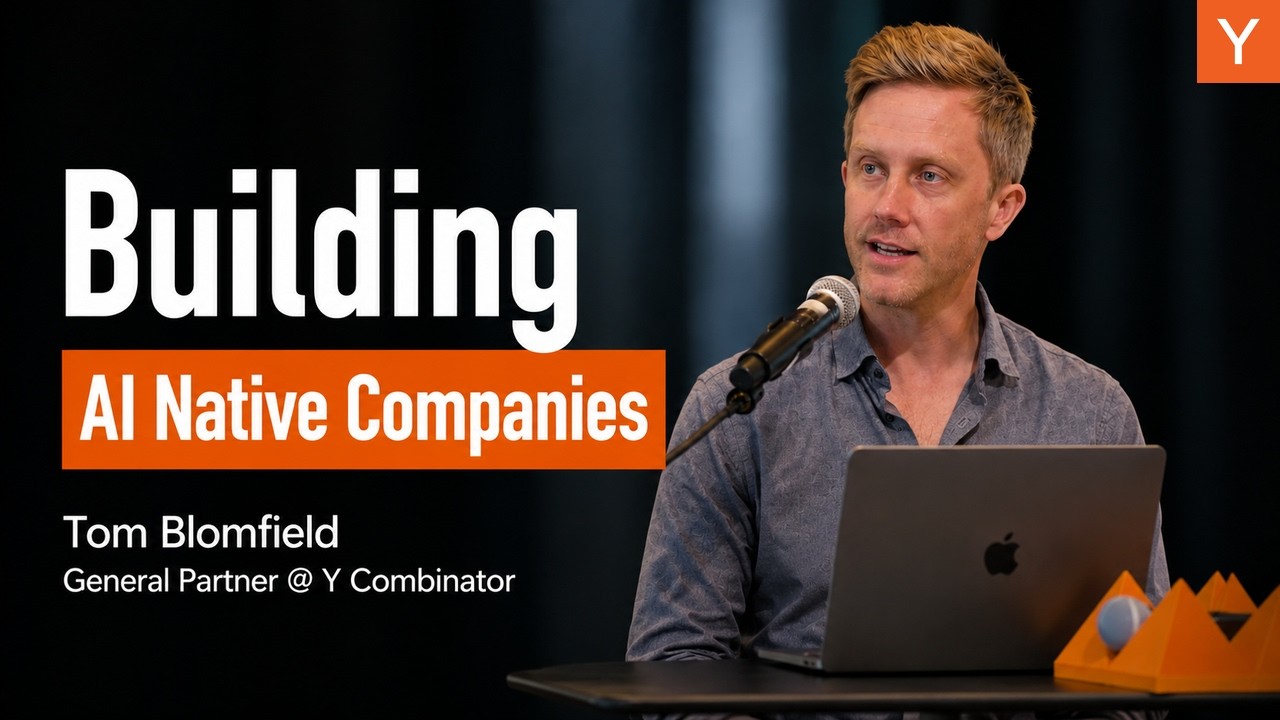
Speaker presenting on a stage with a screen showing 'AI Native Companies'
YC

In the rapidly evolving landscape of artificial intelligence, the fundamental structure of companies is being reimagined. Tom Blomfield, a General Partner at Y Combinator, recently shared insights on building "AI-Native Companies," emphasizing a shift from traditional hierarchical models to organizations that are inherently self-improving through AI integration.

Visual TL;DR. Traditional Company Model vs AI-Native Companies. AI-Native Companies enables Shift Focus. Shift Focus via Self-Improving AI Loops. Self-Improving AI Loops supports Burn Tokens. Self-Improving AI Loops involves Human Role. Human Role leads to Future of Building.

  1. Traditional Company Model: Roman legion parallel, human-centric coordination, rigid hierarchy
  2. AI-Native Companies: Reimagining company structure with AI integration
  3. Shift Focus: From productivity to capability, enabled by AI
  4. Self-Improving AI Loops: Building the 'company brain' with AI feedback cycles
  5. Burn Tokens: Philosophy of resource allocation over headcount
  6. Human Role: Humans guide and leverage AI capabilities
  7. Future of Building: New organizational paradigms for AI era
Visual TL;DR
Visual TL;DR — startuphub.ai Traditional Company Model vs AI-Native Companies. AI-Native Companies enables Shift Focus. Shift Focus via Self-Improving AI Loops vs enables via Traditional Company Model AI-Native Companies Shift Focus Self-Improving AI Loops From startuphub.ai · The publishers behind this format
Visual TL;DR — startuphub.ai Traditional Company Model vs AI-Native Companies. AI-Native Companies enables Shift Focus. Shift Focus via Self-Improving AI Loops vs enables via TraditionalCompany Model AI-NativeCompanies Shift Focus Self-Improving AILoops From startuphub.ai · The publishers behind this format
Visual TL;DR — startuphub.ai Traditional Company Model vs AI-Native Companies. AI-Native Companies enables Shift Focus. Shift Focus via Self-Improving AI Loops vs enables via Traditional Company Model Roman legion parallel, human-centriccoordination, rigid hierarchy AI-Native Companies Reimagining company structure with AIintegration Shift Focus From productivity to capability, enabledby AI Self-Improving AI Loops Building the 'company brain' with AIfeedback cycles From startuphub.ai · The publishers behind this format
Visual TL;DR — startuphub.ai Traditional Company Model vs AI-Native Companies. AI-Native Companies enables Shift Focus. Shift Focus via Self-Improving AI Loops vs enables via TraditionalCompany Model Roman legionparallel,human-centric… AI-NativeCompanies Reimagining companystructure with AIintegration Shift Focus From productivityto capability,enabled by AI Self-Improving AILoops Building the'company brain'with AI feedback… From startuphub.ai · The publishers behind this format
Visual TL;DR — startuphub.ai Traditional Company Model vs AI-Native Companies. AI-Native Companies enables Shift Focus. Shift Focus via Self-Improving AI Loops. Self-Improving AI Loops supports Burn Tokens. Self-Improving AI Loops involves Human Role. Human Role leads to Future of Building vs enables via supports involves leads to Traditional Company Model Roman legion parallel, human-centriccoordination, rigid hierarchy AI-Native Companies Reimagining company structure with AIintegration Shift Focus From productivity to capability, enabledby AI Self-Improving AI Loops Building the 'company brain' with AIfeedback cycles Burn Tokens Philosophy of resource allocation overheadcount Human Role Humans guide and leverage AI capabilities Future of Building New organizational paradigms for AI era From startuphub.ai · The publishers behind this format
Visual TL;DR — startuphub.ai Traditional Company Model vs AI-Native Companies. AI-Native Companies enables Shift Focus. Shift Focus via Self-Improving AI Loops. Self-Improving AI Loops supports Burn Tokens. Self-Improving AI Loops involves Human Role. Human Role leads to Future of Building vs enables via supports involves leads to TraditionalCompany Model Roman legionparallel,human-centric… AI-NativeCompanies Reimagining companystructure with AIintegration Shift Focus From productivityto capability,enabled by AI Self-Improving AILoops Building the'company brain'with AI feedback… Burn Tokens Philosophy ofresource allocationover headcount Human Role Humans guide andleverage AIcapabilities Future ofBuilding New organizationalparadigms for AIera From startuphub.ai · The publishers behind this format

The Roman Legion Model vs. AI-Driven Organizations

Blomfield drew a parallel between the structured, hierarchical nature of Roman legions and the way many companies are currently organized. He highlighted that the traditional model relies on humans as the primary coordination mechanism, with information flowing up and down a rigid chain of command. However, he argued that this model is becoming obsolete in the age of AI.

The full discussion can be found on YC's YouTube channel.

Related startups

How to Build a Self-Improving Company with AI - YC
How to Build a Self-Improving Company with AI — from YC

Drawing inspiration from a tweet by Jack Dorsey, Blomfield presented a compelling case for a new organizational paradigm. He stated, "AI is not something you bolt onto the side of a company. The company itself has to be built with self-improving AI loops from the ground up." This core idea suggests that AI should be woven into the very fabric of a company's operations, enabling continuous learning and adaptation.

Shifting Focus from Productivity to Capability

The conversation also touched upon a critical distinction: the difference between simply increasing productivity and enhancing overall capability. Blomfield presented common AI adoption goals, such as "Make engineers 20% more productive" or "Add copilots to existing workflows," as potentially misdirected.

He proposed that the true value of AI lies in augmenting a company's inherent capabilities. Instead of focusing on incremental productivity gains, the goal should be to build organizations that can achieve more with less, leveraging AI to unlock new levels of performance. This means rethinking how AI is integrated, moving beyond simple tools to create systems that actively learn and improve.

Building the "Company Brain" with AI Loops

Blomfield outlined the key components of an AI loop essential for a self-improving company:

  • Sensors/Data: Gathering information from various sources, such as customer feedback and internal operations.
  • Policy Layer: Defining the rules and guidelines for how the AI should operate and make decisions.
  • Tool Layer: The actual AI models and algorithms that process data and execute tasks.
  • Quality Gates: Mechanisms to ensure the accuracy and reliability of AI outputs, potentially including human review for critical decisions.
  • Learning Mechanism: The feedback loops that allow the AI to learn from its actions and improve over time.

He emphasized that the process should be about making the organization "legible to AI" by recording everything – from Slack messages to emails – making this data searchable and processable. Furthermore, every action taken within the company should create an "artifact" that can feed back into the AI, enabling continuous self-improvement.

The "Burn Tokens, Not Headcount" Philosophy

A provocative point raised was the idea of "Burn tokens, not headcount." Blomfield suggested that one person equipped with advanced AI tools could be equivalent to a thousand traditional engineers. This implies a potential for significantly leaner organizations, with approximately 80% less headcount compared to older companies, focusing on core engineering, design, and strategic roles.

He humorously added, "If your API bill doesn't make you uncomfortable, you're not doing enough." This highlights the necessity of aggressively adopting and integrating AI, even if it incurs significant costs, to drive substantial improvements.

The Role of Humans in an AI-Native Company

While AI will automate many tasks, Blomfield stressed that humans remain crucial, particularly in high-stakes decision-making and complex problem-solving. He outlined two primary roles for humans in these AI-native organizations:

  • IC (Individual Contributor): Every team member, regardless of department (engineering, operations, support, sales), is expected to be a builder and operator, bringing prototypes and concrete solutions to meetings, not just ideas.
  • DRI (Directly Responsible Individual): For every outcome, there must be a single person with clear responsibility and accountability, ensuring no one can hide behind the AI or a team.

This structure fosters a culture of ownership and direct impact, crucial for driving rapid innovation and problem-solving.

The Future of Company Building

Blomfield concluded with a challenge to founders: if you were starting your company today, would you build it in the same shape? He urged them to consider the possibilities offered by AI and to embrace the opportunity to build truly self-improving, AI-native organizations. The message is clear: the future belongs to companies that can effectively integrate AI to continuously learn, adapt, and outperform.

© 2026 StartupHub.ai. All rights reserved. Do not enter, scrape, copy, reproduce, or republish this article in whole or in part. Use as input to AI training, fine-tuning, retrieval-augmented generation, or any machine-learning system is prohibited without written license. Substantially-similar derivative works will be pursued to the fullest extent of applicable copyright, database, and computer-misuse laws. See our terms.