




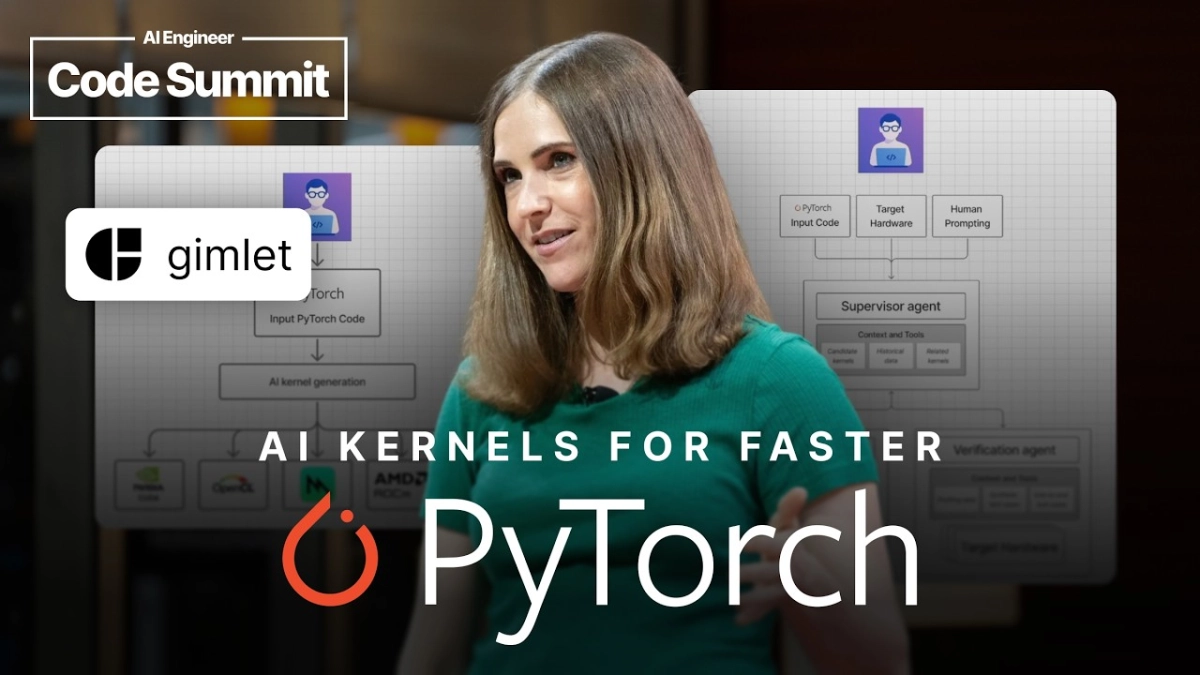
In the relentless pursuit of computational efficiency, the fine art of low-level kernel optimization has long remained the exclusive domain of a select few, a bottleneck in the age of rapidly evolving AI models. Natalie Serrino, Co-founder of Gimlet Labs, recently illuminated this critical challenge and her company's novel approach at the AIE Code Summit. Her presentation centered on how AI-generated kernels can dramatically accelerate custom PyTorch code, tackling the inherent complexities of hardware-specific optimizations without requiring extensive human intervention.
Gimlet Labs is at the forefront of building an agentic inference cloud, purpose-built for performance and efficiency. Serrino explained their core mission: to leverage AI to automatically synthesize kernels, bridging the gap between high-level PyTorch code and the nuanced demands of diverse hardware. This initiative is particularly pertinent given the explosion of AI models and the heterogeneous nature of modern computing environments, from NVIDIA GPUs to Apple Silicon and various other platforms.