

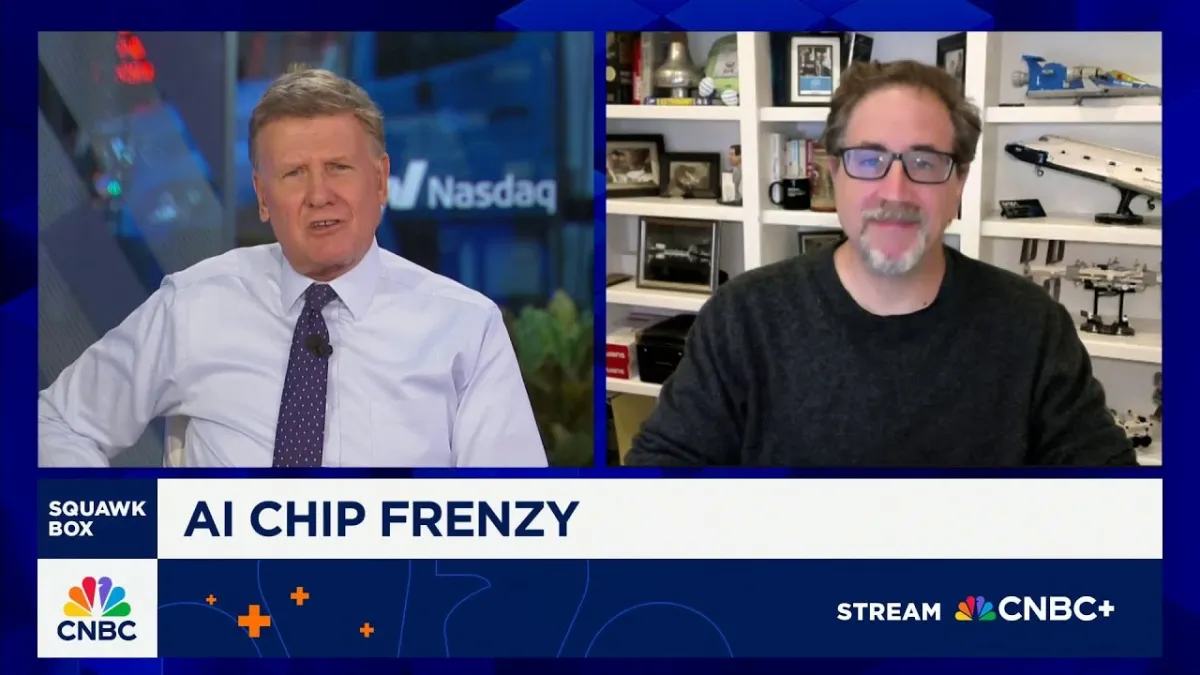
The current surge in artificial intelligence, far from being a speculative bubble, represents a foundational shift with a long growth trajectory, according to Stacy Rasgon, Bernstein's U.S. semiconductor managing director and senior analyst. Speaking with Joe Kernen and Sara Eisen on CNBC's *Squawk Box*, Rasgon offered a sharp analysis of the chips sector and the broader AI ecosystem, asserting that the market is still in its nascent stages, propelled by genuine demand and strategic, albeit sometimes unconventional, investments. His insights push back against growing concerns of an impending AI bust, drawing a clear distinction between today's landscape and the dot-com era.
Rasgon’s central thesis is that the AI cycle is "still early." This isn't merely optimistic forecasting but a reasoned argument grounded in the delayed gratification inherent in large-scale technological deployments. He pointed out that many of the significant deals being announced today, such as Oracle Cloud’s plan to deploy 50,000 AMD AI chips, are not slated to begin shipping until the end of next year, with full impact potentially extending into 2027. This extended timeline suggests a methodical build-out, rather than a frantic, over-leveraged rush. If one is concerned about "air pockets or digestion" in the market, Rasgon argued, it’s "clearly not this year, it doesn’t seem like it’s next year, and if these big projects don’t even start to ship until the end of next year, it’s probably not 2027 either." This extended horizon implies a sustained period of investment and deployment, providing a much longer runway than previous tech booms.
A critical differentiator from historical speculative bubbles, particularly the dot-com bust of the early 2000s, lies in the nature of demand and asset utilization. Rasgon emphatically stated, "There's no question on demand right now… nobody can get enough." He contrasted this with the "dark fiber sitting in the ground today" from the dot-com era, infrastructure that was built but never utilized. In the current AI wave, he observed, "Everything is getting used. Like, nobody's buying GPUs and sticking them on a shelf in a warehouse somewhere; they are all getting deployed and getting used, and they can't get enough." This direct correlation between investment and immediate, productive deployment underscores a fundamental health in the market that was absent in prior speculative frenzies.
The financial strength and strategic acumen of the primary investors further bolster Rasgon's bullish outlook. The companies driving the bulk of AI spending, he noted, "are some of the most well-funded and most profitable businesses that humanity has ever developed, and they're not idiots." These hyperscalers and tech giants are not making investments based on fleeting hype; they are deploying capital with a clear understanding of the long-term returns and competitive advantages AI offers. They possess the financial wherewithal to sustain massive capital expenditures and the operational expertise to integrate these advanced technologies into their existing, highly profitable business models, thereby generating tangible returns.
Related Reading
- OpenAI's Silicon Strategy: Building a Hyperscale Moat with Broadcom
- OpenAI's Infrastructure Gambit: Custom Chips and Strategic Moats
- OpenAI and Broadcom Forge Custom Chip Alliance Amidst AI's "Avalanche of Demand"
The ecosystem’s interconnectedness, while potentially appearing "incestuous" as one host suggested, is also a sign of strategic alignment rather than fragility. Companies like NVIDIA, generating "hundreds of billions of dollars of free cash flow," are actively investing in and supporting the broader AI ecosystem. This isn't merely a lack of alternative investment opportunities; it's a recognition that fostering the growth of the entire AI landscape ultimately benefits their core business. Similarly, AMD’s decision to accept equity in OpenAI in exchange for chip sales, a move that might raise eyebrows, is seen by Rasgon as a calculated strategy for "Lisa [Su, AMD CEO] to be on the OpenAI rocket ship." It’s a pragmatic approach to secure a position within a rapidly expanding, high-stakes market, illustrating the intense competition and strategic maneuvers defining this early stage.
Despite the dizzying valuations of some AI leaders like NVIDIA, Rasgon maintains that the underlying fundamentals are sound. The current phase, while characterized by significant investment, is still experimental in many enterprise applications. However, on the hyperscale side, returns are already evident. The sheer scale of demand for compute, coupled with the strategic, profitable nature of the major players, distinguishes this AI cycle from past bubbles. It suggests a more robust and enduring transformation, built on tangible utility and sustained innovation, rather than detached speculation.



