

Artificial Intelligence

AI Agents Demand New Security Rules

The rapid rise of AI agents in enterprises creates complex identity and access management challenges, demanding new security solutions for 2026.

Mar 7 at 3:28 PM3 min read
Abstract digital network illustrating AI agent connections and security protocols.

The enterprise adoption of AI agents is accelerating, moving beyond experimentation into core workflows. Companies like BNY are already deploying hundreds of 'digital workers,' with others seeing transformative success in development and customer support. This surge, however, amploys the risks associated with identity management.

Recent threat reports highlight that identity has become the primary attack surface, with intrusions often blending into normal activity. AI agents, essentially non-human identities, introduce complex challenges for existing security frameworks. Poorly managed agent credentials and over-privileged identities present lucrative opportunities for threat actors. As Insight Partners notes, addressing AI agent identity and access management (Agent IAM) is the defining security topic for 2026.

Agents as Digital Employees: A Flawed Analogy

Many enterprises aim to treat AI agents like digital employees, assigning them unique identities and owners. While this addresses the 'identity' aspect, it falls short on 'access management.' The dynamic permissions required by agents, unlike predictable robotic process automation, pose a significant governance challenge.

Tracking delegated permissions and identifying the origination of actions through multi-hop delegation is complex. Current standards like OAuth are insufficient, pushing enterprises toward custom solutions or waiting for updated standards from bodies like the IETF. This problem is amplified by ephemeral agents that must inherit strict permissions from parent processes.

The Credential Conundrum and Beyond Access

AI agents necessitate a broad set of credentials, including the often-dreaded 'credential zero' problem. This scales up the challenge of managing non-human identities (NHIs). Solutions might involve deep authorization, zero standing privileges (ZSP), or just-in-time (JIT) access.

Without biometrics for agents, security reverts to scaled credential management. This presents an opportunity to embed best practices like the Secure Production Identity Framework for Everyone (SPIFFE/SPIRE). Beyond mere access, monitoring how agents *use* their granted access is crucial, extending the insider threat problem to AI.

The Future of Agent IAM: Innovation Required

While core identity challenges for agents might be addressed by existing vendors, access and action management, especially with multi-hop delegation, demand novel solutions. The complexity of Agent IAM could also spur innovation in more agile Identity Governance and Administration (IGA) tools.

Opportunities for innovation lie in solving identity origination and traceability, monitoring agent intent and actions (akin to UEBA for agents), and managing dynamic authorizations using ZSP and JIT models. New entrants in Agent IAM and AI Agent Security could disrupt incumbents.

The Evolving AI Security Landscape

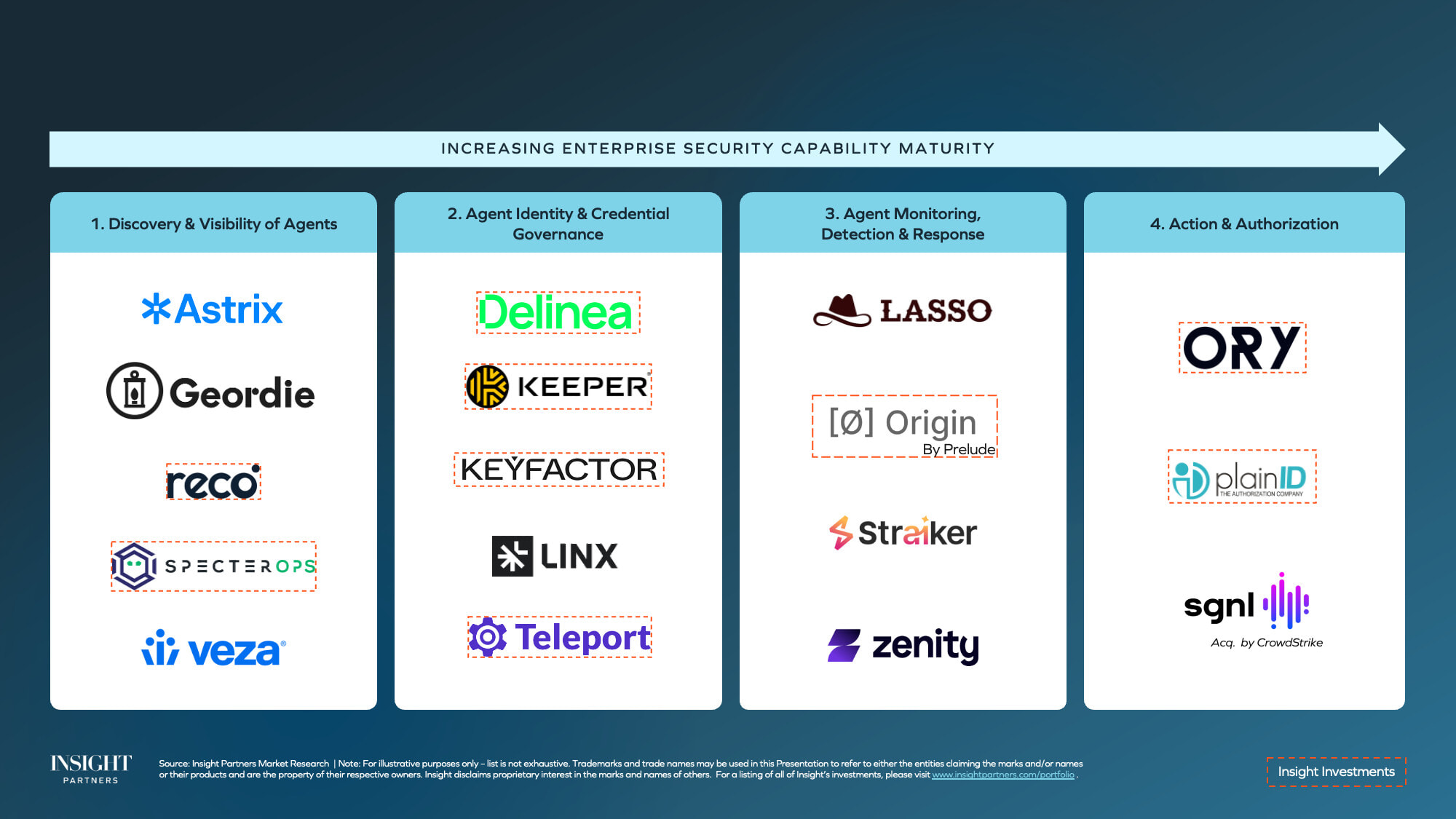
Securing AI agents requires re-evaluating existing security controls. Innovations are emerging across endpoints, SaaS, and cloud environments. Solutions like Prelude's Origin monitor agentic behavior on endpoints, while companies like Reco address 'AI sprawl' across SaaS applications.

Cloud-native platforms from Wiz, Aqua, and Sysdig, alongside established players, are tackling cloud risks. The NHI space is evolving, with solutions expanding to cover agent discovery and access control. Unified identity across humans, machines, and agents is becoming table stakes.

Agent Identity as the New Control Plane

The explosion of agent identities necessitates solutions for visibility, monitoring, and remediation. Companies like Veza (acquired by ServiceNow) and Linx are pioneering Identity Security Posture Management (ISPM) and modern IGA. Tools providing identity attack path management, like SpecterOps, are vital for controlling agent sprawl.

The need for ZSP, JIT access, and dynamic authorization is driving interest in solutions like Keto by Ory, which offers flexible, relationship-based access control (ReBAC). Advancements continue in securing model context protocols (MCP) and agent infrastructure access, with tools like Tailscale's MCP Gateway and Promptfoo offering native guardrails.

Platform Consolidation on the Horizon

The AI security market is seeing strategic acquisitions. The first wave focused on AI model security companies. The second wave, Agent Identity, is underway with acquisitions like CyberArk and SGNL. A third wave is expected to encompass monitoring, detection, and response capabilities for agent activity.