

Rust: The Ideal Language for Vibe-Coding?

Daniel Szoke from Sentry argues that Rust's strict constraints make it ideal for AI agentic coding, turning compile errors into valuable debugging feedback.

5 min read
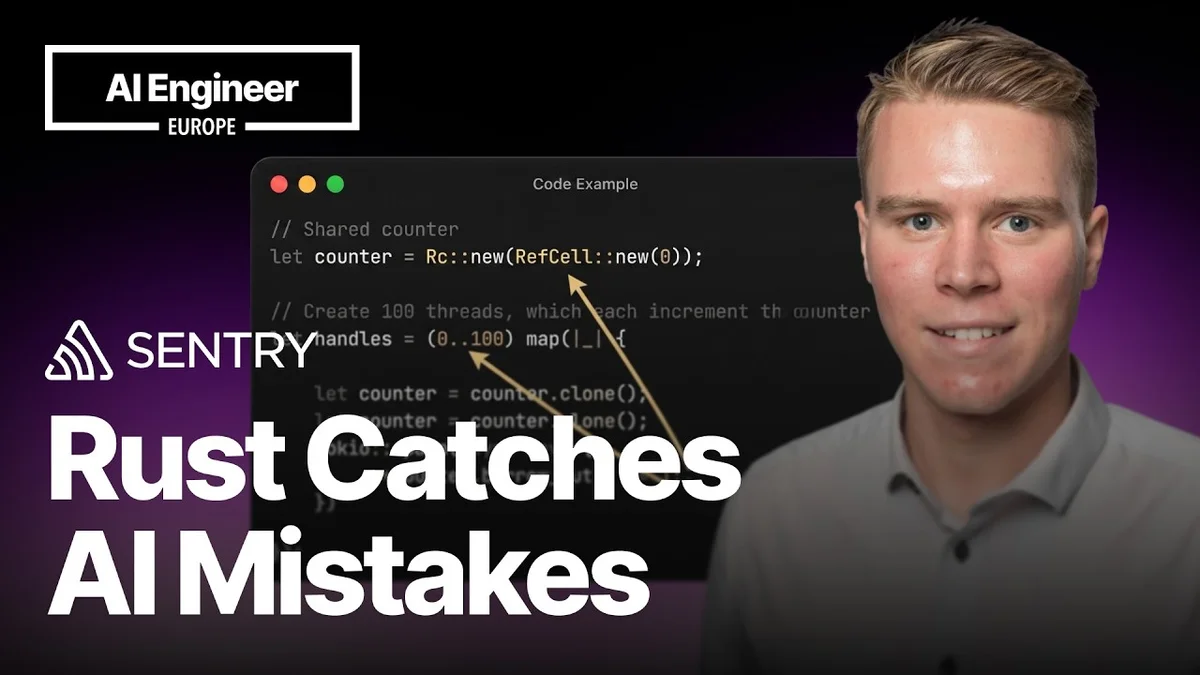
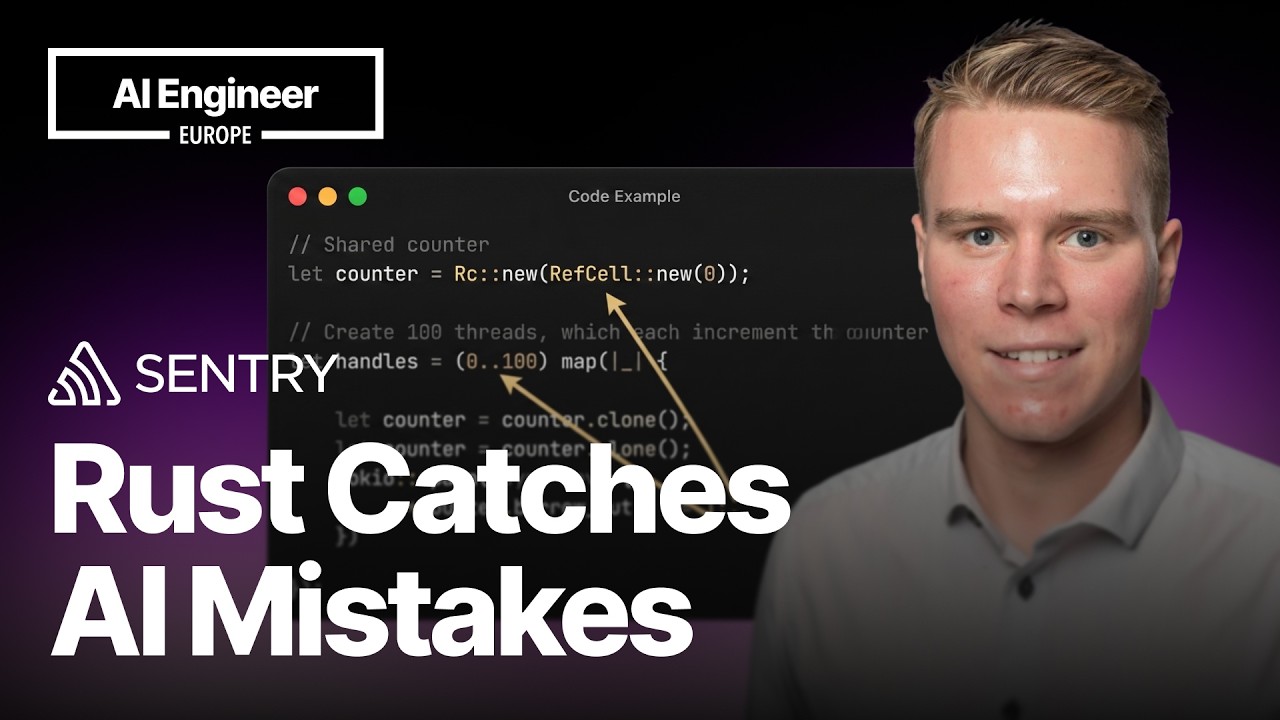
Slide titled 'Why Rust is the Ideal Language for Vibe-Coding' with speaker Daniel Szoke's name and Sentry logo.
AI Engineer
Visual TL;DR
Vibe-Coding with AIContext
generating code with AI agents, a new development paradigm
From the articleDaniel Szoke, a Rust SDK maintainer at Sentry, presented a compelling argument for Rust as the ideal language for "vibe-coding", a term he uses to describe the process of generating code with AI agents.
Conventional WisdomDriver
From the articleIn his talk, Szoke challenged the conventional wisdom that favors languages like Python and JavaScript for AI code generation, highlighting the often-overlooked benefits of Rust's inherent constraints.
Challenging Status QuoCore
Daniel Szoke from Sentry argues for Rust
Python/JS StrengthsContext
readable syntax, large AI ecosystem, beginner-friendly
From the article 4 mentionsSzoke began by acknowledging the common perception that Python and JavaScript are the go-to languages for AI-driven coding.
Rust's ConstraintsDriver
strict rules that turn errors into debugging feedback
From the article 9+ mentionsHe argued that while Rust's constraints might make it harder for LLMs to generate correct code on the first try, this difficulty is precisely what makes it a good thing.
Compiler as PartnerEffect
constraints become advantages in AI code generation
From the article 4 mentionsThe compiler, in this context, acts not as an impediment, but as an intelligent partner, guiding the AI towards correct and safe solutions.
Ideal for AgentsOutcome
Rust's structure enhances AI agentic coding reliability
From the article 2 mentionsDaniel Szoke, a Rust SDK maintainer at Sentry, presented a compelling argument for Rust as the ideal language for "vibe-coding", a term he uses to describe the process of generating code with AI agents.

Contents(3)

Daniel Szoke, a Rust SDK maintainer at Sentry, presented a compelling argument for Rust as the ideal language for "vibe-coding", a term he uses to describe the process of generating code with AI agents. In his talk, Szoke challenged the conventional wisdom that favors languages like Python and JavaScript for AI code generation, highlighting the often-overlooked benefits of Rust's inherent constraints.

Rust: The Ideal Language for Vibe-Coding? - AI Engineer
Rust: The Ideal Language for Vibe-Coding?, from AI Engineer

The Conventional Wisdom: Python and JavaScript Reign Supreme

Szoke began by acknowledging the common perception that Python and JavaScript are the go-to languages for AI-driven coding. He noted that when asking an AI like ChatGPT for the "number one best programming language for vibe coding," the answer is consistently Python. This is attributed to Python's:

  • Extremely readable and short syntax, making outputs easier to verify.
  • Massive ecosystem supporting AI, web, and automation development.
  • Beginner-friendliness, making it easier to iterate on AI outputs.
  • Its consistent ranking as #1 for AI coding tasks.

The same logic applies to JavaScript and TypeScript, which have seen a surge in popularity for AI-assisted development, as evidenced by GitHub's Octoverse report, which shows TypeScript emerging as the most used language on the platform.

Challenging the Status Quo: Why Rust Shines for Agentic Coding

Szoke then pivoted to his central thesis: that Rust, despite its reputation for being more complex, is actually a superior choice for AI agentic coding. He argued that while Rust's constraints might make it harder for LLMs to generate correct code on the first try, this difficulty is precisely what makes it a good thing.

Szoke elaborated on this by pointing out that LLMs are fallible and can make mistakes, just like humans. In dynamic languages like Python or JavaScript, these mistakes might not be caught until runtime, leading to difficult-to-debug issues. Rust, however, with its strict compiler that enforces numerous invariants, acts as a powerful guardrail.

He highlighted Rust's key safety guarantees:

  • Strict Type Safety: The compiler prevents type errors, ensuring that data is used in a consistent and predictable way.
  • Null Safety: Rust's design eliminates the concept of a universal "null" value, forcing developers to explicitly handle the absence of a value, thereby preventing null pointer exceptions.
  • "Fearless Concurrency": Rust's ownership and borrowing system ensures that concurrent operations are safe by default, preventing data races at compile time.

The Compiler as a Partner: Turning Constraints into Advantages

Szoke presented a code example demonstrating a common concurrency issue in Rust where an attempt to share mutable data across threads without proper synchronization leads to a compile-time error. The error message:

"error: future cannot be sent between threads safely"

and its subsequent explanation:

"note: captured value is not `Send`"

serves as a crucial debugging tool. This feedback loop, where the AI agent receives immediate, specific error messages from the Rust compiler, allows it to iteratively correct its mistakes. Szoke emphasized that this process is often faster and more reliable than trying to catch such errors at runtime in less strictly typed languages.

He concluded that while LLMs might be more immediately productive with languages that allow for more flexibility and less upfront rigidity, Rust's constraints ultimately lead to more robust and reliable code. The compiler, in this context, acts not as an impediment, but as an intelligent partner, guiding the AI towards correct and safe solutions.

© 2026 StartupHub.ai. All rights reserved. Do not enter, scrape, copy, reproduce, or republish this article in whole or in part. Use as input to AI training, fine-tuning, retrieval-augmented generation, or any machine-learning system is prohibited without written license. Substantially-similar derivative works will be pursued to the fullest extent of applicable copyright, database, and computer-misuse laws. See our terms.