
The public sector faces a critical inflection point in 2025. Despite AI's transformative potential, government agencies are lagging, with many initiatives stalled in 'pilot purgatory' and failing to deliver tangible benefits to residents or frontline workers. McKinsey research reveals the public sector's AI quotient score is a mere 26 out of 100, significantly below the global average of 35.
Achieving real impact demands more than isolated experiments. It requires a fundamental 'rewiring' of how public services are delivered, integrating AI into the core operating model rather than treating it as an add-on.
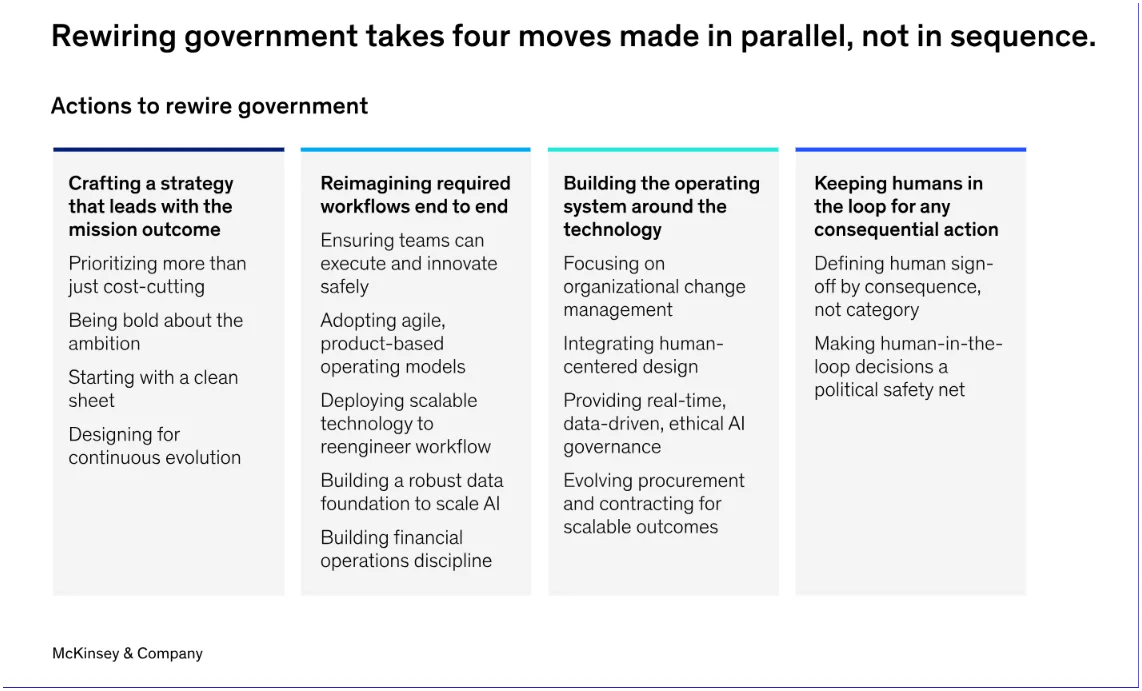
Beyond Pilots: A Four-Part Blueprint
Unlocking AI's full potential in government necessitates a simultaneous four-pronged approach, moving beyond piecemeal efforts:
- Crafting a mission-led strategy: Focus on meaningful outcomes for residents and appropriate costs, not just technology. Ambition is key; incremental changes yield minimal results.
- Reimagining end-to-end workflows: This is where 60% of AI value lies. Agencies must redesign processes from the ground up, adopting agile, product-based models and building robust data foundations concurrently with AI work.
- Building the operating system around the technology: This involves significant organizational change management. For every dollar spent on technology, five dollars must go towards capability building, adoption, and buy-in.
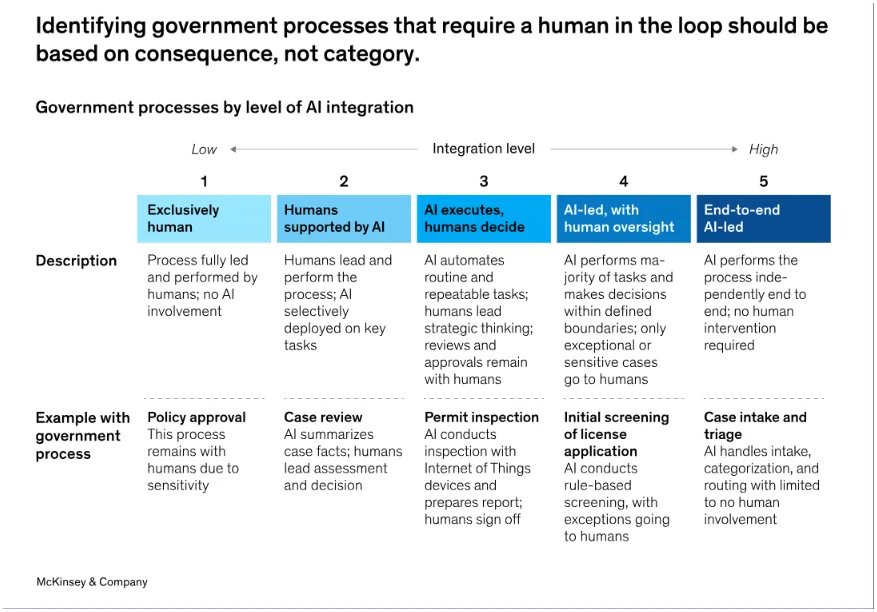
- Keeping humans in the loop for consequential actions: Define human sign-off by consequence, not category. Public trust hinges on the ability for human review, override, and explanation of AI-driven decisions.
Government agencies face unique structural challenges unlike the private sector. These include rigid procurement rules not designed for outcomes-based contracting, fragmented data across siloed agencies, and workforce inflexibility. Decisions affecting individuals also demand heightened explainability and auditability.
However, these constraints are surmountable. Successful public sector AI programs reimagine entire cross-functional processes from the resident's perspective, starting work without hesitation on available data, and explicitly framing AI as a tool to empower existing workforces, not reduce headcount. Measuring success by tangible resident outcomes, such as shorter wait times or faster emergency responses, is paramount.
The Path to an AI-Native Government
The frustrations of government bureaucracy are well-known. AI presents a rare opportunity to move beyond incremental improvements, fostering operational agility, unlocking innovation, and fundamentally transforming the resident experience. This will involve an evolving partnership between people, AI agents, and robots.
A truly AI-native government could redefine citizen interactions, from AI-led case intake and triage to AI-executed permit inspections with human approval, streamlining processes and enhancing responsiveness. This demands strong leadership, cross-sector collaboration, and a relentless focus on resident-centered outcomes.
The first step is often the hardest. Immediate actions for leaders include publishing measurable, resident-facing outcomes for AI by year-end, mapping existing workflows for legacy constraints, and standing up cross-functional pods with real decision rights. Evolving procurement to outcomes-based contracts and committing to significant change management investment ratios are also crucial for success in AI in public sector 2025 and beyond.



