


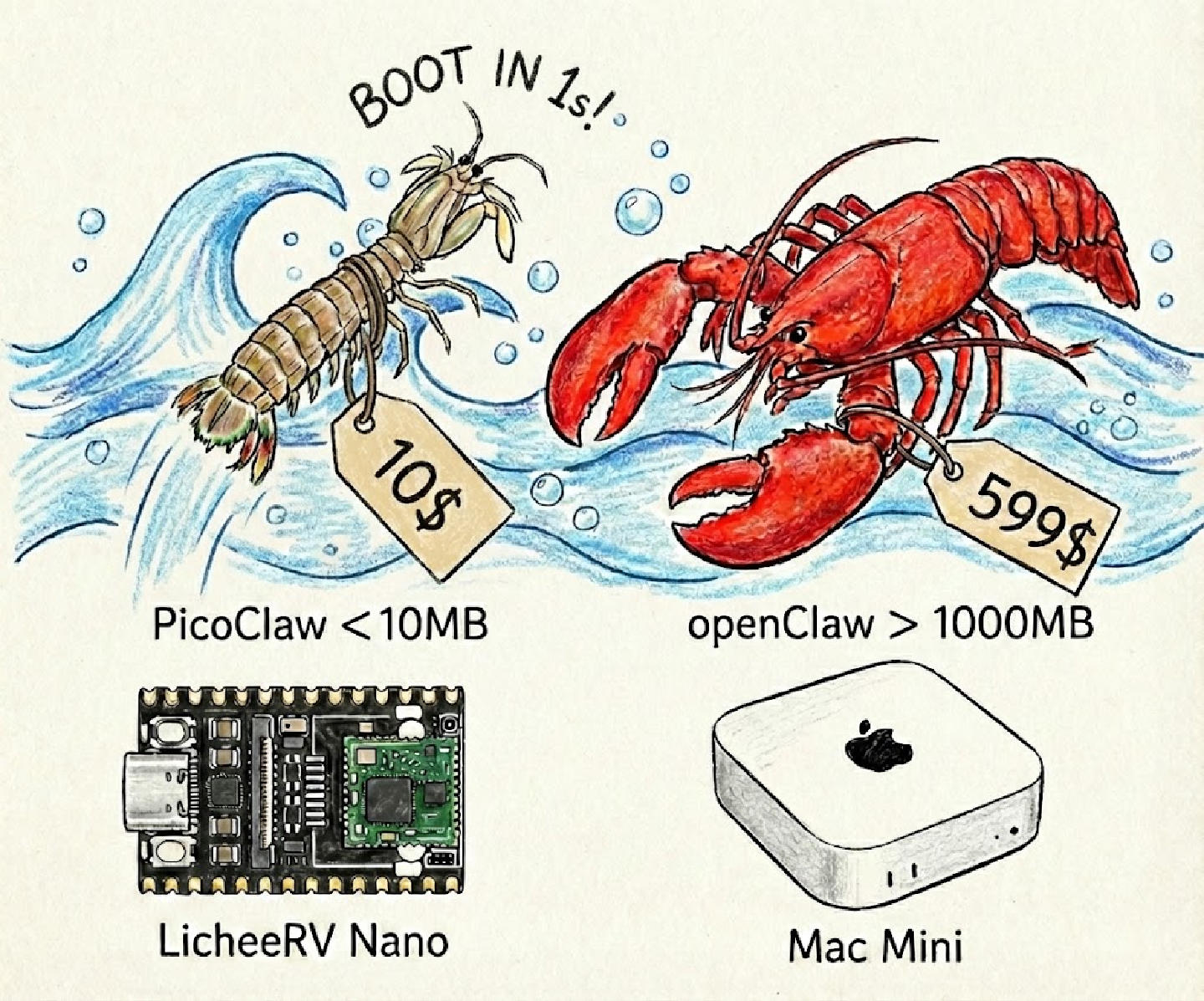
Sipeed's PicoClaw project is pushing the boundaries of accessible AI, offering a personal assistant that runs on surprisingly modest hardware. Developed in Go, this AI assistant is engineered for extreme efficiency, requiring less than 10MB of RAM and booting in a mere second, even on a 0.6GHz single-core processor.
This focus on minimal resource consumption makes PicoClaw significantly cheaper and more memory-efficient than comparable projects like OpenClaw, which demands over 1GB of RAM. The project highlights its ability to run on hardware costing as little as $10, positioning it as a contender in the burgeoning field of low-cost AI hardware, a market also eyed by giants in the low-cost AI hardware space.

AI-Bootstrapped Development
A key differentiator for PicoClaw is its development methodology. The project claims a significant portion of its core code, around 95%, was generated by an AI agent, with human developers providing refinement. This self-bootstrapping approach in Go aims for peak performance and efficiency.
The project's capabilities span standard AI assistant workflows, including acting as a full-stack engineer, managing logging and planning, and performing web searches for learning. Its portability is also a strong suit, with a single binary supporting RISC-V, ARM, and x86 architectures.
Ultra-Lightweight and Portable
PicoClaw's <10MB RAM footprint is a stark contrast to alternatives, making it suitable for a wide range of devices. Sipeed suggests deployments on low-cost boards like the LicheeRV-Nano for home assistance or more capable boards for automated server maintenance.