

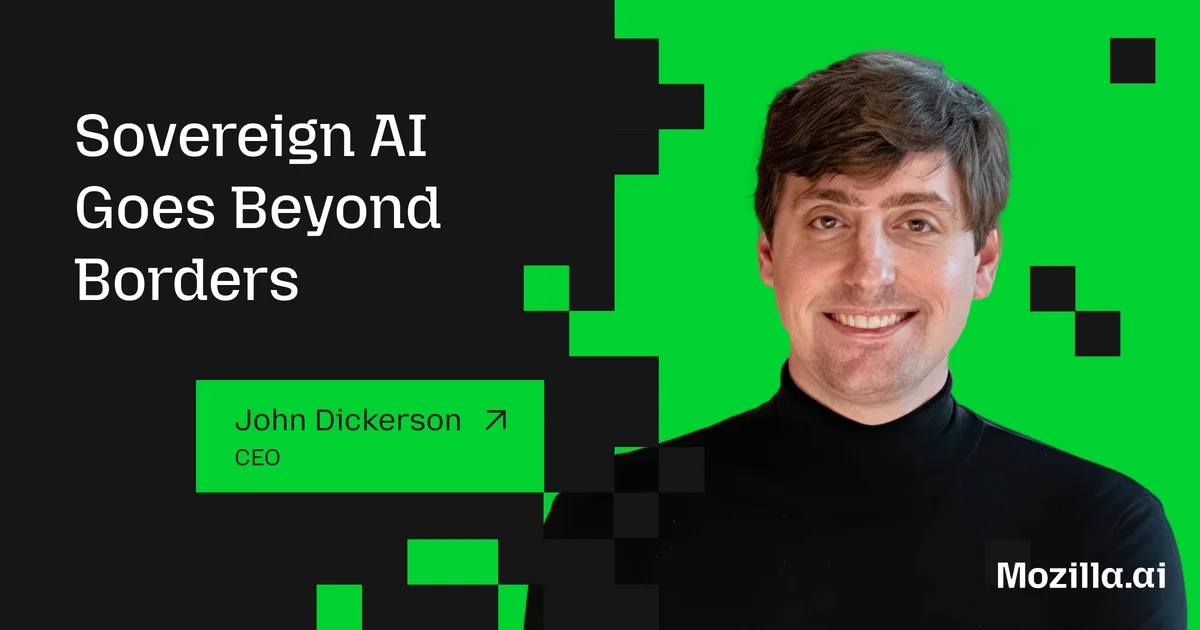
Mozilla.ai: AI Sovereignty Beyond Borders

Mozilla.ai's CEO John Dickerson redefines sovereign AI beyond geopolitics, emphasizing control, choice, and resilience at every level from nations to individuals.

John Dickerson, CEO of Mozilla.ai, speaking at a conference about AI.
John Dickerson, CEO of Mozilla.ai, discusses the broader implications of sovereign AI.· Mozilla Blog

The conversation around sovereign AI often centers on national independence, a geopolitical framing that Mozilla.ai CEO John Dickerson believes is too narrow. True AI sovereignty, he argues, must encompass control and agency across all levels, from nations down to individuals. This broader perspective is crucial as AI systems become more deeply integrated into global infrastructure. Mozilla.ai is championing this vision.

Beyond Geopolitics: A Four-Tiered Approach

While geopolitical tensions drive discussions about nations building their own AI capabilities to avoid reliance on tech superpowers like the US or China, Dickerson sees this as only one facet. He outlines four critical levels of sovereignty:

  • Nation-state: The geopolitical competition for AI independence.
  • Enterprise and corporate: Companies seeking to own their AI processes, audit models, and avoid vendor dependency.
  • Community: Local groups, cities, or organizations needing control over AI's impact and information flow.
  • Individuals: Personal agency over data, access to information, and digital interactions.

"It all comes down to control, agency, resilience," Dickerson states, emphasizing that these principles apply universally, not just at the highest geopolitical echelons.

Lessons from the Early Internet

The foundational design of the internet offers a cautionary tale and a roadmap. ARPANET's emphasis on decentralization and robustness, though initially driven by military needs, fostered an open ecosystem.

Over time, the internet centralized, with a few major players now controlling significant infrastructure. Dickerson sees a parallel with the current AI landscape, warning against repeating the same mistakes of creating single points of failure.

Building a Resilient AI Stack

Owning an AI stack extends beyond hardware. Dickerson draws a parallel to the open-source LAMP stack that powered the early web. The goal is to leverage modular, battle-tested components.

A modern AI stack requires layers for data collection, model training, inference, agentic interaction, and evaluation. Using open-source tools and building in fallbacks is paramount.

This means having the ability to switch between cloud providers or even fallback to on-premise or open-weight models. "They can turn off access to things. And they do," Dickerson warns.

The Choice-First Philosophy

Mozilla.ai's approach, termed the "Choice-first Stack," prioritizes flexibility. Tools like any-llm provide a unified interface, allowing users to swap underlying Large Language Models with a simple configuration change, preserving application code.

This philosophy extends to agent frameworks (any-agent) and safety guardrails (any-guardrail), enabling easy switching and benchmarking without extensive rewrites.

The practical benefits include rapid adaptation to performance changes and the ability to A/B test new models quickly.

Empowering Smaller Teams and Individuals

Decentralization and coalition building are key to making sovereign AI accessible beyond large corporations and wealthy nations. Concepts like distributed compute, proven by projects like SETI@home, are becoming reality.

Tools like llamafile and encoderfile enable running AI models locally with minimal setup, democratizing access to private AI capabilities.

Owning your AI stack should not require a dedicated infrastructure team.

Data Privacy and Individual Control

Users of popular AI tools often lack awareness of how their data is used. Dickerson urges users to inquire about what these systems learn, highlighting the potential for extensive profiling from casual use.

Options like trusted execution environments, private cloud compute, and on-premise models offer increasing levels of data privacy.

For truly sensitive information, keeping it within one's own environment is essential.

The Enduring Importance of Geography and Openness

While open source is a powerful equalizer, geographical barriers persist. Cloud provider accessibility and infrastructure limitations remain significant challenges for international operations.

Open protocols are vital for leveling the playing field, but access to underlying infrastructure ultimately determines who can participate.

Designing for a Sovereign AI Future

A healthy AI future mirrors the robustness of the open internet: built on heterogeneous hardware and software, with extensible open protocols. It prioritizes resilience and the ability to disconnect when necessary.

Sovereignty in AI is fundamentally a design principle, achievable through conscious choices at every layer—infrastructure, model, application, and individual habits.

Building in the ability to swap components from the outset is key. The internet's evolution shows that retrofitting security and decentralization is a long, arduous process.

"Choice goes a long way toward a healthy world," Dickerson concludes.

© 2026 StartupHub.ai. All rights reserved. Do not enter, scrape, copy, reproduce, or republish this article in whole or in part. Use as input to AI training, fine-tuning, retrieval-augmented generation, or any machine-learning system is prohibited without written license. Substantially-similar derivative works will be pursued to the fullest extent of applicable copyright, database, and computer-misuse laws. See our terms.