

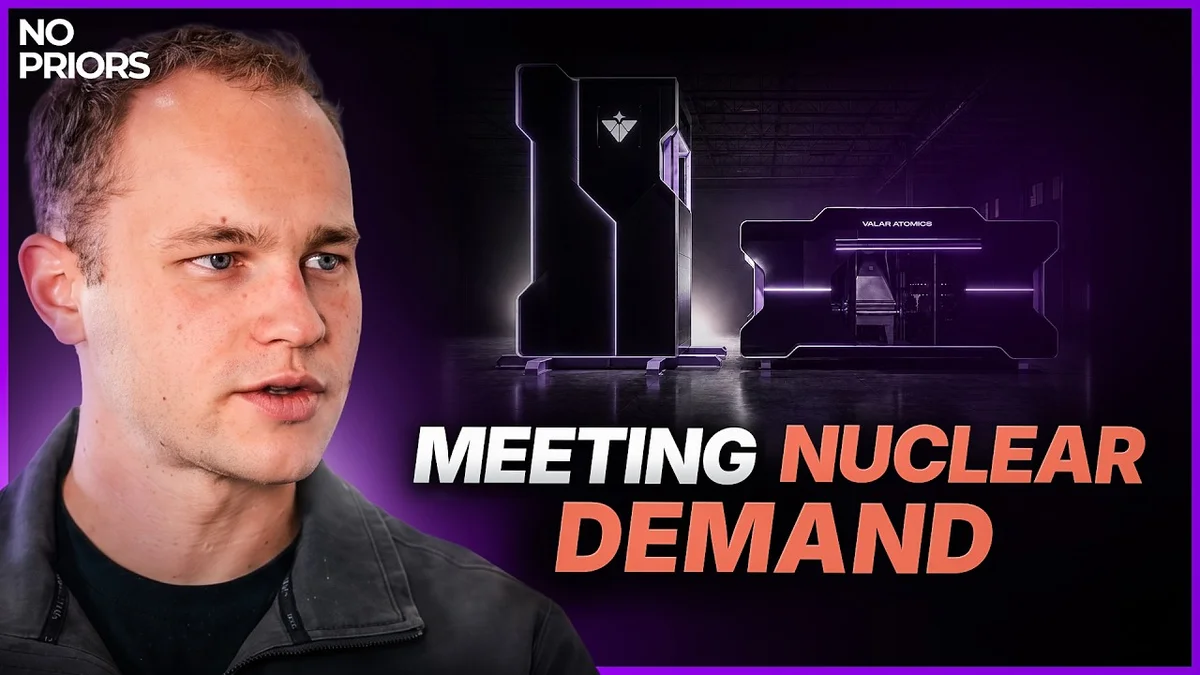
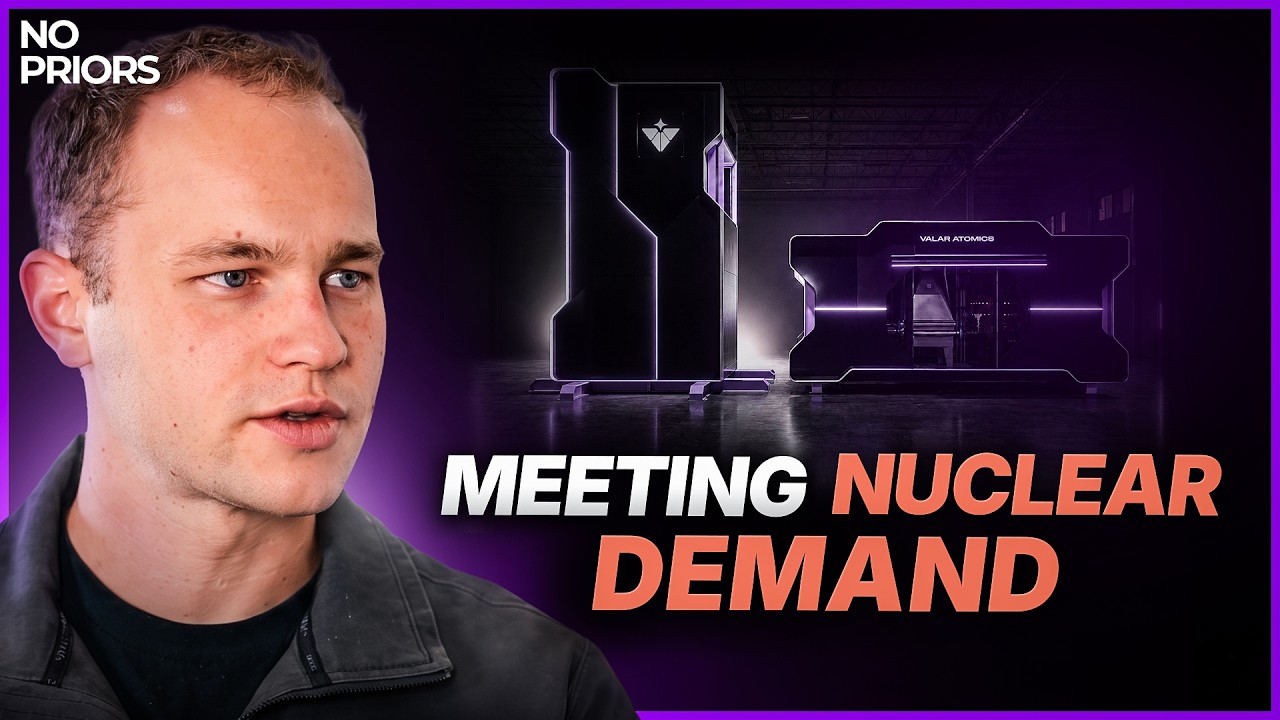
Valor Atomics Powers AI Chip with Nuclear Reactor

Valor Atomics CEO Isaiah Taylor discusses powering an AI chip with a nuclear reactor, the challenges of the nuclear industry, and the company's innovative approach to safety and scale.

Valor Atomics CEO Isaiah Taylor speaking in front of a large concrete structure at a nuclear facility.
Isaiah Taylor, Founder & CEO of Valor Atomics, discusses the company's vision for scaling nuclear energy.· NoPriors
Visual TL;DR
AI Compute DemandDriver
growing demand for power, particularly driving need for new energy solutions
From the article 4 mentionsTaylor highlighted the growing demand for power, particularly driven by AI compute, as a key premise for Valor's work.
Nuclear StagnationDriver
industry focused on modeling, not hardware iteration and execution
From the article 9 mentionsValor Atomics, a startup focused on revolutionizing nuclear energy, has achieved a significant milestone by powering an AI chip with its advanced nuclear reactor.
Valor AtomicsCore
startup challenging traditional nuclear, building reactors for planetary scale
From the article 9+ mentionsValor Atomics' commitment to making energy ten times cheaper is central to its mission.
Advanced Reactor DesignContext
innovative approach to safety and scale, more manufactured than constructed
From the article 3 mentionsThis groundbreaking feat, demonstrated at their Utah facility, marks the first time a startup has successfully generated power from an advanced reactor design and is the fifth new nuclear device to produce power in the United States since 2000.
New Regulatory PathwayContext
overcoming traditional hurdles with a streamlined, innovative approval process
From the article 4 mentionsBreaking the "chicken and egg" problem in nuclear regulation, where data is needed to gain regulatory approval but running a plant is required to generate that data, is crucial.
Power AI ChipOutcome
first time a startup successfully generated power from an advanced reactor
From the article 5 mentionsThe company has now successfully achieved criticality and generated power, providing empirical data that bypasses the traditional regulatory hurdles.
Cheaper EnergyEffect
goal to make energy ten times cheaper for humanity, increasing accessibility
From the article 7 mentionsBy focusing on making energy cheaper, Valor aims to unlock new applications and demand, creating a potentially infinite market for their technology.
Contents(6)

Valor Atomics, a startup focused on revolutionizing nuclear energy, has achieved a significant milestone by powering an AI chip with its advanced nuclear reactor. This groundbreaking feat, demonstrated at their Utah facility, marks the first time a startup has successfully generated power from an advanced reactor design and is the fifth new nuclear device to produce power in the United States since 2000.

Valor Atomics Powers AI Chip with Nuclear Reactor - NoPriors
Valor Atomics Powers AI Chip with Nuclear Reactor, NoPriors

The company, founded with a vision for "nuclear reactors built for planetary scale," is challenging the traditional nuclear industry's approach. According to Isaiah Taylor, founder and CEO of Valor Atomics, the industry has historically been more focused on "modeling and simulation" rather than "hardware iteration and execution." Valor aims to change this by building reactors that are "more manufactured than constructed," with a goal of making energy ten times cheaper for humanity.

The AI Compute Demand and Energy's Role

Taylor highlighted the growing demand for power, particularly driven by AI compute, as a key premise for Valor's work. He explained that energy, as a commodity, sees demand dictated by price. By focusing on making energy cheaper, Valor aims to unlock new applications and demand, creating a potentially infinite market for their technology. He drew a parallel to SpaceX's early trajectory, where initial skepticism about their ambitious numbers eventually gave way to reality.

Overcoming Nuclear's Stagnation

The conversation also delved into why the United States stopped building nuclear reactors for over 50 years. Taylor attributed this to the Three Mile Island incident, which, despite causing no fatalities or injuries, led to a significant public relations setback and fear. He also noted the atrophy of large-scale civil infrastructure skills in the U.S. during that period, shifting the focus towards advanced manufacturing.

Valor's approach addresses this by focusing on a manufacturing-centric model for reactors, similar to the automotive industry. Taylor emphasized that the key missing element in previous attempts, often referred to as Small Modular Reactors (SMRs), was the necessity of "hardware iteration." This involves actually turning plants on, achieving critical states, and learning from the physical process, rather than relying solely on modeling and simulation.

A New Regulatory Pathway

Breaking the "chicken and egg" problem in nuclear regulation, where data is needed to gain regulatory approval but running a plant is required to generate that data, is crucial. Valor is leveraging a less-known pathway through the Department of Energy (DOE), originally chartered for testing nuclear reactors. The Trump administration's Executive Order 14301, which called for three advanced reactors to go critical on American soil, provided the opportunity for Valor to activate this pathway. The company has now successfully achieved criticality and generated power, providing empirical data that bypasses the traditional regulatory hurdles.

The Valor Atomics Advantage: Speed, Scale, and Safety

Valor's pace of progress is attributed to a relentless focus on simplicity and a "super safe architecture." Taylor stated, "a trico reactor, graphite moderated, helium cooled reactor of the geometry that we've built it here is just about as safe as humanity knows how to build a nuclear reactor." This inherent safety allows for faster movement and scalability. The company also prioritizes hiring individuals with "extreme agency" and a "bias to action," often drawing talent from outside the nuclear industry who have experience building complex hardware.

Innovating with Concrete and Materials

A key innovation highlighted is Valor's proprietary "modular citadel" made of pre-cast concrete blocks. These blocks are designed with a tortuous path to block gamma rays and neutrons, ensuring safety. The manufacturing process, which takes only 42 hours for the entire citadel, contrasts sharply with traditional methods. Valor even invented its own grade of concrete, specifically engineered for density, strength, and the absence of rebar (to avoid neutron activation and waste), a feat accomplished by a team of two young engineers.

The Future of Energy

Valor Atomics' commitment to making energy ten times cheaper is central to its mission. By focusing on the fundamental economics of production and leveraging a startup mindset, the company believes it can overcome the historical inertia in the nuclear sector. Their success in achieving criticality and generating power positions them as a significant player in the future of clean energy, especially with the burgeoning demand from AI and other high-tech industries.

© 2026 StartupHub.ai. All rights reserved. You may not republish this article in full without a license. Search engines and AI research tools may crawl and summarize for reference. Bulk reproduction or model training requires a license. See our terms.
Daniel Singer

Written by

Daniel Singer

Editor, StartupHub.ai

Daniel Singer is the editor of StartupHub.ai, a technology expert and thought leader on AI and its applications across sectors, from fintech and healthcare to developer tooling and consumer software. He writes and tests the tools covered here thoroughly and regularly, and built StartupHub.ai to give founders, operators and buyers a clearer read on what they are actually being sold.