

Agentic AI has rapidly shifted from experimental tech to a core business asset in 2026, according to a new survey from CrewAI. The report, surveying 500 senior executives, reveals a landscape marked by high adoption claims yet moderate depth in actual workflow automation.
Adoption: High Hype, Moderate Depth
While 65% of organizations report using AI agents, this figure likely includes standard Generative AI tools, inflating the perception of autonomous agent deployment. True workflow automation stands at an average of 31%, with only 10% of companies automating over half their processes.
The majority of respondents believe they've moved beyond pilot phases. 37% claim full workflow adoption, and 44% are actively scaling across teams.
Strategic Priorities: Risk Over Returns
Enterprises are prioritizing foundational elements for AI agent implementation. Security and Governance (34%) and Ease of Integration (30%) top the list of evaluation criteria.
Counterintuitively, Time-to-Value or ROI ranked last, cited by only 2% of respondents. This suggests a focus on mitigating risks and ensuring operational compatibility before chasing immediate financial gains.
Workforce and Business Impact
Agentic AI is predominantly optimizing technical and operational backbones. Information Technology (52%) and Operations (44%) are the primary beneficiaries, followed by Customer Support and Sales (39% each).
The main perceived impacts are saving time (75%) and reducing costs (69%). Despite efficiency gains, 55% of respondents also reported a high impact on headcount reduction, indicating a dual approach to productivity and labor cost management.
Implementation: Build vs. Buy
Organizations show a strong preference for flexibility, with 57% opting to build agent solutions on top of existing tools, often open-source based, rather than starting from scratch.
This trend is particularly pronounced in industries like Construction (73%) and Financial Services (71%), suggesting a focus on integrating AI into established systems.
Future Outlook: Universal Expansion
The outlook for agentic AI in 2026 is one of aggressive scaling. 100% of respondents plan to expand their adoption, with 74% classifying production deployment as a critical strategic imperative.
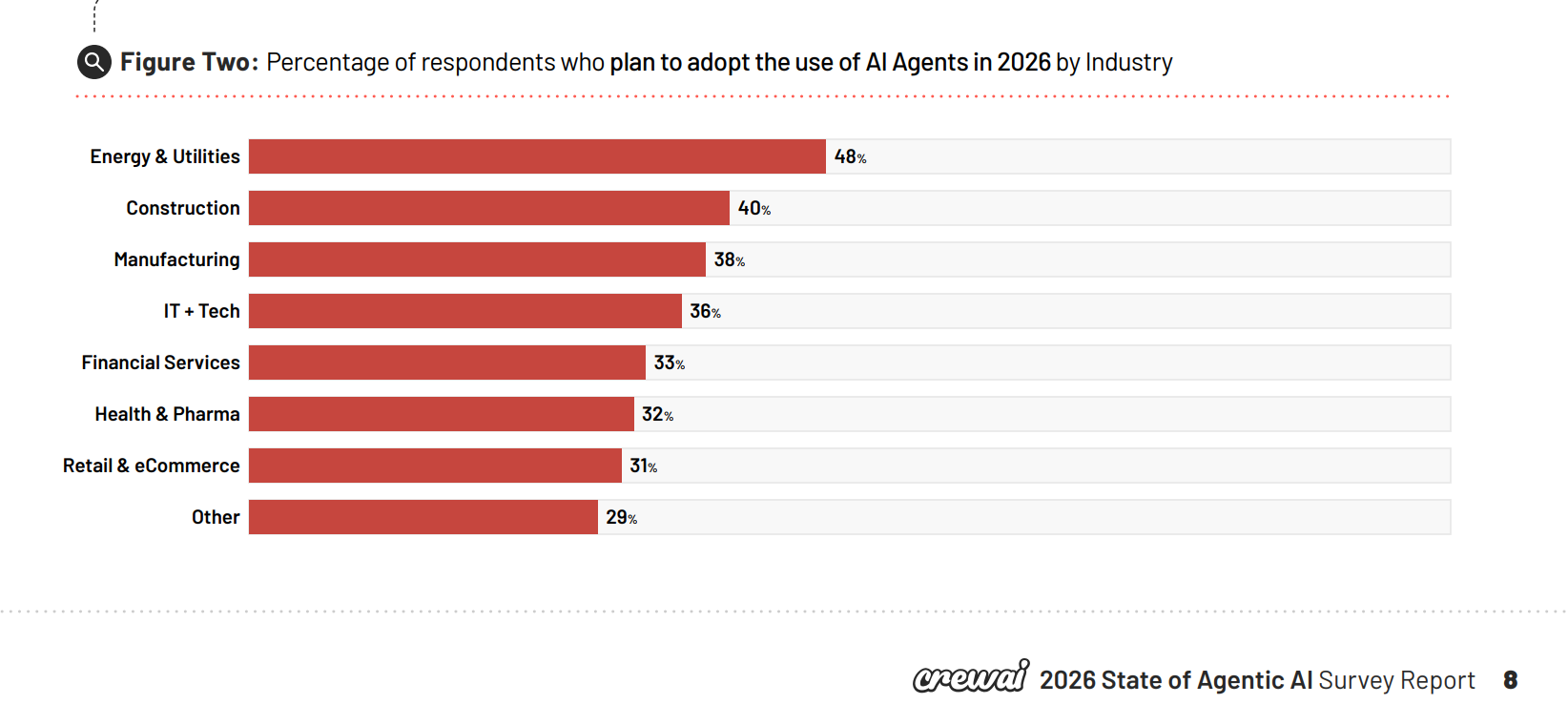
Companies anticipate an average expansion of 33% in their agentic AI usage throughout the year.
Barriers to Scale
The primary obstacles to realizing significant business impact are technical and structural, not conceptual. Data Readiness and Integration (35%) remains the top barrier, followed closely by the Skills Gap (33%).
Notably, only 23% cited a lack of clear business use cases, indicating that the challenge lies in execution – acquiring clean data and skilled talent – rather than identifying opportunities.


