AMD's Helios: A Make-or-Break AI System

AMD unveils its first rack-scale AI system, Helios, aiming to challenge Nvidia with a powerful, integrated solution backed by major tech clients like Microsoft and Meta.

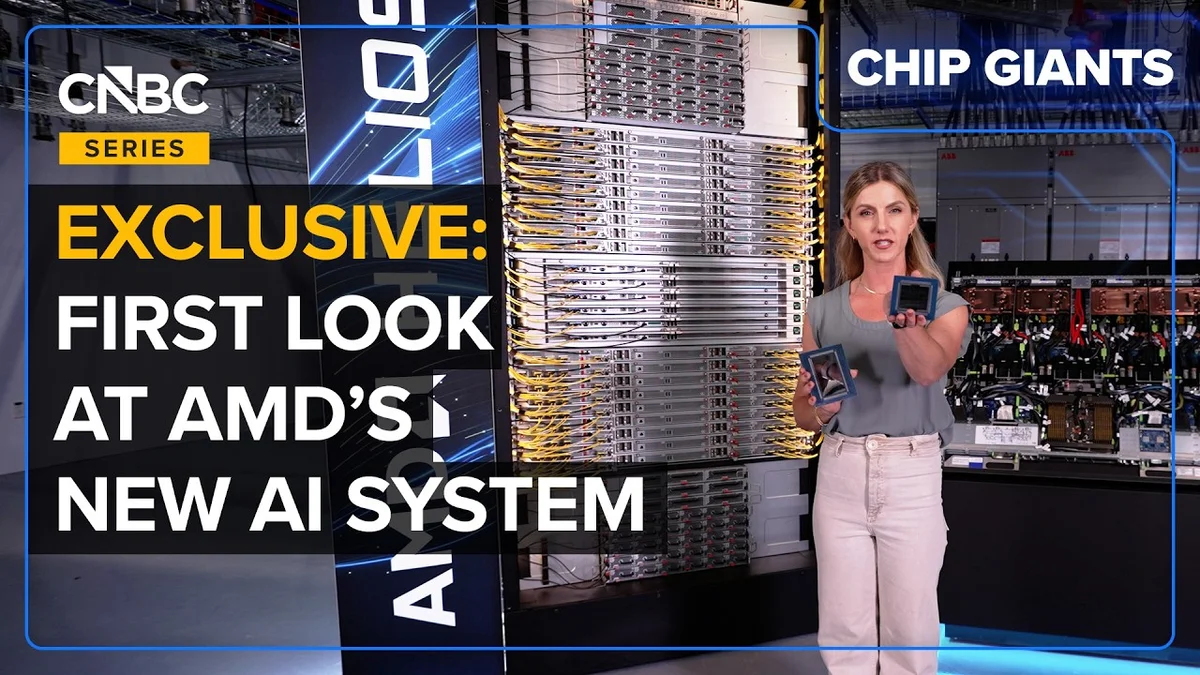
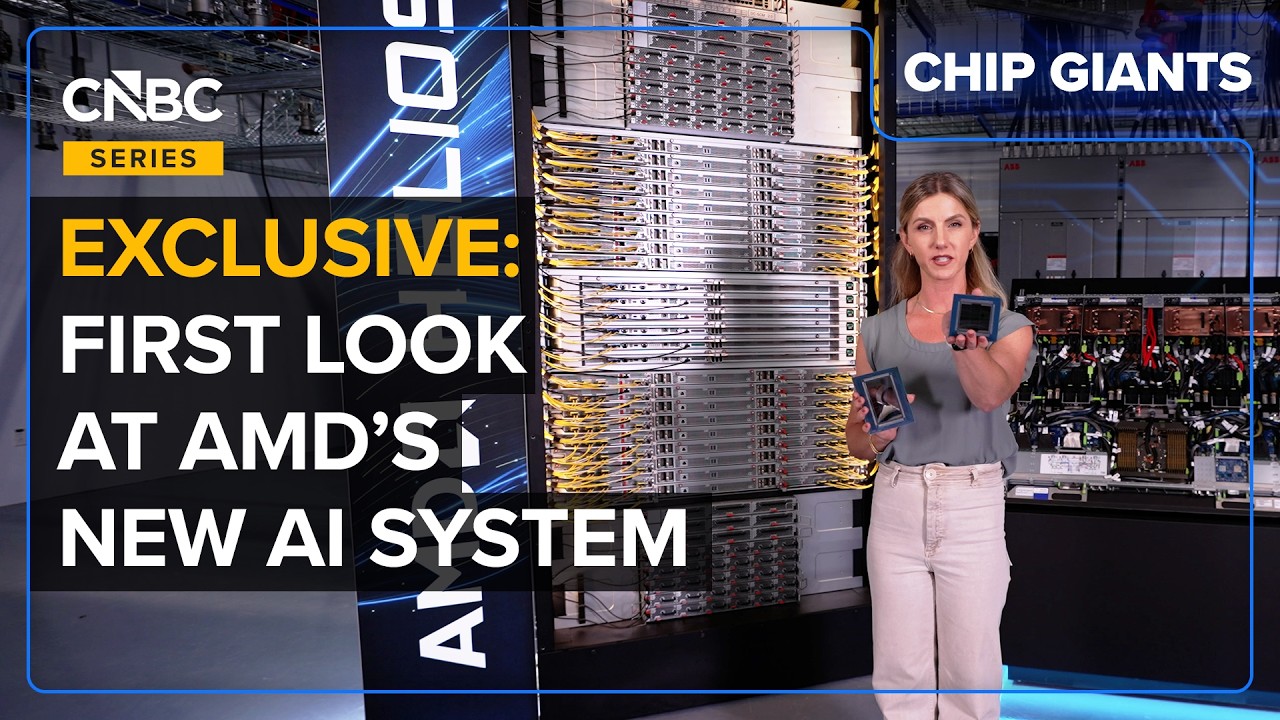
Katie Tarasov from CNBC stands in front of an AMD Helios AI system rack.
Katie Tarasov of CNBC inside AMD's megalab with the Helios AI system.· CNBC
Visual TL;DR
Nvidia's AI DominanceDriver
near-monopoly in data center GPUs due to mature CUDA software ecosystem
From the article 6 mentionsThe company's long-term vision for data center dominance is evident in its detailed roadmaps and consistent delivery on product promises, a strategy that has seen its data center CPU market share steadily increase.
AMD Unveils HeliosCore
first rack-scale AI system, weighing 7,000 pounds and valued at $5.5 million
From the article 8 mentionsChip giant Advanced Micro Devices (AMD) is making a significant play in the AI hardware race with the introduction of its first rack-scale system, Helios.
Integrated SolutionContext
each rack equipped with 72 GPUs and 18 CPUs for superior performance and efficiency
From the articleThis integrated approach, AMD argues, allows for a more cohesive and customizable AI factory solution.
Challenge NvidiaEffect
directly positioned to disrupt the status quo in the AI infrastructure market
From the article 7 mentionsWhile Helios presents a strong challenge to Nvidia, AMD faces its own set of constraints.
Major Client BackingCore
backed by tech giants like Microsoft, Meta, OpenAI, and Oracle for AI workloads
Market DisruptionOutcome
offers a powerful alternative for burgeoning AI workloads, potentially shifting market share
From the article 5 mentionsFor years, Nvidia has held a near-monopoly in the data center GPU market, largely due to its mature CUDA software ecosystem and high-performance AI chips.
Data Center AscendancyOutcome
aims to solidify AMD's position as a key player in the evolving data center landscape
From the article 6 mentionsAMD's data center lead, Forrest Norrod, highlighted the system's architecture, noting significant benefits in inference and memory bandwidth capabilities.
Contents(6)

Chip giant Advanced Micro Devices (AMD) is making a significant play in the AI hardware race with the introduction of its first rack-scale system, Helios. This new system, named after the Greek god who pulls the sun across the sky, is designed to offer a powerful alternative to Nvidia's dominant AI infrastructure, potentially disrupting the market and offering key players like Microsoft, Meta, OpenAI, and Oracle a new option for their burgeoning AI workloads.

StartupHub data

Companies working on this

Profiles of the companies named in this story, with funding and a one-liner from our database.

Meta
$40.1B
Leading social media and technology platform connecting billions of people globally.
OpenAI
Private / $100B+ est
OpenAI is an AI research and deployment company dedicated to ensuring that artificial general intelligence benefits all of humanity.
AMD
Designs and manufactures high-performance microprocessors and graphics processors for computing and data center markets.
AMD's Helios: A Make-or-Break AI System - CNBC
AMD's Helios: A Make-or-Break AI System, from CNBC

Challenging the AI Titan

For years, Nvidia has held a near-monopoly in the data center GPU market, largely due to its mature CUDA software ecosystem and high-performance AI chips. AMD's Helios system is positioned to directly challenge this status quo. The Helios system is a substantial piece of technology, weighing up to 7,000 pounds and valued at $5 million to $5.5 million, according to estimates. Each rack is equipped with 72 GPUs and 18 CPUs, a configuration AMD claims offers superior performance and efficiency compared to Nvidia's latest offerings, such as Grace Blackwell and Vera Rubin. AMD's data center lead, Forrest Norrod, highlighted the system's architecture, noting significant benefits in inference and memory bandwidth capabilities.

A Comprehensive In-House Solution

Helios represents a significant integration of AMD's core competencies. The system brings together four key areas where AMD has in-house expertise: its GPUs, CPUs, networking technology (bolstered by its acquisition of Pensando), and software, including its ROCm platform. This integrated approach, AMD argues, allows for a more cohesive and customizable AI factory solution. The system is designed with liquid cooling, utilizing copper cold plates to manage the heat generated by the numerous GPUs and CPUs within each compute tray.

Key Customers and Early Commitments

The launch of Helios is backed by significant early commitments from major technology players. Microsoft has already signed deals to deploy Helios in its data centers, building on its existing relationship with AMD and its early adoption of AMD's MI300X GPU. Meta has also made substantial commitments, planning to deploy one gigawatt of AMD GPUs on Helios racks later this year, as part of a larger deal to use up to six gigawatts. OpenAI and Oracle are also among the companies set to deploy Helios this year, signaling a strong market reception for AMD's new AI platform.

AMD's Data Center Ascendancy

AMD's focus on the data center segment is a strategic shift, as it's now the company's primary driver of revenue, seeing a 57% year-over-year increase. The company expects tens of billions of dollars in data center AI revenue starting next year, with Helios expected to contribute the majority of this. This push into AI infrastructure is built on years of development and strategic acquisitions, including Xilinx for $50 billion and ZT Systems for $4.9 billion, which have bolstered AMD's capabilities in chip design, server building, and AI software. The company's long-term vision for data center dominance is evident in its detailed roadmaps and consistent delivery on product promises, a strategy that has seen its data center CPU market share steadily increase.

While Helios presents a strong challenge to Nvidia, AMD faces its own set of constraints. Securing wafer capacity from Taiwan Semiconductor Manufacturing Company (TSMC) for its MI455 GPUs, manufactured on TSMC's most advanced two-nanometer node, is a critical factor. Additionally, advanced packaging, particularly TSMC's CoWoS capacity, is heavily dominated by Nvidia, requiring AMD to secure capacity from other Taiwanese packaging companies. The global shortage of High Bandwidth Memory (HBM) also presents a challenge, though AMD claims to have secured its necessary supply through strong relationships with major memory suppliers. Despite these hurdles, AMD's investment in Helios and its comprehensive AI strategy positions it as a serious contender in the rapidly expanding AI market.

© 2026 StartupHub.ai. All rights reserved. You may not republish this article in full without a license. Search engines and AI research tools may crawl and summarize for reference. Bulk reproduction or model training requires a license. See our terms.
Daniel Singer

Written by

Daniel Singer

Editor, StartupHub.ai

Daniel Singer is the editor of StartupHub.ai, a technology expert and thought leader on AI and its applications across sectors, from fintech and healthcare to developer tooling and consumer software. He writes and tests the tools covered here thoroughly and regularly, and built StartupHub.ai to give founders, operators and buyers a clearer read on what they are actually being sold.

More from Daniel Singer

