

Today in AI: Alibaba Stumbles, Robotaxis Roll, and AI Agents Soar

Alibaba's earnings miss contrasts with a surge in AI-driven stocks like Tesla and Cloudflare. We dive into automated bot rules, the 'picks and shovels' of AI infrastructure, and public concerns about data centers.

6 min read
Today in AI: Alibaba Stumbles, Robotaxis Roll, and AI Agents Soar
🎙️ Listen to this episode of Today in AI

Alibaba's earnings miss contrasts with a surge in AI-driven stocks like Tesla and Cloudflare. We dive into automated bot rules, the 'picks and shovels' of AI infrastructure, and public concerns about data centers.

In this episode

Transcript

Ada: Welcome to Today in AI, I'm Ada.

Sam: And I'm Sam. Today, we're tracking a fascinating divergence in the market: Alibaba's stumble versus the rising tide of AI-driven gains for companies like Tesla and Cloudflare.

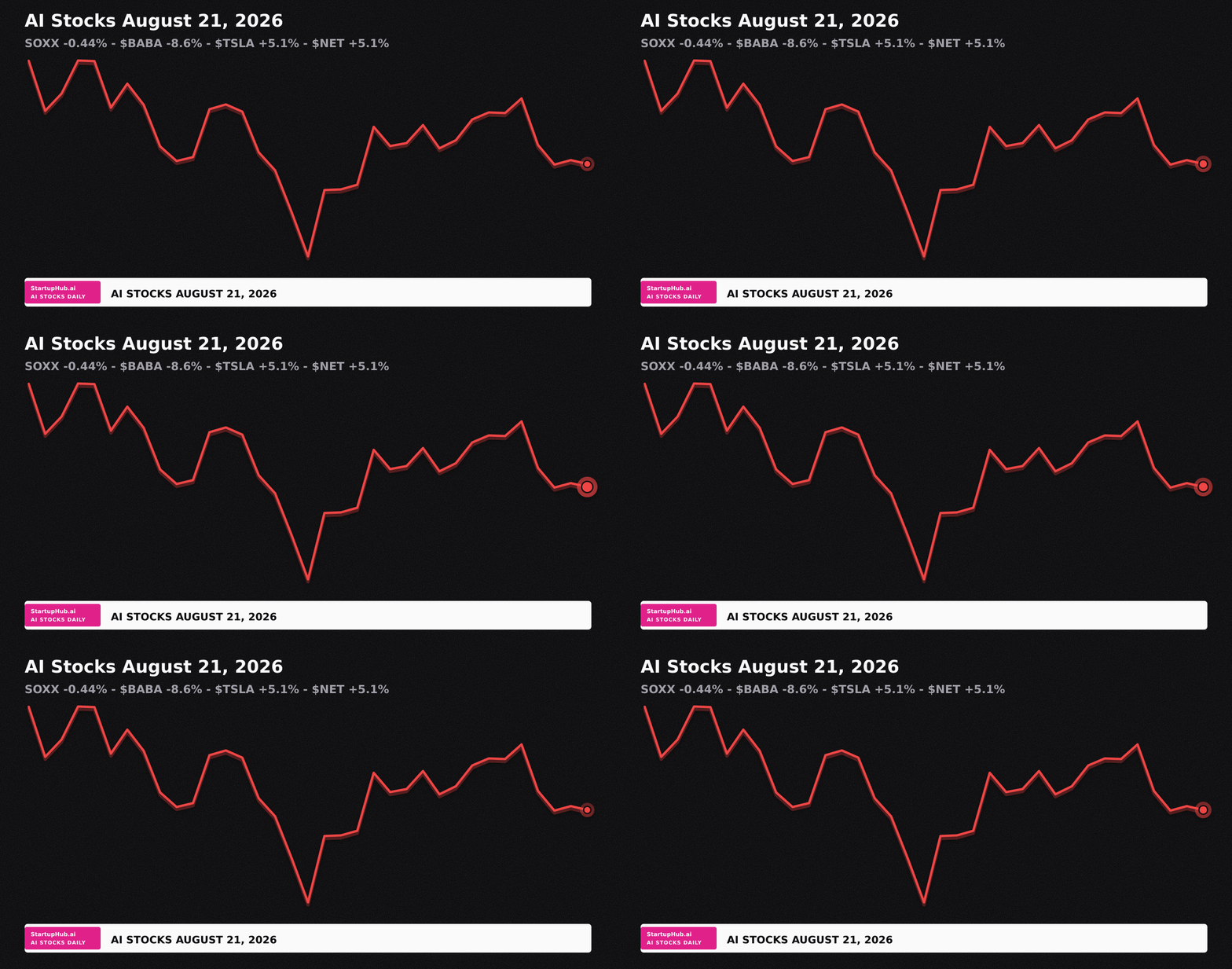
Ada: Absolutely, Sam. Let's dive right into that top story. Alibaba slid eight point six percent after a fiscal first quarter earnings miss. The big takeaway here is that their AI capital spending is running four and a half times faster than new cloud revenue growth. This isn't just a blip; it's a significant indicator of the intense investment required in the AI race, even for established tech giants. They're pouring money into foundational AI capabilities, but the immediate revenue isn't keeping pace yet.

Sam: It really highlights the long game being played in AI, doesn't it? On the flip side, we saw some significant jumps driven by AI news. Tesla, for instance, jumped five point one percent after Nevada approved five thousand robotaxis. This is a massive win for their autonomous driving ambitions and a tangible step towards widespread commercial deployment. It shows that regulatory approvals are a critical catalyst for the market's reaction to AI progress.

Ada: And then there's Cloudflare, which also gained five point one percent. Their surge came after AI-agent traffic crossed fifty percent of their network volume. That's a huge milestone. It signifies a fundamental shift in internet traffic patterns. AI agents are no longer just a niche; they're becoming a dominant force, driving significant demand for network infrastructure and services. This isn't just about bots, it's about intelligent, automated systems interacting with the web at scale.

Sam: That Cloudflare story actually leads us right into our next piece. Cloudflare is further streamlining bot management with its new Bot Preference Sync feature. This automatically updates robots dot txt files for AI bots, simplifying a traditionally complex task for site owners. It's a pragmatic solution to a growing problem. As AI agents become more prevalent, managing their access and behavior becomes crucial for website performance and security. This automation is a welcome development.

Ada: Exactly. It's an example of the infrastructure evolving to meet the demands of the AI era. Speaking of infrastructure, ITG's CFO, Chris Mecray, is calling his company the 'picks and shovels' of the AI boom. He detailed their fiber optic infrastructure work, their recent IPO, and how AI data center buildouts are driving their growth. It's a crucial reminder that while we often focus on the AI models and applications, the physical backbone enabling all of it is just as vital. Companies laying the fiber and building the data centers are seeing immense demand.

Sam: It's a classic investment thesis, right? When there's a gold rush, you invest in the companies selling the tools. ITG is clearly positioning itself in that sweet spot. Now, let's talk about something that might sound a bit academic but has real implications for how AI is developed and deployed. Google DeepMind recently clarified what they mean by 'full-stack AI.' While the details weren't fully laid out in the summary, this kind of definition setting is important. It helps align expectations and focus research efforts, especially in a field as rapidly evolving as AI. Understanding their holistic approach could give us clues about future product integration and capabilities.

Ada: Indeed. A common language and framework are essential. Moving on, prediction markets continue to show high interest in AI and crypto. Polymarket's prediction markets saw nineteen point seven million dollars in twenty-four hour volume, with a lot of that activity tied to AI-related outcomes. This isn't just about speculative betting; it's a fascinating barometer of public sentiment and perceived probabilities regarding future tech developments and market shifts. It shows where the smart money, or at least the actively engaged money, thinks the future is heading.

Sam: And it's not just general AI interest. We're seeing specific bets on AI IPOs from companies like OpenAI and Anthropic, alongside future Mars missions. It reflects a high-stakes environment where traders are looking to capitalize on major technological leaps. The fact that these AI IPOs are getting similar attention to audacious space exploration projects really underscores the perceived transformative power of AI.

Ada: That's a great point, Sam. It puts AI on par with some of humanity's grandest ambitions. Now, for something a bit more granular and practical, we have 'Claude's Corner,' featuring Corvera. This Y Combinator Winter 2026 startup is deploying AI agents to automate the back-office grind that often kills CPG brands at scale. They've built an agentic OS on an MCP, emphasizing that domain expertise is their real moat. This is a fantastic example of AI agents moving beyond theoretical applications and into solving very specific, painful business problems. Automating the mundane but crucial tasks in consumer packaged goods operations can be a game-changer for efficiency and scalability.

Sam: And the fact that they're providing a full build guide for replication is incredibly valuable for the broader AI community. It fosters learning and accelerates development. However, not all news surrounding AI infrastructure is positive. Public support for AI data centers has seen a significant collapse, according to a recent poll. This raises serious questions about future infrastructure development. This decline coincides with discussions among leading AI organizations about engineering systems to prevent institutional capture, which might suggest a growing public unease about the concentration of AI power and its physical footprint.

Ada: That's a critical point, Sam. The 'not in my backyard' sentiment is clearly emerging for AI infrastructure. It's a challenge the industry will need to address head-on. Finally, former IBM CEO Sam Palmisano discussed AI implementation plans, while data shows AI is slowing wage growth. This is a complex issue. While AI promises productivity gains, its immediate impact on labor markets is a growing concern. The discussion around USMCA trade and the Colorado River crisis also touched on how AI might influence broader economic and geopolitical challenges. It's a reminder that AI's ripples extend far beyond just tech companies.

Sam: A lot to unpack today, from market movements to infrastructure challenges and societal impacts. For the full stories and more in-depth analysis, head over to startuphub dot ai. That's all for today in AI.

Ada: We'll be back tomorrow with more of the day's biggest AI news.

© 2026 StartupHub.ai. All rights reserved. Do not enter, scrape, copy, reproduce, or republish this article in whole or in part. Use as input to AI training, fine-tuning, retrieval-augmented generation, or any machine-learning system is prohibited without written license. Substantially-similar derivative works will be pursued to the fullest extent of applicable copyright, database, and computer-misuse laws. See our terms.