

The AI Doctor's 'Oracle Problem'

The 'Oracle Problem' in healthcare AI: why scoring well on tests doesn't equal real-world medical effectiveness.

8 min read
Abstract graphic representing AI and medical data, with a question mark symbolizing the Oracle Problem.
a16z Blog
Visual TL;DR
AI in HealthcareCore
promise of AI: early disease detection, personalized treatments, reduced physician burnout
From the article 7 mentionsThe promise of AI in healthcare is immense: imagine an AI that can spot diseases earlier, personalize treatments, and reduce physician burnout.
Acing BenchmarksDriver
AI models achieve perfect scores on tests, but real-world impact is uncertain
From the article 9 mentionsSimilarly, AI models trained on vast datasets can achieve perfect scores on benchmarks, but this doesn't guarantee real-world effectiveness.
Gap: Test vs. LifeDriver
From the articleThe gap between "good at the test" and "good in life" is proving a significant hurdle.
The Oracle ProblemDriver
fundamental challenge: how to truly measure AI effectiveness beyond test scores
From the article 5 mentionsYet, a fundamental challenge, dubbed the "Oracle Problem," is creating an invisible bottleneck for widespread adoption.
Invisible BottleneckOutcome
From the articleYet, a fundamental challenge, dubbed the "Oracle Problem," is creating an invisible bottleneck for widespread adoption.
AI in HealthcareCore
promise of AI: early disease detection, personalized treatments, reduced physician burnout
From the article 7 mentionsThe promise of AI in healthcare is immense: imagine an AI that can spot diseases earlier, personalize treatments, and reduce physician burnout.
Subjective MedicineContext
medicine lacks clear, objective 'ground truth' for clinical decisions
From the article 3 mentionsThis issue, highlighted by Bobby Samuels in a recent a16z Blog post, questions how we truly measure if an AI model is "good" in the messy reality of medicine, beyond just acing tests.
Acing BenchmarksDriver
AI models achieve perfect scores on tests, but real-world impact is uncertain
From the article 9 mentionsSimilarly, AI models trained on vast datasets can achieve perfect scores on benchmarks, but this doesn't guarantee real-world effectiveness.
Gap: Test vs. LifeDriver
From the articleThe gap between "good at the test" and "good in life" is proving a significant hurdle.
The Oracle ProblemDriver
fundamental challenge: how to truly measure AI effectiveness beyond test scores
From the article 5 mentionsYet, a fundamental challenge, dubbed the "Oracle Problem," is creating an invisible bottleneck for widespread adoption.
Invisible BottleneckOutcome
From the articleYet, a fundamental challenge, dubbed the "Oracle Problem," is creating an invisible bottleneck for widespread adoption.
Measuring Real ImpactEffect
need to measure real-world impact, not just marketing benchmarks
Path ForwardEffect
solving the Oracle Problem is crucial for AI's future in healthcare
Contents(5)

The promise of AI in healthcare is immense: imagine an AI that can spot diseases earlier, personalize treatments, and reduce physician burnout. Yet, a fundamental challenge, dubbed the "Oracle Problem," is creating an invisible bottleneck for widespread adoption. This issue, highlighted by Bobby Samuels in a recent a16z Blog post, questions how we truly measure if an AI model is "good" in the messy reality of medicine, beyond just acing tests.

The core of the problem lies in how we define and evaluate success. When a medical student aces every test, we'd still hesitate if they were the sole caregiver. Similarly, AI models trained on vast datasets can achieve perfect scores on benchmarks, but this doesn't guarantee real-world effectiveness. The gap between "good at the test" and "good in life" is proving a significant hurdle.

The Subjectivity of Medicine

Medicine, unlike many other domains, lacks a clear, objective "ground truth." Clinical decisions are often influenced by a doctor's experience, individual judgment, and subtle nuances that are hard to standardize. What might be the "right" decision for one physician on a given day, based on their unique approach and the specific patient context, may differ for another. Training an AI on this data means the benchmarks themselves become "opinionated," reflecting the biases of the evaluators rather than absolute clinical correctness.

This subjectivity is evident even in seemingly objective areas like surgical choices. For instance, the decision between a partial and total knee replacement can vary significantly based on the surgeon's preference, accounting for a much larger percentage of variation than patient characteristics alone. Across numerous surgical procedures, physician identity can explain anywhere from 7% to 77% of the variation in treatment choices. An AI might agree with the recorded action but for the wrong reason, or disagree and still be clinically defensible. Static benchmarks struggle to differentiate these scenarios.

Hidden Data and Marketing Benchmarks

Adding to the complexity, the underlying clinical data used for training and evaluation is often proprietary and tightly guarded by healthcare institutions. This lack of transparency makes independent verification difficult. Furthermore, benchmarks, intended to be objective measures, can inadvertently become marketing tools. A company's success on a benchmark might say more about how the test was designed, its specific prompts, grading rubrics, and answer formats, than about the model's actual clinical merit compared to a competitor.

This creates a principal-agent problem: buyers struggle to trust the AI products they are purchasing because the evaluation methods themselves are not fully transparent or universally agreed upon. Even as models are updated frequently, traditional government arbitration or static task forces can't keep pace with rapid evolution.

The Rise of AI in Patient Interactions

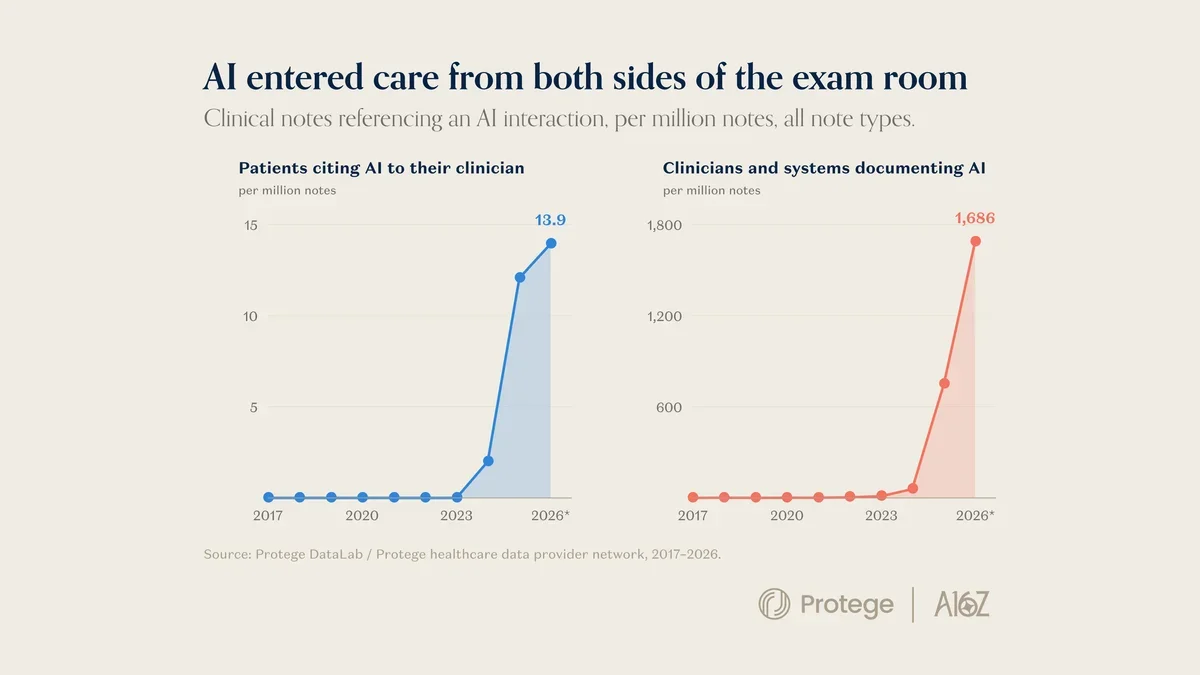
The urgency of the Oracle Problem is amplified by the increasing integration of AI into daily patient life. OpenAI's ChatGPT, for example, is reportedly used by over 300 million people weekly for health-related queries. Interactions where patients ask AI models for clarification on medical advice are rapidly increasing, as are instances of AI generating medical notes, with nearly a third of SOAP notes projected to be AI-written soon. This widespread adoption means AI predictions, which can influence consequential choices, are being made and acted upon without a robust mechanism for verifying their outcomes.

Beyond Benchmarks: Measuring Real-World Impact

The article argues that current benchmarks often test models in a vacuum, using compressed vignettes instead of full patient records. Many public healthcare AI benchmarks provide far less context than a median patient record, limiting their relevance. Moreover, the very nature of clinical decision-making is dynamic and influenced by a multitude of factors, patient flow, clinician capacity, and even recent patient outcomes, that are difficult to capture in a static test.

What's needed are evaluations that move beyond simply passing tests. Instead of asking if an AI can pass the MCAT, the critical question is: "How productive is AI at getting the overall picture right, and making us healthy?" True impact should be measured by metrics like life expectancy, quality-adjusted life years, nurse burnout, physician turnover, and medical mistrust, not just healthcare utilization. These are the benchmarks that matter for health systems and patients alike.

The Path Forward: Solving the Oracle Problem

The "Oracle Problem" is a sophisticated challenge that requires more than just more data or compute power. It demands a new way of thinking about evaluation, one that focuses on long-term, real-world outcomes. Companies like Protege, mentioned in the original post, are working to develop tests that measure what healthcare AI must do for real clinicians and patients to produce tangible health gains. This endeavor is critical for building trust and enabling the true potential of AI in medicine.

In the broader AI startup scene, this challenge highlights the need for rigorous, outcome-oriented validation. While companies like Alphabet Inc. (NASDAQ:GOOGL) and Microsoft (NASDAQ:MSFT) are investing heavily in AI for healthcare, and OpenAI (score 86/100) leads in foundational models, the practical deployment challenges remain immense. StartupHub.ai data shows that while OpenAI leads in overall score among competitors tracked (71/100 for an unnamed company, 72/100 for Perplexity AI, 50/100 for matey, 52/100 for Lucidworks), the real-world efficacy in specialized domains like healthcare is a different beast. As model capacity grows, the ability to verify their real-world impact will become the ultimate determinant of success and trust in the sector.

© 2026 StartupHub.ai. All rights reserved. Do not enter, scrape, copy, reproduce, or republish this article in whole or in part. Use as input to AI training, fine-tuning, retrieval-augmented generation, or any machine-learning system is prohibited without written license. Substantially-similar derivative works will be pursued to the fullest extent of applicable copyright, database, and computer-misuse laws. See our terms.