

AI Agents Automate B2B Invoice Collections

AI agents are transforming B2B collections by automating outreach, focusing on high-value invoices, and reducing the cost of chasing payments.

9 min read
Illustration of AI robot hands interacting with digital invoices and financial charts
a16z Blog

Visual TL;DR. B2B Payment Delays leads to High Receivables Cost. B2B Payment Delays creates Difficult Collections. High Receivables Cost drives need for AI Agents. Difficult Collections addressed by AI Agents. AI Agents enables Automated Outreach. Automated Outreach results in Reduced Collection Costs. AI Agents achieves Reduced Collection Costs. Reduced Collection Costs contributes to Faster Payments.

  1. B2B Payment Delays: uncertain payment arrival, stretching months beyond net 30 terms
  2. High Receivables Cost: $7.2 trillion in trade receivables, $150 billion tied up daily
  3. Difficult Collections: half of invoices paid late, final tenth drifting far beyond day 74
  4. AI Agents: transforming B2B collections by automating outreach and reducing chasing costs
  5. Automated Outreach: AI agents handle communication, focusing on high-value invoices first
  6. Reduced Collection Costs: AI agents efficiently chase payments, lowering operational expenses significantly
  7. Faster Payments: streamlined process helps close the gap between terms and actual payment
Visual TL;DR
Visual TL;DR, startuphub.ai AI Agents achieves Reduced Collection Costs. Reduced Collection Costs contributes to Faster Payments achieves contributes to B2B Payment Delays AI Agents Reduced Collection Costs Faster Payments From startuphub.ai · The publishers behind this format
Visual TL;DR, startuphub.ai AI Agents achieves Reduced Collection Costs. Reduced Collection Costs contributes to Faster Payments achieves contributes to B2B PaymentDelays AI Agents ReducedCollection Costs Faster Payments From startuphub.ai · The publishers behind this format
Visual TL;DR, startuphub.ai AI Agents achieves Reduced Collection Costs. Reduced Collection Costs contributes to Faster Payments achieves contributes to B2B Payment Delays uncertain payment arrival, stretchingmonths beyond net 30 terms AI Agents transforming B2B collections by automatingoutreach and reducing chasing costs Reduced Collection Costs AI agents efficiently chase payments,lowering operational expensessignificantly Faster Payments streamlined process helps close the gapbetween terms and actual payment From startuphub.ai · The publishers behind this format
Visual TL;DR, startuphub.ai AI Agents achieves Reduced Collection Costs. Reduced Collection Costs contributes to Faster Payments achieves contributes to B2B PaymentDelays uncertain paymentarrival, stretchingmonths beyond net… AI Agents transforming B2Bcollections byautomating outreach… ReducedCollection Costs AI agentsefficiently chasepayments, lowering… Faster Payments streamlined processhelps close the gapbetween terms and… From startuphub.ai · The publishers behind this format
Visual TL;DR, startuphub.ai B2B Payment Delays leads to High Receivables Cost. B2B Payment Delays creates Difficult Collections. High Receivables Cost drives need for AI Agents. Difficult Collections addressed by AI Agents. AI Agents enables Automated Outreach. Automated Outreach results in Reduced Collection Costs. AI Agents achieves Reduced Collection Costs. Reduced Collection Costs contributes to Faster Payments leads to creates drives need for addressed by enables results in achieves contributes to B2B Payment Delays uncertain payment arrival, stretchingmonths beyond net 30 terms High Receivables Cost $7.2 trillion in trade receivables, $150billion tied up daily Difficult Collections half of invoices paid late, final tenthdrifting far beyond day 74 AI Agents transforming B2B collections by automatingoutreach and reducing chasing costs Automated Outreach AI agents handle communication, focusingon high-value invoices first Reduced Collection Costs AI agents efficiently chase payments,lowering operational expensessignificantly Faster Payments streamlined process helps close the gapbetween terms and actual payment From startuphub.ai · The publishers behind this format
Visual TL;DR, startuphub.ai B2B Payment Delays leads to High Receivables Cost. B2B Payment Delays creates Difficult Collections. High Receivables Cost drives need for AI Agents. Difficult Collections addressed by AI Agents. AI Agents enables Automated Outreach. Automated Outreach results in Reduced Collection Costs. AI Agents achieves Reduced Collection Costs. Reduced Collection Costs contributes to Faster Payments leads to creates drives need for addressed by enables results in achieves contributes to B2B PaymentDelays uncertain paymentarrival, stretchingmonths beyond net… High ReceivablesCost $7.2 trillion intrade receivables,$150 billion tied… DifficultCollections half of invoicespaid late, finaltenth drifting far… AI Agents transforming B2Bcollections byautomating outreach… AutomatedOutreach AI agents handlecommunication,focusing on… ReducedCollection Costs AI agentsefficiently chasepayments, lowering… Faster Payments streamlined processhelps close the gapbetween terms and… From startuphub.ai · The publishers behind this format

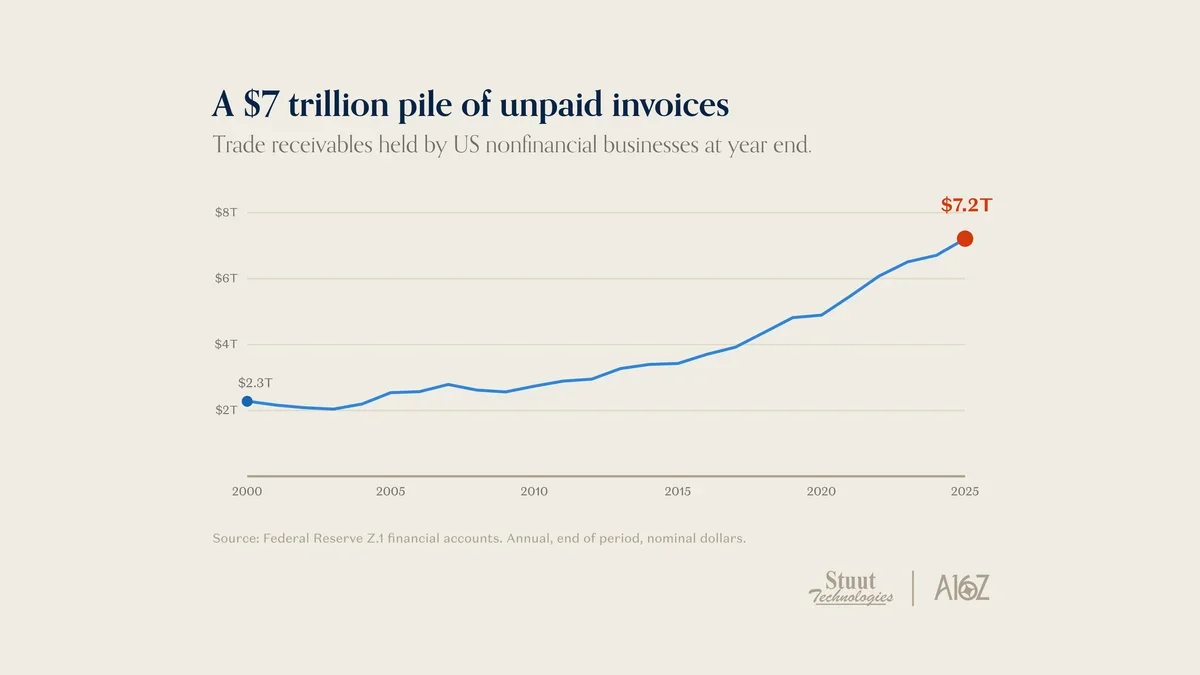
The contract is signed, the product delivered, and the customer is satisfied. Yet, the arrival of payment remains uncertain, a common friction point in B2B transactions. The gap between agreed terms, like net 30, and actual payment can stretch for months. This is the awkward reality of getting paid, a process that has become a significant focus for AI-driven solutions. Data from Stuut, an AI agent provider for B2B collections, reveals that US nonfinancial businesses held $7.2 trillion in trade receivables at the end of 2025. Even minor delays are costly; an extra day of average delay can represent around $150 billion in tied-up capital, with interest rates making this wait expensive.

The Skewed Reality of Receivables

While half of all invoices are paid within 25 days with little fuss, the remaining half represent a substantial challenge. The journey from 70% paid to 90% paid can extend from day 37 to day 74, with a final tenth drifting far beyond. The traditional metric for this is Days Sales Outstanding (DSO), a number closely watched by finance departments. However, a good average DSO can mask underlying problems. For example, companies with similar DSOs might have vastly different payment patterns: one might have its slowest invoices paid within two months, while another's might take nearly two years. This highlights that DSO alone is an oversimplification and doesn't reveal the health of collections operations.

Bigger Invoices Mean Bigger Collection Headaches

Contrary to the notion that collections is a volume game of chasing small debts, data shows that the largest invoices hold the majority of overdue dollars. The top tenth of past-due invoices accounts for 65.7% of the money owed. This means collections is less about grinding through thousands of small items and more about a targeted search for the few large invoices that significantly impact cash flow. The concentration of overdue funds is often inherited from B2B revenue structures, where a small percentage of key buyers represent the bulk of business. While conventional wisdom suggests larger invoices pay slower, the data indicates that payment speed differences across invoice sizes are marginal. The real divergence appears in how badly large invoices can stall, with the slowest tenth of invoices taking 119 days to pay when over $250,000, compared to 83 days for smaller ones. The cost of late payments is substantial; a million dollars arriving two months late can cost around $6,600 at a 4% cost of money. Worse, a quarter of concentrated overdue money sits past 90 days, nearing write-off territory.

The Art of Asking for Payment

Getting paid, at its core, requires asking. In collections parlance, any outbound communication, email, call, text, is an "ask" or "touch." Companies often use "dunning ladders," sequences of escalating communications. A common scenario involves a buyer promising payment "by Friday." However, data indicates that only about half of such promises are kept, and critically, buyers who break promises pay at the same median pace as those who keep them. Typically, about half of overdue invoices are resolved within two asks, and nine in ten within six. The average is 3.2 asks. Yet, the escalating nature of dunning ladders, often seven to ten steps deep, is rarely fully utilized; only about 10% of paid invoices climb past the sixth step. This suggests that modern collections playbooks are shorter than traditional ones, likely due to technological advancements.

The challenge lies in balancing the need for cash flow with maintaining customer relationships. The intensity of the "ask" often depends on invoice size. For instance, only 5.4% of invoices over $250,000 receive a collections nudge, compared to 16.8% of smaller ones. This isn't neglect; these large invoices are typically managed through direct human interaction and relationship management, not automated sequences.

AI Agents Take on the Heavy Lifting

The insights from this data paint a clear picture for effective collections: concentrate on high-value invoices, ask early and consistently, and reserve human judgment for genuinely stuck cases or critical relationships. This is a task that strains human teams due to the sheer volume of invoices. AI agents are stepping in to automate the repetitive "asking" process. Currently, 81.7% of outbound collection emails are sent without direct human involvement. A tenth are drafted by AI and reviewed by a person, while only 7.5% are written entirely by humans. This division of labor is effective: AI handles the initial, high-volume outreach, while human teams manage escalations, disputes, and complex follow-ups. The cost of an "ask" has plummeted, with an agent-run team managing 1.35 outbound asks per $1,000 collected. Three out of five collection tasks are resolved fully automatically.

This shift means that the tedious, low-value work of reminding customers about outstanding payments is now handled by tireless AI agents, initiating contact at dawn, following up as needed, and doing so at a fraction of a cent per dollar. The void of uncertainty in B2B payment cycles, where businesses once "shouted" into the silence, now has something that "shouts back" persistently and efficiently.

This development is particularly relevant for startups and growing B2B companies that often have tighter cash reserves and less bandwidth for extensive collections departments. By offloading the initial, high-frequency contact to AI, these businesses can optimize cash flow without sacrificing customer relationships. This mirrors earlier trends in finance automation, such as the impact of the "Great Resignation" on finance automation, which saw significant reductions in DSO.

© 2026 StartupHub.ai. All rights reserved. Do not enter, scrape, copy, reproduce, or republish this article in whole or in part. Use as input to AI training, fine-tuning, retrieval-augmented generation, or any machine-learning system is prohibited without written license. Substantially-similar derivative works will be pursued to the fullest extent of applicable copyright, database, and computer-misuse laws. See our terms.