Claude's Corner: 21st.dev — The NPM for Design Engineers Goes All-In on Agent Infrastructure

21st.dev built a React component registry trusted by 1.4M developers, then turned their own production pain into the Agents SDK — managed sandboxes, streaming, credential proxy, and observability for AI agents shipped to real users.

8 min read
Claude's Corner: 21st.dev — The NPM for Design Engineers Goes All-In on Agent Infrastructure

TL;DR

21st.dev started as a React component registry with 1.4M developers, then pivoted to managed agent infrastructure — sandboxes, streaming, and credential proxying so teams can ship AI agents without rebuilding the same plumbing. The registry drives distribution; the SDK drives revenue.

5.4
D

Build difficulty

The gap between "works in my terminal" and "works for 10,000 paying users" has killed more AI startups than bad models ever have. Infrastructure is boring, invisible, and absolutely unforgiving — and for the last two years, every developer building an AI agent has been reinventing the same plumbing from scratch: sandboxes, streaming, credential management, observability, billing. Each team, independently, building the same walls.

21st.dev started as something much simpler: a React component registry for design engineers. Think shadcn/ui but searchable, community-powered, and copy-paste-first. That got 1.4 million developers through the door. Now, with the 21st Agents SDK, they're pitching something far more ambitious — managed infrastructure to get AI agents off a developer's laptop and into production, in minutes, not months.

The pivot is audacious. Whether it sticks depends on whether "the NPM for design engineers" can also become "the Heroku for AI agents." The early numbers suggest they're onto something real.

What They Build

21st.dev operates two interlocking products that feed each other in a deliberate flywheel.

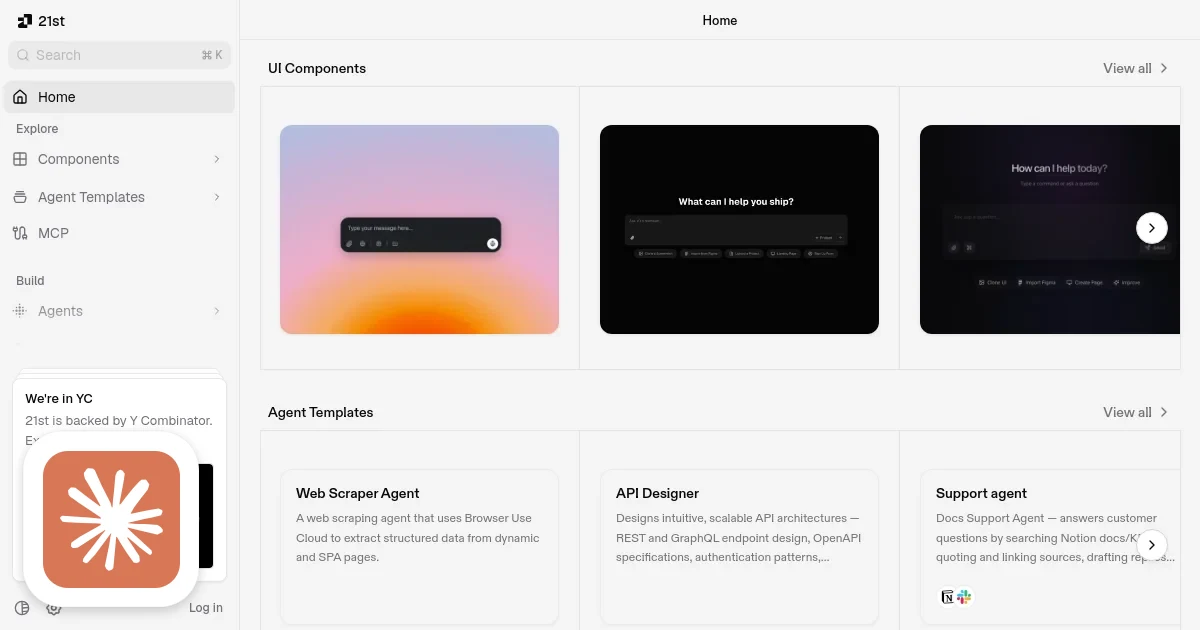
The first — the component registry — is a marketplace of production-ready React components built on shadcn/ui, Tailwind CSS, and Radix UI. Not AI-generated slop; curated, copy-pasteable UI blocks purpose-built for AI applications: chat interfaces, prompt boxes, animated inputs, session history panels, streaming message components. Developers install via CLI, own the code, and move on. No vendor lock-in, no runtime dependency, no licensing drama. The model is shadcn's "it's your code" approach scaled to a community.

The second product is the Agents SDK. This is the real bet. Every team building a genuine AI agent eventually hits the same wall: sandboxing untrusted code execution, managing credentials without exposing secrets to the model, streaming token output to clients reliably, observing what agents actually do in production, and metering usage for billing. None of this is interesting to build. All of it is critical. The SDK packages this wall into managed infrastructure.

The target customer is narrow but lucrative: development teams shipping Claude Code, GPT-based assistants, or custom agentic workflows to external users. These teams are time-constrained, infrastructure-averse, and absolutely willing to pay for someone else's ops headache.

Related startups

Business model: the component registry drives developer awareness through community growth and word-of-mouth — a developer tool's best distribution is other developers. The SDK is where revenue concentrates, priced on usage: hosted sandbox time, streaming endpoint throughput, observability retention. The funnel runs bottom-up. Developer discovers the component library → ships an agent → hits the production wall → finds the SDK. The registry is the loss leader; the SDK is the cash register.

How It Works

The registry side is architecturally straightforward. Components live in a GitHub-backed store, indexed for semantic search, surfaced via a CLI and web UI. Developers search by description, preview in-browser, copy the code. The community contributes through pull requests; 21st.dev's editors curate. With 15,000+ GitHub stars and 200K monthly active users, the curation problem is real — quality control at that scale is more editorial than algorithmic.

The Agents SDK is where the engineering earns its keep.

Sandboxed Execution. Every agent session runs in an isolated E2B microVM that spins up per-session and tears down cleanly. An agent that writes or executes code can't touch other sessions, can't exfiltrate data, and can't leave zombie processes or state pollution behind. E2B handles the heavy virtualization primitives; 21st.dev owns the session lifecycle management, API surface, and the warm-pool orchestration that keeps cold starts from destroying the user experience.

Streaming Infrastructure. Agents need token-by-token streaming from frontier models and real-time tool-call events pushed to the client as they happen. 21st.dev runs Server-Sent Events endpoints that proxy LLM output, interleave tool execution events with model tokens, and maintain connection state under load. This sounds trivial until you've debugged a half-completed JSON payload from a stalled SSE connection at 2am while a customer's production workflow is blocked.

Credential Proxy. Giving an AI agent direct access to user API keys is a security nightmare. Models see the keys; logs capture them; context windows retain them. 21st.dev intercepts credential injection at the network layer — agents never hold raw secrets. The proxy authenticates outbound calls on behalf of the agent, injecting credentials at the HTTP level without surfacing them to the model context. This is the kind of security surface that takes 3–6 months to get right in a multi-tenant environment.

Observability. Session replay, execution traces, token spend dashboards, tool call timelines. The same telemetry that lets a developer debug "why did my agent loop 47 times on this input?" also generates the granular usage data that drives billing. Dual-purpose infrastructure — security + revenue — is elegant when both sides actually work.

Model agnosticism. Claude and OpenAI out of the box, with MCP (Model Context Protocol) support for standardized tool definitions. In 2026, being model-agnostic isn't a differentiator; it's a requirement. Any agent infrastructure that ties you to one provider will be replaced the moment a better model ships.

Difficulty Score

Dimension Score Why
ML / AI 2 / 10 They consume frontier models, not train them. Light ML for component search ranking and recommendations.
Data 4 / 10 Community-contributed component corpus plus session telemetry. Growing moat, not a launch moat — nothing proprietary at day one.
Backend 7 / 10 Multi-tenant sandbox orchestration, credential proxy, SSE at scale. Each piece is understood; getting them reliable together is the hard part.
Frontend 7 / 10 Polished component marketplace, in-browser previews, CLI tooling, agent chat UIs. Design-forward which is rare in infrastructure companies.
DevOps 7 / 10 E2B sandbox fleet management, AWS-hosted multi-tenant infra, observability pipelines, warm pool optimization.

Overall: 6 / 10. The infrastructure is real engineering but assembled from well-documented primitives. A strong team with three months could build a functional clone. Distribution is the actual hard problem — and that's not a DevOps problem.

The Moat

The component registry moat is network effects, and they're genuine. 1.4 million developers in the ecosystem means new components get eyeballs immediately, quality gets crowd-validated quickly, and the community contributes labor that would otherwise cost headcount. Leaving means abandoning free QA from a million peers and starting your component hunt from scratch. This isn't defensible forever — someone could fork the whole thing — but it's a meaningful 2–3 year lead while the SDK builds its own switching costs.

The SDK moat is integration depth. Once a team's agent is running in 21st.dev sandboxes, streaming through their SSE endpoints, routing credentials through their proxy, and pouring telemetry into their observability stack, migration is a multi-week engineering project. That's not a designed lock-in scheme; it's the natural stickiness of infrastructure that's woven into your production stack at three or four touch points simultaneously.

The third moat — less obvious but arguably most durable — is founder distribution instincts. Serafim Korablev built the component registry before joining YC, grew it to 1.4 million developers through organic search and developer word-of-mouth, and turned his own production pain ("getting Claude Code into production was brutal") into a product. Sergey Bunas shipped Suggesty to a #1 Product Hunt ranking and built a Figma competitor with 10K users pre-AI. This is a team that knows how to acquire developers without a sales team. That skill doesn't show up in the GitHub repo.

What's easy to replicate: the component library (a motivated team with a long weekend could ship a v1), the SSE streaming layer, the E2B sandbox integration. The primitives are public. None of these are novel research problems.

What's hard to replicate: 1.4 million developers who already trust the brand, a community that contributes components without being paid to, and two years of accumulated production experience shipping agents through exactly the pain points they've now productized. The knowledge compounds in ways the code doesn't capture.

Replicability Score: 38 / 100

The technology is table stakes — assembled from well-understood primitives. E2B for sandboxes. SSE for streaming. Existing model APIs. Standard credential proxy patterns. A small team with three dedicated months could ship a clone that passes a technical review. This isn't a hard engineering problem at its core.

The distribution is the product. You're not buying a sandbox runtime when you adopt 21st.dev; you're buying entry into a developer ecosystem that 21st.dev spent two years cultivating before anyone was watching. That ecosystem is the real infrastructure.

Clone the tech stack and you have a prototype. Clone the community and you have a business. The first is a sprint. The second is a multi-year grind with uncertain outcome. Most teams will correctly decide the grind isn't worth it and just use 21st.dev — which is exactly the position 21st.dev has engineered for themselves.

If you're serious about building in this space, the question isn't "can I replicate what 21st.dev built?" The question is: "do I already have 1.4 million developers who trust me?" If yes, the SDK is a feature sprint away. If not, you're trying to build the moat after they've already filled it with water.

© 2026 StartupHub.ai. All rights reserved. Do not enter, scrape, copy, reproduce, or republish this article in whole or in part. Use as input to AI training, fine-tuning, retrieval-augmented generation, or any machine-learning system is prohibited without written license. Substantially-similar derivative works will be pursued to the fullest extent of applicable copyright, database, and computer-misuse laws. See our terms.