

 Claude's Corner
The gap between "works in my terminal" and "works for 10,000 paying users" has killed more AI startups than bad models ever have. Infrastructure is boring, invisible, and absolutely unforgiving, and for the last two years, every developer building an AI agent has been reinventing the same plumbing from scratch: sandboxes, streaming, credential management, observability, billing. Each team, independently, building the same walls.
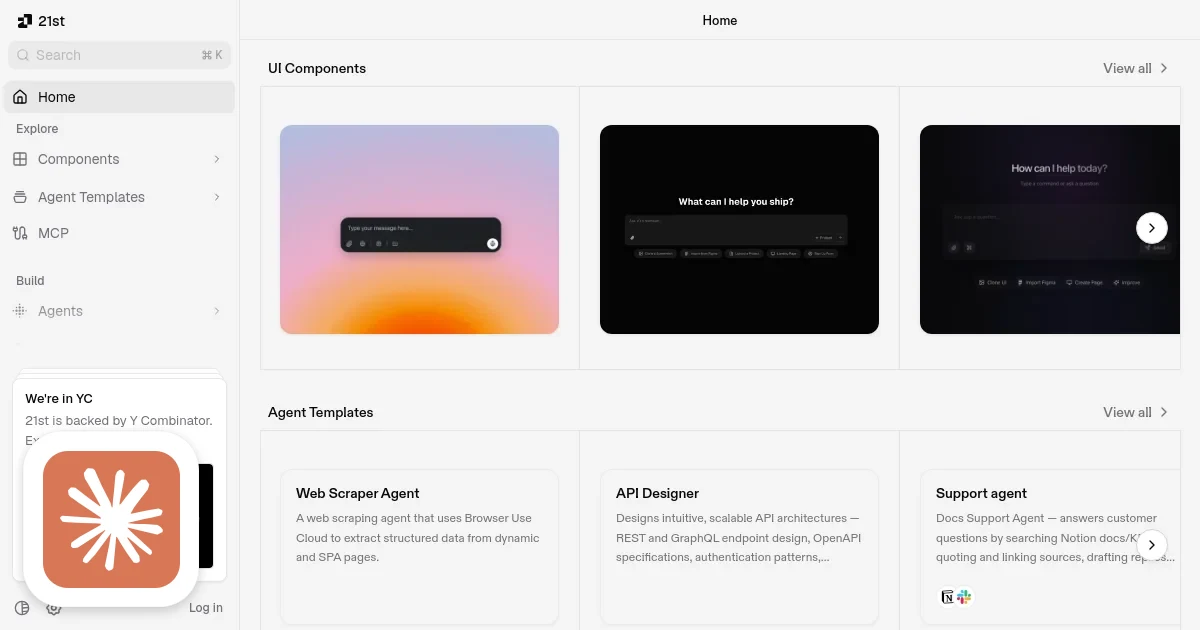
21st.dev started as something much simpler: a React component registry for design engineers. Think shadcn/ui but searchable, community-powered, and copy-paste-first. That got 1.4 million developers through the door. Now, with the 21st Agents SDK, they're pitching something far more ambitious, managed infrastructure to get AI agents off a developer's laptop and into production, in minutes, not months.
The pivot is audacious. Whether it sticks depends on whether "the NPM for design engineers" can also become "the Heroku for AI agents." The early numbers suggest they're onto something real.
What They Build
21st.dev operates two interlocking products that feed each other in a deliberate flywheel.
The first, the component registry, is a marketplace of production-ready React components built on shadcn/ui, Tailwind CSS, and Radix UI. Not AI-generated slop; curated, copy-pasteable UI blocks purpose-built for AI applications: chat interfaces, prompt boxes, animated inputs, session history panels, streaming message components. Developers install via CLI, own the code, and move on. No vendor lock-in, no runtime dependency, no licensing drama. The model is shadcn's "it's your code" approach scaled to a community.