

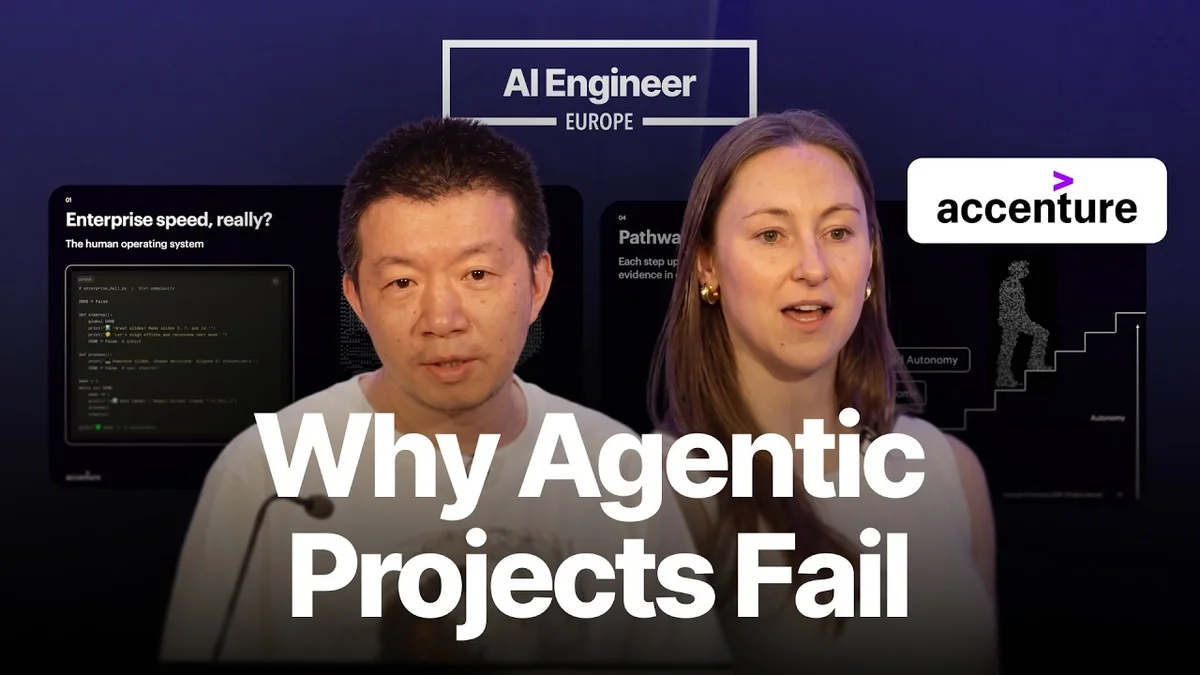
Why Enterprise Agentic AI Projects Often Fail

Accenture's Jess Grogan-Avignon & Jack Wang explain why most enterprise agentic AI projects fail and how to succeed by embracing iterative delivery and building trust.

Jess Grogan-Avignon and Jack Wang from Accenture present on enterprise agentic AI projects.
Jess Grogan-Avignon and Jack Wang of Accenture discuss the challenges and future of enterprise agentic AI.· AI Engineer
Visual TL;DR
Enterprise PaceContext
From the article 9+ mentionsGrogan-Avignon and Wang began by characterizing the typical enterprise environment as one built for 'human pace.' This involves established structures focused on control, process, repeatability, and governance, all designed for predictable, incremental progress.
Machine SpeedContext
rapidly evolving world of artificial intelligence, agentic AI projects
From the article 2 mentionsThe speakers highlighted that enterprises are now entering a new era where they must operate at 'machine speed.' This shift is driven by the accelerating pace of AI development and deployment, which promises to transform everything enterprises know.
High Failure RatesOutcome
From the articleIn the rapidly evolving world of artificial intelligence, enterprise agentic projects are frequently encountering significant hurdles, leading to a high rate of failure.
New Engineering MindsetCore
prescription for success, embracing iterative delivery and building trust
From the article 2 mentionsTo overcome these challenges, Grogan-Avignon and Wang proposed a shift in approach, emphasizing the need for a new engineering mindset.
Start Now, Deliver DifferentlyContext
measure in confidence, iterative delivery approach
Finance as PartnerContext
transformation partner, not a gatekeeper
From the articleInstead, finance departments should act as transformation partners, supporting a portfolio of AI bets rather than rigidly justifying each project in isolation.
Governance as EngineeringContext
make governance speed an engineering problem
From the article 4 mentionsGovernance, often seen as a bottleneck, needs to be addressed as an engineering challenge.
Contents(3)

In the rapidly evolving world of artificial intelligence, enterprise agentic projects are frequently encountering significant hurdles, leading to a high rate of failure. Jess Grogan-Avignon and Jack Wang from Accenture, speaking at AI Engineer Europe, illuminated the core reasons behind these widespread project setbacks. Their presentation, "Most Enterprise Agentic Projects Are Doomed, Here's Why," offered a critical perspective on the challenges and provided a roadmap for navigating the complexities of deploying AI agents within large organizations.

Why Enterprise Agentic AI Projects Often Fail - AI Engineer
Why Enterprise Agentic AI Projects Often Fail, from AI Engineer

The Enterprise Context: Human Pace vs. Machine Speed

Grogan-Avignon and Wang began by characterizing the typical enterprise environment as one built for 'human pace.' This involves established structures focused on control, process, repeatability, and governance, all designed for predictable, incremental progress. For years, this model has driven success in large enterprises across various sectors, from telecommunications and utilities to healthcare and consumer products. However, the advent of AI, particularly agentic AI, introduces a fundamental tension with this established operational rhythm.

The speakers highlighted that enterprises are now entering a new era where they must operate at 'machine speed.' This shift is driven by the accelerating pace of AI development and deployment, which promises to transform everything enterprises know. The core problem, as they articulated, is that the traditional enterprise structures, built for human-paced iteration, are not adequately equipped to handle the speed and emergent behaviors of AI.

The Reality: High Failure Rates and Stalled Progress

Citing research, the presenters revealed a stark reality: 88% of companies remain stuck in the piloting or experimentation phase with AI, failing to achieve significant returns on their investments. This is not merely due to a lack of data or access to APIs, but rather a deeper issue rooted in how enterprises are trying to engineer AI within their existing frameworks.

The core of the problem lies in the fundamental difference between traditional software delivery and the deployment of agentic AI. Traditional projects often assume that scope, value, and cost are knowable upfront. This allows for detailed business cases, extensive planning, and phased rollouts. Agentic AI, however, breaks these assumptions. Its solutions and value are often emergent, meaning they are discovered through experimentation rather than being predetermined. The cost of experimentation and execution can drop dramatically, enabling enterprises to attempt previously economically impossible tasks.

The Prescription for Success: A New Engineering Mindset

To overcome these challenges, Grogan-Avignon and Wang proposed a shift in approach, emphasizing the need for a new engineering mindset. They outlined a four-pronged prescription for success:

1. Start Now: Deliver Differently, Measure in Confidence

Enterprises should embrace a more agile and experimental approach. This involves shaping projects around hypotheses rather than rigid requirements and running delivery in small, iterative loops of experiment, evaluate, and iterate. This allows for continuous learning and adaptation as the AI's capabilities and value become clearer.

2. Make Finance a Transformation Partner, Not a Gatekeeper

The traditional approach to funding, where ROI is meticulously calculated upfront, is often incompatible with the exploratory nature of agentic AI. Instead, finance departments should act as transformation partners, supporting a portfolio of AI bets rather than rigidly justifying each project in isolation. This allows for exploration and the discovery of value beyond immediate, quantifiable cost-out metrics.

3. Make Governance Speed an Engineering Problem

Governance, often seen as a bottleneck, needs to be addressed as an engineering challenge. The presenters advocate for building governance as code, enabling faster, more flexible, and more automated control mechanisms that can keep pace with AI development. This approach helps manage risks without stifling innovation.

4. Redefine Your Moat as What You Compound Today

The true competitive advantage, or 'moat,' for enterprises in the AI era will not come from proprietary algorithms alone, but from the ability to build and compound feedback loops. This means continuously learning from deployed AI systems, iterating on their performance, and using that learning to create a virtuous cycle of improvement and value creation.

The speakers concluded by stressing that the success of agentic AI projects lies not just in building the technology, but in fundamentally rethinking the enterprise's operational and strategic approach. By embracing these principles, organizations can move beyond the common pitfalls and unlock the transformative potential of AI.

© 2026 StartupHub.ai. All rights reserved. You may not republish this article in full without a license. Search engines and AI research tools may crawl and summarize for reference. Bulk reproduction or model training requires a license. See our terms.
Daniel Singer

Written by

Daniel Singer

Editor, StartupHub.ai

Daniel Singer is the editor of StartupHub.ai, a technology expert and thought leader on AI and its applications across sectors, from fintech and healthcare to developer tooling and consumer software. He writes and tests the tools covered here thoroughly and regularly, and built StartupHub.ai to give founders, operators and buyers a clearer read on what they are actually being sold.

More from Daniel Singer