


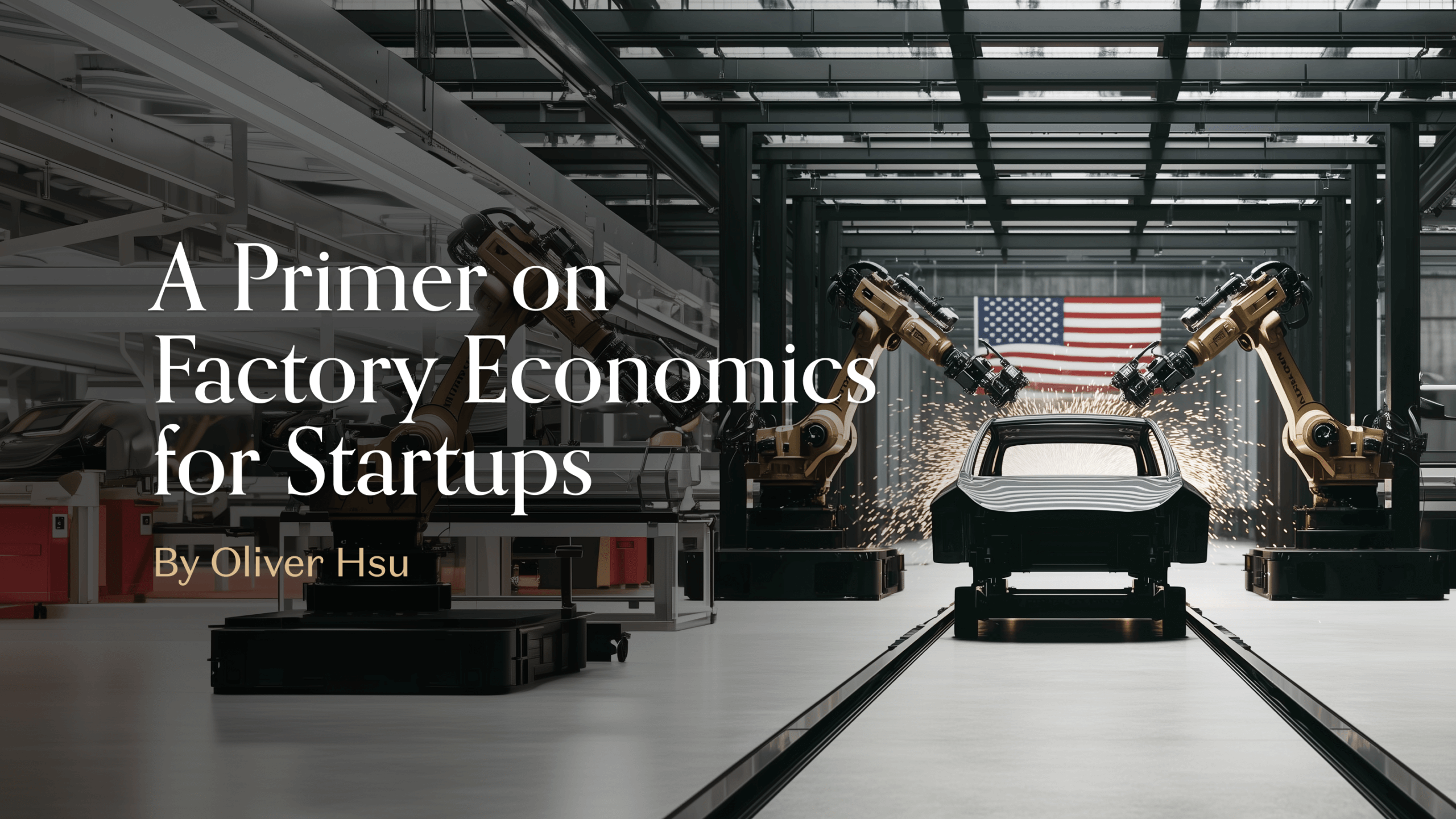
In certain hardware-centric industries, the true innovation lies not just in what a company makes, but critically, how it makes it. This distinct business model, often dubbed 'The Factory is the Product', features economic dynamics that diverge sharply from traditional manufacturing and software startups. Companies like Trener Robotics or even Tesla are prime examples, where the production capacity and proprietary manufacturing technology form the core intellectual property and competitive moat.
These businesses are not simply outsourcing production; they are developing novel manufacturing processes where the factory itself is the product. As more founders build companies that design, build, and scale their own manufacturing, mastering factory economics becomes essential. This primer, originally detailed by Andreessen Horowitz, explores the fundamental economic principles, operational metrics, and capital strategies vital for navigating this transition from product design to scaled production.
Basic Economics: Costs, Yield, and Learning
At its core, factory economics revolves around managing costs, optimizing yield, and leveraging learning curves. Costs are broadly categorized into variable (direct materials, labor, consumables) and fixed (depreciation, salaries, facilities). The ratio between these, known as operating leverage, significantly impacts unit economics; high fixed costs amplify gains with volume but magnify losses from underutilization.
Yield, the measure of successful output after process losses, is a critical lever. It encompasses incoming quality, first-pass yield, rework success, final test yield, and even field return rates. A mere 20-point difference in yield can create a substantial cost advantage, as demonstrated by a competitor achieving 90% yield versus 70%, resulting in a significantly lower effective cost per good unit.
Learning curves, as described by Wright's Law, illustrate how cumulative production drives down the cost or time per unit. This reduction stems from improved labor efficiency, process optimization, design for manufacturability, and economies of scale. For 'factory is the product' companies, a steep learning curve combined with sufficient capital to accelerate production is key to outpacing competitors.