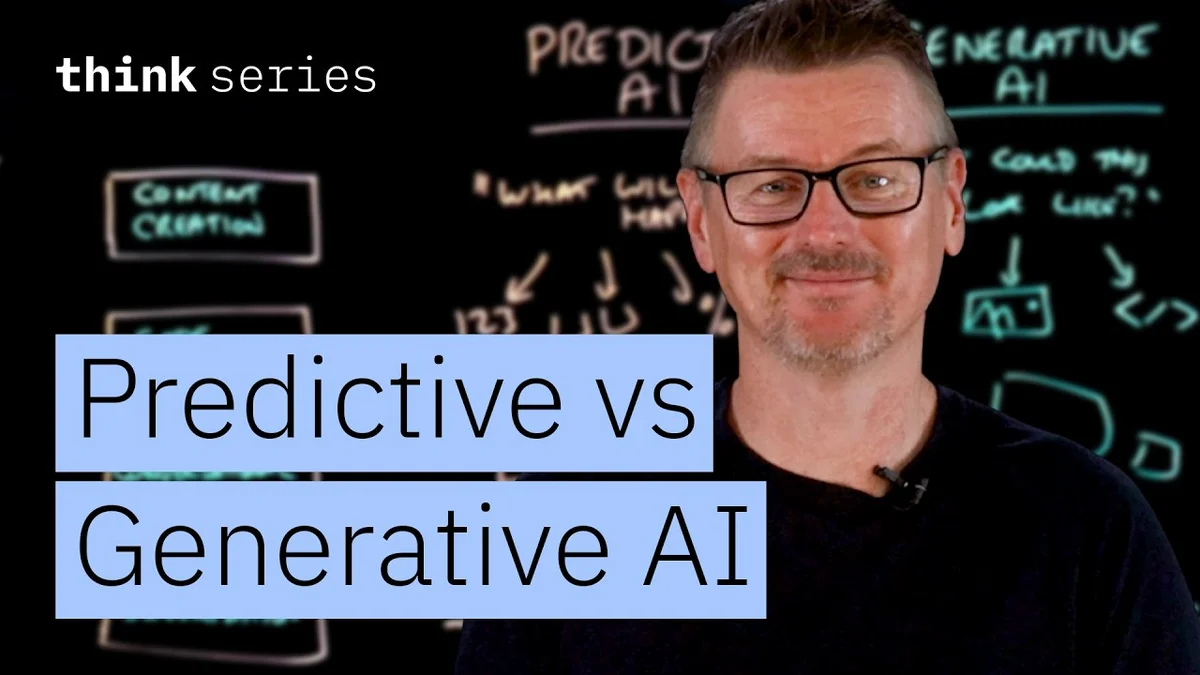
In the rapidly evolving world of artificial intelligence, the terms "predictive AI" and "generative AI" are often used, sometimes interchangeably. However, understanding the fundamental differences between these two powerful branches of AI is crucial for grasping their respective applications and capabilities. Martin Keen, a Master Inventor at IBM, breaks down these distinctions in a clear and accessible manner, explaining how each type of AI works and when to deploy them.
The Core Distinction: Predicting vs. Creating
Keen highlights that the primary difference lies in the questions each type of AI seeks to answer. Predictive AI is fundamentally about forecasting. It looks at historical data and patterns to answer questions like "What will happen next?" or "What is the probability of this event occurring?" Examples include predicting sales figures for the next quarter, identifying potentially fraudulent transactions, or forecasting stock prices.
Generative AI, on the other hand, is focused on creation. It learns patterns from existing data to generate entirely new content that resembles the training data. The question it aims to answer is "What could this look like?" This can manifest as writing text, composing music, creating images, or even generating code.
The full discussion can be found on IBM's YouTube channel.

Data Consumption and Output Types
The way these AI types consume and process data also differs. Predictive AI typically works with structured data, often in the form of tables with rows and columns, representing historical observations and their associated outcomes. The output from predictive models is usually a specific label or a numerical value, a prediction, a classification, or a probability.