Pablo Castro on AI and Knowledge Systems at Microsoft

Pablo Castro, Microsoft Distinguished Engineer and CVP for AI Knowledge, discusses how advanced knowledge systems are vital for building effective AI applications and agents.

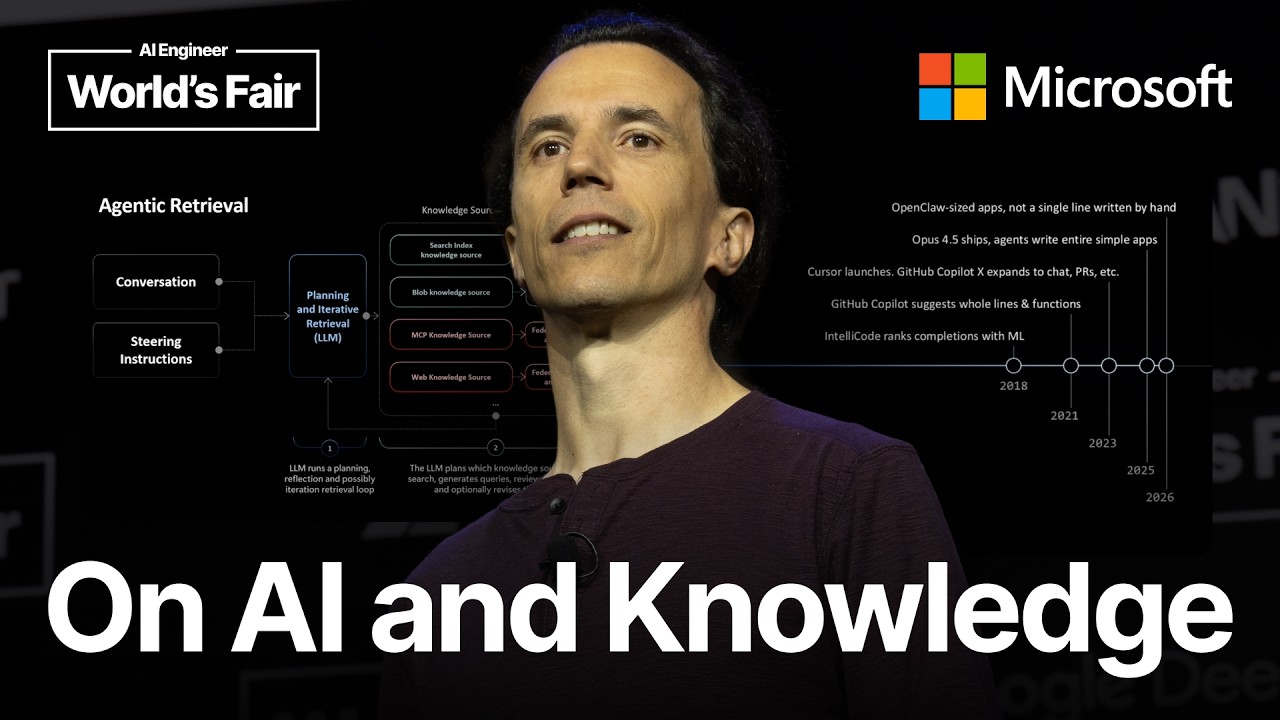
Pablo Castro speaking about AI and knowledge systems at Microsoft
AI Engineer
Visual TL;DR
Pablo CastroCore
From the article 9 mentionsIn a recent presentation, Pablo Castro, a Distinguished Engineer and Corporate Vice President (CVP) for AI Knowledge at Microsoft (NASDAQ:MSFT), explored the critical intersection of artificial intelligence and knowledge systems.
Effective AI ApplicationsDriver
building more capable and reliable AI applications and agents for users
From the article 6 mentionsCastro's presentation emphasized that effective AI is inextricably linked to robust knowledge systems.
Advanced Knowledge SystemsContext
vital for effective AI, focusing on information understanding and retrieval
From the article 8 mentionsFoundry IQ, for example, represents an effort to build advanced knowledge infrastructure that supports complex AI tasks.
Foundry IQCore
key initiative enhancing AI applications across Microsoft's product portfolio
From the article 2 mentionsCastro's influence extends to key initiatives such as Foundry IQ, Azure AI Search, and Azure Content Understanding, all of which are designed to improve how AI processes, organizes, and retrieves information.
Azure AI SearchCore
part of Castro's influence, improving AI's ability to leverage data
From the article 6 mentionsAzure AI Search, a core component of Microsoft (NASDAQ:MSFT)'s cloud offerings, is a direct beneficiary of this focus on knowledge systems.
Azure Content UnderstandingCore
another initiative shaping how AI interacts with vast amounts of data
From the article 4 mentionsSimilarly, Azure Content Understanding focuses on extracting meaning and structure from raw, unstructured content.
Future of AIOutcome
From the article 2 mentionsHis work at Microsoft's CoreAI division is central to shaping the future of how AI interacts with and leverages vast amounts of data.
Contents(5)

In a recent presentation, Pablo Castro, a Distinguished Engineer and Corporate Vice President (CVP) for AI Knowledge at Microsoft (NASDAQ:MSFT), explored the critical intersection of artificial intelligence and knowledge systems. Castro's insights shed light on how advanced information understanding and retrieval are foundational to developing more capable and reliable AI applications and agents. His work at Microsoft's CoreAI division is central to shaping the future of how AI interacts with and leverages vast amounts of data.

StartupHub data

Microsoft

A global technology leader providing software, cloud services, AI, and devices for individuals and businesses.

Founded
1975
Location
Redmond, Washington, United States
Pablo Castro on AI and Knowledge Systems at Microsoft - AI Engineer
Pablo Castro on AI and Knowledge Systems at Microsoft, from AI Engineer

Who Is Pablo Castro

Pablo Castro serves as a Distinguished Engineer and CVP within Microsoft's CoreAI division. In this role, he spearheads the AI Knowledge team, focusing on the development of state-of-the-art information understanding and retrieval systems. His expertise is directly applied to enhancing AI applications and agents across Microsoft's product portfolio. Castro's influence extends to key initiatives such as Foundry IQ, Azure AI Search, and Azure Content Understanding, all of which are designed to improve how AI processes, organizes, and retrieves information.

The Core of AI and Knowledge Systems

Castro's presentation emphasized that effective AI is inextricably linked to robust knowledge systems. He articulated that for AI to move beyond basic pattern recognition and truly become intelligent agents, they must possess sophisticated mechanisms for understanding and retrieving information. This involves not just accessing data, but comprehending its context, relevance, and interconnections.

The challenge, as Castro explained, lies in enabling AI to not only store knowledge but also to reason with it dynamically. This capability is vital for AI agents to perform complex tasks, answer nuanced questions, and generate accurate, contextually appropriate responses. Without strong knowledge foundations, AI systems are prone to inaccuracies, inconsistencies, and what is often termed "hallucination", fabricating information that is not factually supported.

Building Better AI Applications and Agents

The practical application of Castro's work is evident in Microsoft's efforts to build better AI applications and agents. He highlighted that these systems are designed to enhance various aspects of AI functionality, from improving search results to powering intelligent assistants and automating complex workflows. The goal is to create AI that is not only powerful but also trustworthy and reliable.

One of the central tenets of this approach is the development of systems that can extract, organize, and synthesize information from diverse sources. This includes structured data, unstructured text, and multimedia content. By effectively processing this information, AI can gain a deeper understanding of specific domains and respond with greater precision.

Foundry IQ, Azure AI Search, and Azure Content Understanding

Castro's team is directly responsible for several pivotal Microsoft technologies that embody these principles. Foundry IQ, for example, represents an effort to build advanced knowledge infrastructure that supports complex AI tasks. While specific details were not fully elaborated, it points to a foundational layer designed for deep information processing.

Azure AI Search, a core component of Microsoft (NASDAQ:MSFT)'s cloud offerings, is a direct beneficiary of this focus on knowledge systems. It provides developers with tools to integrate powerful search capabilities into their applications, driven by AI-enhanced understanding of content. This moves beyond keyword matching to semantic search, where the AI understands the intent behind a query and the meaning within documents.

Similarly, Azure Content Understanding focuses on extracting meaning and structure from raw, unstructured content. This is crucial for applications that need to analyze large volumes of text, such as legal documents, research papers, or customer feedback. By automating the understanding of content, these systems enable AI to perform tasks that would otherwise require extensive human effort.

The Future of AI Knowledge

The ongoing development of these knowledge systems is critical for the next generation of AI. Castro's work suggests a future where AI agents are not just tools but intelligent collaborators, capable of accessing, processing, and applying vast amounts of information with human-like comprehension. This advancement is essential for addressing increasingly complex problems across industries, from scientific discovery to personalized education.

The integration of robust knowledge systems also plays a key role in making AI more transparent and explainable. When an AI can demonstrate its reasoning by referencing specific pieces of knowledge, it builds greater trust and allows users to better understand its decision-making process. This is a significant step towards more responsible and ethical AI development.

© 2026 StartupHub.ai. All rights reserved. You may not republish this article in full without a license. Search engines and AI research tools may crawl and summarize for reference. Bulk reproduction or model training requires a license. See our terms.
Daniel Singer

Written by

Daniel Singer

Editor, StartupHub.ai

Daniel Singer is the editor of StartupHub.ai, a technology expert and thought leader on AI and its applications across sectors, from fintech and healthcare to developer tooling and consumer software. He writes and tests the tools covered here thoroughly and regularly, and built StartupHub.ai to give founders, operators and buyers a clearer read on what they are actually being sold.

More from Daniel Singer