

Nico Albanese: Giving AI Agents Computer Access

Nico Albanese of Vercel argues for empowering AI agents with computer access to unlock their full potential for complex tasks.

4 min read
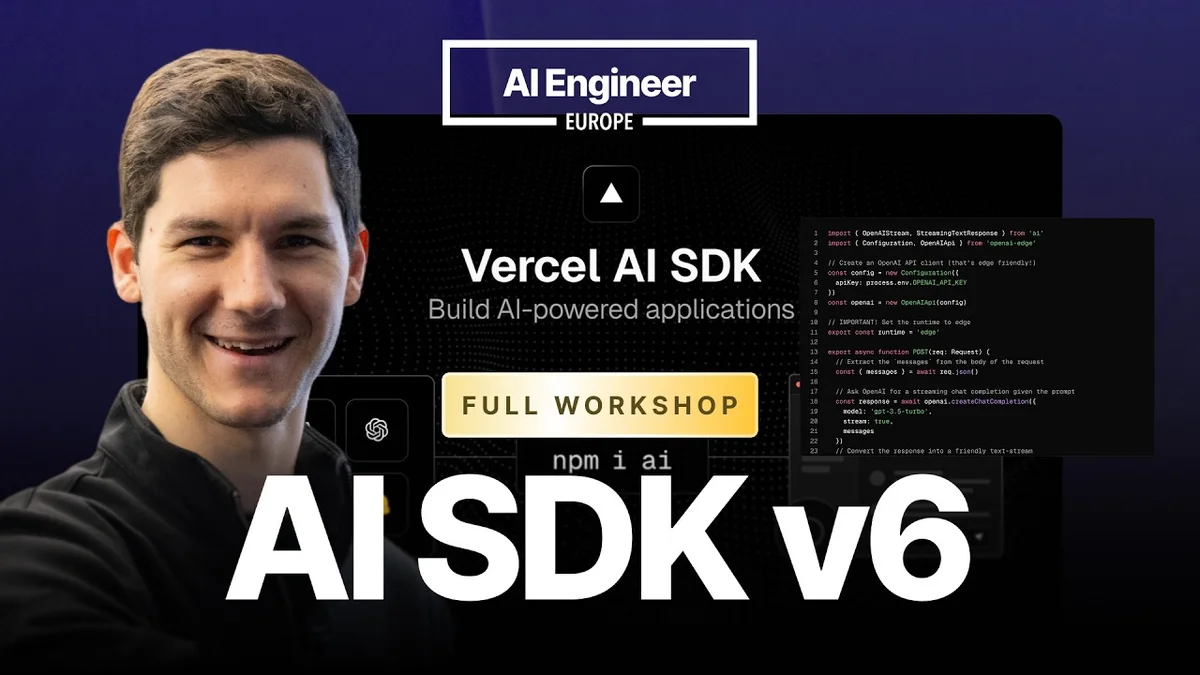
Nico Albanese speaking at a conference about AI agents and computer access.
Image credit: StartupHub.ai· AI Engineer

In a compelling presentation titled "Give Your Agent a Computer," Nico Albanese of Vercel explores a critical frontier in artificial intelligence development: empowering AI agents with the ability to interact with and operate within digital environments. The core thesis suggests that current AI models, while impressive in their understanding and generation capabilities, are fundamentally limited by their inability to take action in the real world or even the digital one. Albanese argues that the next leap in AI utility will come from granting these agents the equivalent of a computer, complete with access to tools, browsers, and the ability to execute commands.

Nico Albanese: Giving AI Agents Computer Access - AI Engineer
Nico Albanese: Giving AI Agents Computer Access — from AI Engineer

Visual TL;DR

Related startups

leads to enables results in Current AILimitations Grant ComputerAccess Unlock AIPotential Future AutonomousAI Original analysis · #1 AI startup directory
leads to enables results in Current AILimitations AI agents lack real-worldor digital executioncapabilities Grant ComputerAccess Give AI agents tools,browsers, and commandexecution Unlock AIPotential Enables complex tasks andautonomous AI development Future AutonomousAI AI agents taking actionand executing plans Original analysis · #1 AI startup directory

The Limitations of Current AI Agents

Albanese highlights the current state of AI agents, which often operate in a sandbox environment. They can process information, generate text, and even plan sequences of actions, but they lack the agency to execute those plans in a meaningful way. This limitation prevents them from performing tasks that require interaction with external systems, such as booking appointments, managing emails, or even performing complex research that involves navigating multiple websites and synthesizing information from various sources.

The presenter emphasizes that true autonomy for AI agents requires more than just understanding; it requires the capacity to act. Without the ability to interface with the digital world, AI agents remain largely theoretical tools, capable of thought but not deed. This gap is what Albanese aims to bridge with the concept of providing agents with computer access.

Unlocking Potential Through Computer Access

The central argument is that granting AI agents access to a computer—or more accurately, the functionalities of a computer—is the key to unlocking their true potential. This access would enable agents to perform a wide range of tasks that are currently beyond their reach. Imagine an agent that can not only draft an email but also send it, schedule a meeting, book a flight, or manage a company's social media presence. These capabilities move AI from passive assistants to active participants in digital workflows.

Albanese suggests that this evolution is not just about convenience but about creating agents that can tackle more complex, multi-step problems. By interacting with web applications, APIs, and other digital tools, agents can perform sophisticated operations that require dynamic decision-making and real-time adaptation, mirroring how humans use computers to accomplish their goals.

The Future of Autonomous AI

The vision presented is one where AI agents are not confined to chatbots or text generators but become powerful digital assistants capable of managing various aspects of our digital lives and work. This implies a future where AI can be delegated complex projects that involve multiple digital touchpoints, significantly increasing productivity and efficiency.
The ability for an AI agent to use a browser, for instance, opens up a world of possibilities. It can conduct in-depth research by visiting websites, extracting relevant data, and compiling reports. It can manage online accounts, perform administrative tasks, and even engage in creative endeavors that require interaction with digital platforms. The presentation points toward a future where AI agents are not just tools but collaborators, capable of independent action within defined parameters.

© 2026 StartupHub.ai. All rights reserved. Do not enter, scrape, copy, reproduce, or republish this article in whole or in part. Use as input to AI training, fine-tuning, retrieval-augmented generation, or any machine-learning system is prohibited without written license. Substantially-similar derivative works will be pursued to the fullest extent of applicable copyright, database, and computer-misuse laws. See our terms.