

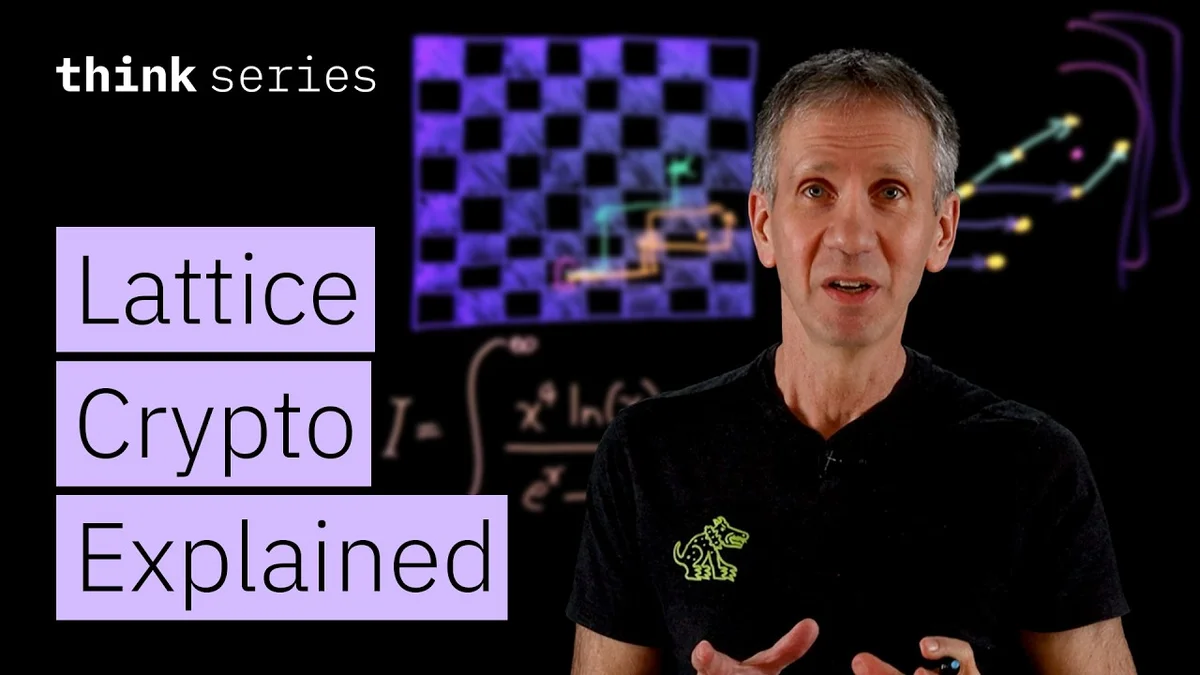
Jeff Crume on IBM's Quantum-Safe Crypto

IBM Distinguished Engineer Jeff Crume discusses the urgent need for quantum-safe cryptography and how lattice-based algorithms are key to securing data against future quantum computers.

3 min read
Jeff Crume, Distinguished Engineer at IBM, discussing quantum-safe cryptography
Image credit: IBM· IBM

Jeff Crume, a Distinguished Engineer at IBM, recently shared insights into the critical challenge of quantum computing's potential to break current encryption methods. In a video discussion, Crume explained the concept of quantum-safe cryptography and the urgent need for organizations to prepare for a future where quantum computers could render today's security protocols obsolete.

Understanding the Threat

Crume began by highlighting the fundamental problem: as quantum computers become more powerful, they will be able to solve complex mathematical problems that underpin much of our current cryptographic infrastructure. Algorithms like Shor's algorithm, for instance, can efficiently factor large numbers, a task that is computationally infeasible for classical computers and forms the basis of widely used encryption schemes like RSA.

"The internet as we know it would cease to exist if quantum computers could break our encryption," Crume stated, emphasizing the far-reaching implications. This threat extends to all forms of sensitive data, from personal information and financial transactions to national security secrets.

The full discussion can be found on IBM's YouTube channel.
Post‑Quantum Security: How Lattice Cryptography Keeps Data Safe - IBM
Post‑Quantum Security: How Lattice Cryptography Keeps Data Safe — from IBM

The Promise of Lattice Cryptography

To counter this looming threat, the cryptographic community is actively exploring and developing new encryption methods that are resistant to quantum attacks. Crume pointed to lattice-based cryptography as a leading contender. He explained the analogy of a chess game to illustrate the complexity involved.

"Imagine a chess game where the board has 1000 dimensions," Crume elaborated. "Finding the shortest path through that complex lattice is incredibly difficult for classical computers, but it's something quantum computers could potentially do efficiently." This inherent mathematical difficulty is what makes lattice-based cryptography quantum-safe.

He further illustrated how increasing the dimensions and adding 'noise' to these mathematical problems exponentially increases their difficulty, making them resistant to even the most powerful quantum computers. This is the core principle behind quantum-safe or post-quantum cryptography (PQC).

IBM's Role and the Path Forward

IBM has been at the forefront of this research, contributing to the standardization efforts led by organizations like the National Institute of Standards and Technology (NIST). Crume mentioned that NIST has been evaluating and selecting PQC algorithms for standardization for the past decade, a process that involves rigorous analysis and testing.

Crume outlined a phased approach for organizations to transition to quantum-safe cryptography:

  • Discovery: Understand where sensitive data resides and which cryptographic algorithms are being used.
  • Inventory: Catalog all cryptographic assets and their dependencies.
  • Evaluation: Assess the impact of quantum computers on current systems and identify which algorithms are most vulnerable.
  • Prioritization: Determine which systems and data need to be protected first, focusing on those with long-term data security requirements.
  • Remediation: Plan and implement the transition to new, quantum-safe algorithms.

"You don't need to wait for a quantum computer to break your encryption," Crume advised. "You need to start planning your transition now." He stressed that the process of discovering, evaluating, and implementing new cryptographic standards is time-consuming and requires careful planning and execution.

The transition to quantum-safe cryptography is not just about implementing new algorithms; it's about a fundamental shift in how we approach digital security. It requires a proactive strategy that anticipates future threats and ensures the long-term confidentiality and integrity of sensitive information in a quantum-enabled world.

© 2026 StartupHub.ai. All rights reserved. Do not enter, scrape, copy, reproduce, or republish this article in whole or in part. Use as input to AI training, fine-tuning, retrieval-augmented generation, or any machine-learning system is prohibited without written license. Substantially-similar derivative works will be pursued to the fullest extent of applicable copyright, database, and computer-misuse laws. See our terms.