

Hugging Face: Agents Train Models with New Skills

Merve Noyan from Hugging Face explains how agents can now train models and utilize new skills to interact with the Hugging Face Hub, enhancing AI development workflows.

5 min read
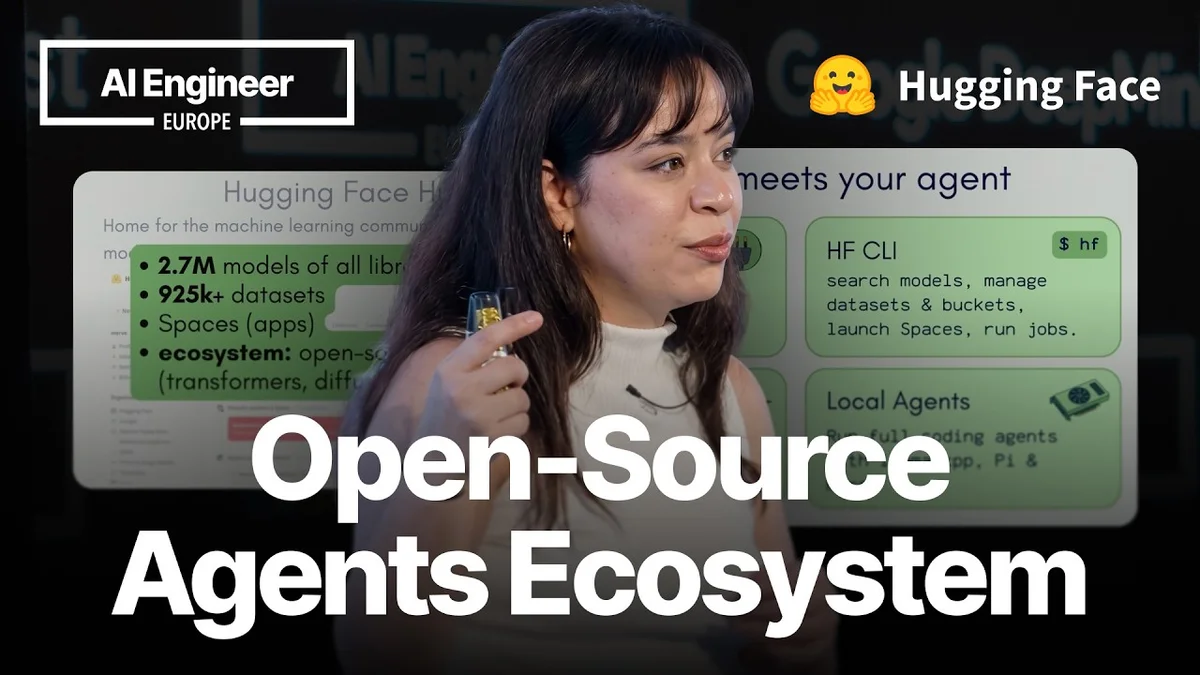
Merve Noyan from Hugging Face presenting on agents training models
Image credit: Hugging Face· AI Engineer
Visual TL;DR
Agents Train ModelsEffect
From the article 7 mentionsMerve Noyan from Hugging Face discusses how agents can now be empowered to train models, expanding the capabilities of the open agent ecosystem.
Hugging Face HubCore
central repository for models, datasets, and applications
From the article 9+ mentionsNoyan highlights the integration of Hugging Face Hub's functionalities, such as model and dataset search, and the ability to run jobs and query Spaces through LLMs.
Hub IntegrationContext
agents leverage Hub for model/dataset search, run jobs
From the article 7 mentionsThe integration of Hugging Face Hub with agents allows for more sophisticated workflows.
Leveraging SkillsContext
skills enable agents to perform advanced training tasks
From the article 6 mentionsNoyan demonstrates how agents can be prompted to find the best model for a specific task, such as OCR for French documents, by leveraging benchmarks and leaderboards available on Hugging Face Hub.
Local Model ServingContext
agents interact with models locally for efficiency
Enhanced AI WorkflowsOutcome
more sophisticated workflows for AI development
From the article 2 mentionsNoyan showcases how agents can be configured to use local LLM endpoints, enabling a seamless workflow for training and inference without relying solely on cloud-based services.
Agent TrainingEffect
agents can train models with new skills
From the article 9+ mentionsThe agent, guided by the user's prompt, identifies a suitable OCR model, retrieves its benchmark performance, and initiates the training process.
Model DiscoveryEffect
agents can discover models based on benchmarks
From the article 9+ mentionsNoyan explains that Hugging Face Hub acts as a central repository for machine learning models, datasets, and applications, fostering a collaborative environment.
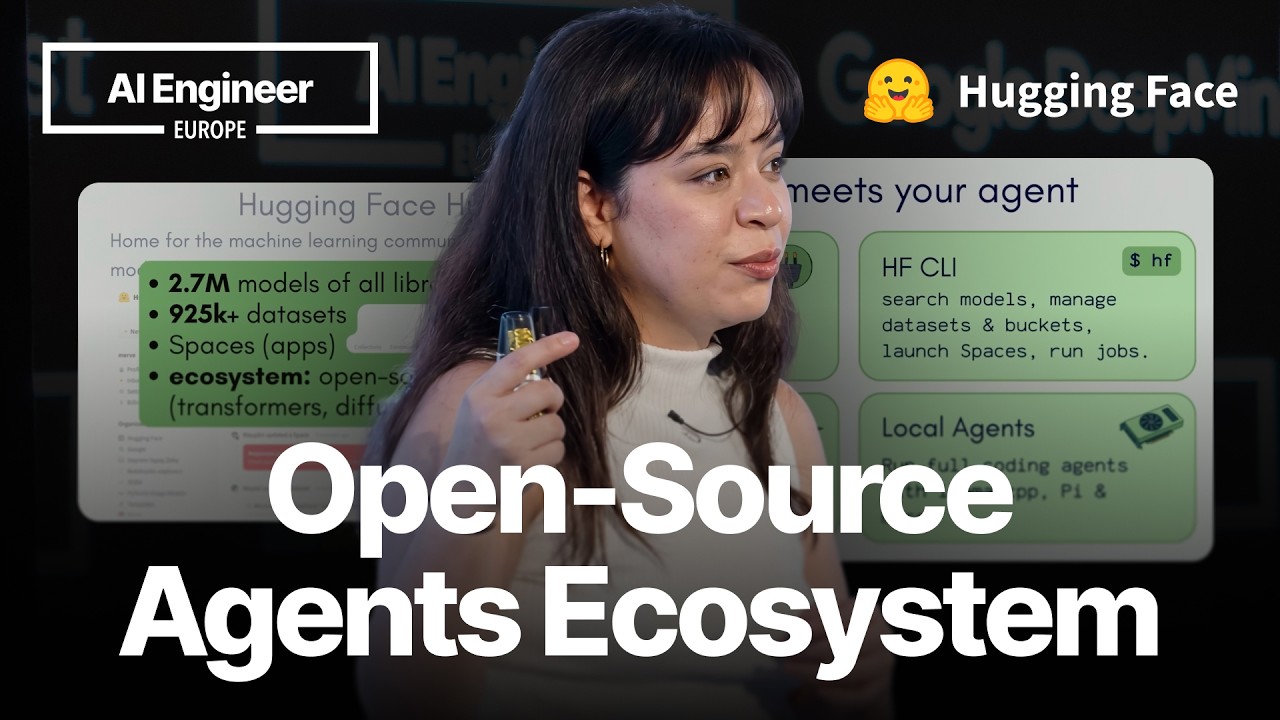
Merve Noyan from Hugging Face discusses how agents can now be empowered to train models, expanding the capabilities of the open agent ecosystem. Noyan highlights the integration of Hugging Face Hub's functionalities, such as model and dataset search, and the ability to run jobs and query Spaces through LLMs.

Hugging Face: Agents Train Models with New Skills - AI Engineer
Hugging Face: Agents Train Models with New Skills — from AI Engineer

Open Agent Ecosystem and Hugging Face Hub Integration

Noyan explains that Hugging Face Hub acts as a central repository for machine learning models, datasets, and applications, fostering a collaborative environment. The platform hosts a vast number of models and datasets, enabling developers to share and discover resources.

The integration of Hugging Face Hub with agents allows for more sophisticated workflows. Agents can now leverage Hugging Face's infrastructure to perform tasks like model selection based on benchmarks, fine-tuning models with specific datasets, and even hosting agent traces for analysis.

Leveraging Skills for Agent Training

A key aspect of this advancement is the introduction of 'skills' that agents can utilize. These skills allow agents to interact with the Hugging Face ecosystem programmatically. For instance, the Hugging Face CLI skill enables agents to search for models, manage datasets, launch Spaces, and run jobs directly.

Noyan demonstrates how agents can be prompted to find the best model for a specific task, such as OCR for French documents, by leveraging benchmarks and leaderboards available on Hugging Face Hub. The agent can then automatically retrieve the necessary information and even suggest optimal configurations.

Local Model Serving and Agent Interaction

The presentation also touches upon the ability to serve LLMs locally, offering more flexibility and control. Tools like llama.cpp and related agents can be integrated with Hugging Face Hub, allowing users to run models on their own infrastructure. This is particularly useful for privacy-sensitive applications or for optimizing performance.

Noyan showcases how agents can be configured to use local LLM endpoints, enabling a seamless workflow for training and inference without relying solely on cloud-based services. The Hugging Face Hub's model repository also provides detailed information on hardware compatibility and recommended configurations for various models.

Skills in Action: Training and Discovery

Noyan illustrates these concepts with practical examples, including a demonstration of training a model remotely using the Hugging Face infrastructure. The agent, guided by the user's prompt, identifies a suitable OCR model, retrieves its benchmark performance, and initiates the training process.

The presentation also highlights the 'Skills' feature, which allows agents to perform actions like building demos with Gradio or exploring datasets in-depth with Hugging Face Datasets. These skills are designed to be easily integrated into various agent frameworks, enhancing their capabilities.

Conclusion

The advancements discussed by Noyan underscore Hugging Face's commitment to building a robust and accessible ecosystem for AI development. By enabling agents to train models and interact with the Hugging Face Hub, the platform empowers developers with greater flexibility and efficiency in building and deploying AI applications.

© 2026 StartupHub.ai. All rights reserved. Do not enter, scrape, copy, reproduce, or republish this article in whole or in part. Use as input to AI training, fine-tuning, retrieval-augmented generation, or any machine-learning system is prohibited without written license. Substantially-similar derivative works will be pursued to the fullest extent of applicable copyright, database, and computer-misuse laws. See our terms.