


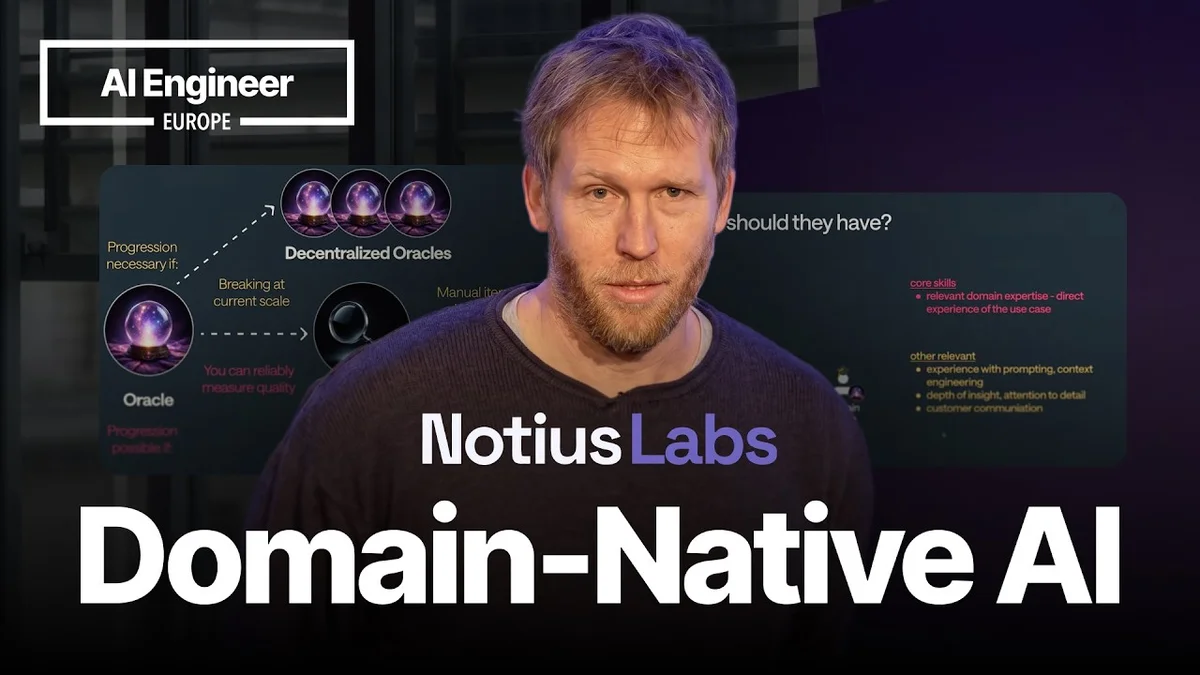
Chris Lovejoy on Building Domain-Native AI Organizations

Chris Lovejoy of Notius Labs discusses the critical role of domain experts in AI product development, outlining three key organizational models: Oracle, Evaluator, and Architect.

8 min read
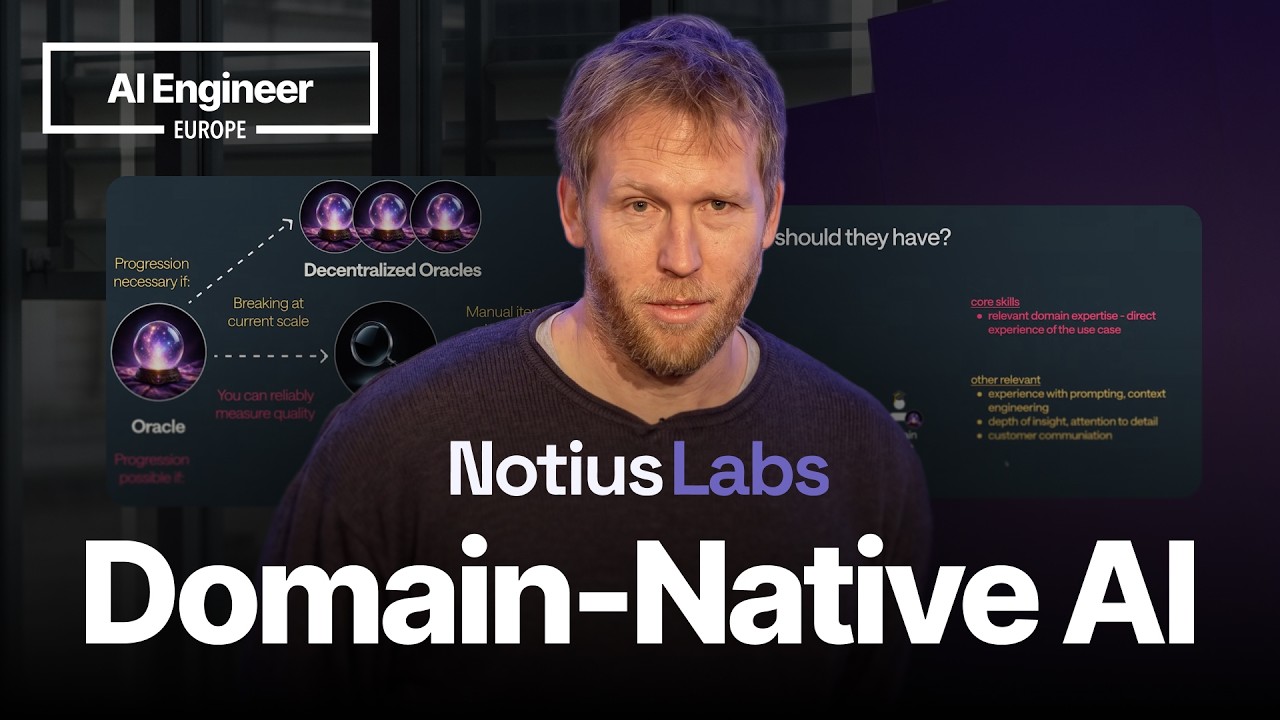
Chris Lovejoy speaking on stage about leveraging domain expertise for AI products.
Image credit: AI Engineer Europe· AI Engineer

Chris Lovejoy, Founder of Notius Labs, shared insights on building effective AI organizations at a recent AI Engineer Europe event. His presentation, "How to Leverage Domain Expertise to Build Better AI Products," emphasized the critical role of domain experts in creating successful AI solutions. Lovejoy argued that the organizational structure and the integration of domain knowledge are more crucial than the underlying AI models themselves.

Chris Lovejoy on Building Domain-Native AI Organizations - AI Engineer
Chris Lovejoy on Building Domain-Native AI Organizations — from AI Engineer

Visual TL;DR. AI Integration Challenges requires Domain Expertise Crucial. Domain Expertise Crucial enables Domain-Native Org. Domain-Native Org includes Oracle Role. Domain-Native Org includes Evaluator Role. Domain-Native Org includes Architect Role. Domain-Native Org leads to Better AI Products. Better AI Products shown by Case Studies.

  1. AI Integration Challenges: organizations struggle to effectively integrate AI into products
  2. Domain Expertise Crucial: domain experts are more vital than AI models themselves
  3. Domain-Native Org: organizing teams around specific business knowledge
  4. Oracle Role: embedding domain expertise directly into AI applications
  5. Evaluator Role: defining and measuring AI quality with metrics
  6. Architect Role: designing systems for continuous AI learning
  7. Better AI Products: creating more successful and effective AI solutions
  8. Case Studies: Granola, Tandem, and Anterior demonstrate success
Visual TL;DR
Visual TL;DR — startuphub.ai AI Integration Challenges requires Domain Expertise Crucial. Domain Expertise Crucial enables Domain-Native Org. Domain-Native Org leads to Better AI Products requires enables leads to AI Integration Challenges Domain Expertise Crucial Domain-Native Org Better AI Products From startuphub.ai · The publishers behind this format
Visual TL;DR — startuphub.ai AI Integration Challenges requires Domain Expertise Crucial. Domain Expertise Crucial enables Domain-Native Org. Domain-Native Org leads to Better AI Products requires enables leads to AI IntegrationChallenges Domain ExpertiseCrucial Domain-Native Org Better AIProducts From startuphub.ai · The publishers behind this format
Visual TL;DR — startuphub.ai AI Integration Challenges requires Domain Expertise Crucial. Domain Expertise Crucial enables Domain-Native Org. Domain-Native Org leads to Better AI Products requires enables leads to AI Integration Challenges organizations struggle to effectivelyintegrate AI into products Domain Expertise Crucial domain experts are more vital than AImodels themselves Domain-Native Org organizing teams around specific businessknowledge Better AI Products creating more successful and effective AIsolutions From startuphub.ai · The publishers behind this format
Visual TL;DR — startuphub.ai AI Integration Challenges requires Domain Expertise Crucial. Domain Expertise Crucial enables Domain-Native Org. Domain-Native Org leads to Better AI Products requires enables leads to AI IntegrationChallenges organizationsstruggle toeffectively… Domain ExpertiseCrucial domain experts aremore vital than AImodels themselves Domain-Native Org organizing teamsaround specificbusiness knowledge Better AIProducts creating moresuccessful andeffective AI… From startuphub.ai · The publishers behind this format
Visual TL;DR — startuphub.ai AI Integration Challenges requires Domain Expertise Crucial. Domain Expertise Crucial enables Domain-Native Org. Domain-Native Org includes Oracle Role. Domain-Native Org includes Evaluator Role. Domain-Native Org includes Architect Role. Domain-Native Org leads to Better AI Products. Better AI Products shown by Case Studies requires enables includes includes includes leads to shown by AI Integration Challenges organizations struggle to effectivelyintegrate AI into products Domain Expertise Crucial domain experts are more vital than AImodels themselves Domain-Native Org organizing teams around specific businessknowledge Oracle Role embedding domain expertise directly intoAI applications Evaluator Role defining and measuring AI quality withmetrics Architect Role designing systems for continuous AIlearning Better AI Products creating more successful and effective AIsolutions Case Studies Granola, Tandem, and Anterior demonstratesuccess From startuphub.ai · The publishers behind this format
Visual TL;DR — startuphub.ai AI Integration Challenges requires Domain Expertise Crucial. Domain Expertise Crucial enables Domain-Native Org. Domain-Native Org includes Oracle Role. Domain-Native Org includes Evaluator Role. Domain-Native Org includes Architect Role. Domain-Native Org leads to Better AI Products. Better AI Products shown by Case Studies requires enables includes includes includes leads to shown by AI IntegrationChallenges organizationsstruggle toeffectively… Domain ExpertiseCrucial domain experts aremore vital than AImodels themselves Domain-Native Org organizing teamsaround specificbusiness knowledge Oracle Role embedding domainexpertise directlyinto AI… Evaluator Role defining andmeasuring AIquality with… Architect Role designing systemsfor continuous AIlearning Better AIProducts creating moresuccessful andeffective AI… Case Studies Granola, Tandem,and Anteriordemonstrate success From startuphub.ai · The publishers behind this format

The Domain-Native AI Organization

Lovejoy outlined a framework for organizing teams around domain expertise, proposing three key roles: Oracle, Evaluator, and Architect. The Oracle role involves directly embedding domain expertise into the AI application, often through prompt engineering or curated data. The Evaluator role focuses on defining and measuring AI quality, establishing metrics and systems to track performance. Finally, the Architect role designs systems that enable continuous learning and improvement through automated feedback loops.

Related startups

He stressed that the choice of approach depends heavily on the specific use case and scale of the AI product. For instance, a startup might begin with a single domain expert acting as an Oracle, but as the product scales and faces challenges like the need for more nuanced quality assessment or the handling of diverse customer needs, the organization may need to transition towards an Evaluator or Architect model.

Addressing Common Mistakes in AI Integration

Lovejoy highlighted common pitfalls companies encounter when integrating AI, including not hiring domain experts early enough, selecting the wrong type of expert, or failing to integrate them effectively into the organizational structure. He asserted that the core challenge lies not just in having the right models, but in operationalizing expert judgment around them.

He presented a decision tree to guide organizations: if AI quality can be measured objectively, the focus shifts to defining and measuring performance. If manual iteration is fast enough, a single domain expert as an Oracle might suffice. However, if manual iteration is too slow, the organization should aim for an Architect role that can automate improvements.

Case Studies: Granola, Tandem, and Anterior

Lovejoy illustrated his points with three case studies:
  • Granola: This company, which uses AI to generate meeting notes, benefited from Jo Barrow, a writer/journalist with extensive research skills. She acted as the primary gatekeeper of AI quality, with her role as an Oracle working well due to the subjective nature of meeting notes and the single core output.
  • Tandem: This medical AI scribe company hired a medical doctor, Roy Pekny, as an early employee. As the product scaled and needed to support a long tail of prompt customizations across various specialties and geographies, the company transitioned to a decentralized Oracle model, hiring doctors from different regions and specialties to manage these nuances.
  • Anterior: Lovejoy's personal experience at Anterior, a prior authorization AI startup, demonstrated a progression from an initial Oracle role (building prompts and code) to an Evaluator role (defining metrics, building review dashboards, and hiring clinicians). Due to the complexities and variations in prior authorization rules, they eventually needed to move towards an Architect role to automate improvements.

These case studies illustrated how the initial approach might evolve as the product and organization scale, emphasizing the need for adaptable roles and a deep understanding of how to integrate domain expertise effectively.

Key Takeaways for Organizations

Lovejoy summarized his advice into three key principles for leveraging domain experts:

  1. Define a Principal Domain Expert: Assigning clear accountability to a single individual can accelerate decision-making and product development by avoiding consensus-building by committee.
  2. Give Them Ownership: Domain experts should be deeply integrated into the product development process, not merely consulted. True ownership allows them to build differentiated products.
  3. Hire for Breadth and Evolve Roles: Seek individuals with relevant domain expertise and a breadth of adjacent skills. Start them in an Oracle capacity and allow their roles to evolve into Evaluator or Architect as the product and organization grow.

Ultimately, Lovejoy concluded that building a successful domain-native AI organization requires a strategic approach to integrating and empowering domain experts throughout the product lifecycle.

© 2026 StartupHub.ai. All rights reserved. Do not enter, scrape, copy, reproduce, or republish this article in whole or in part. Use as input to AI training, fine-tuning, retrieval-augmented generation, or any machine-learning system is prohibited without written license. Substantially-similar derivative works will be pursued to the fullest extent of applicable copyright, database, and computer-misuse laws. See our terms.