
ChatGPT's Personal Finance Capabilities Showcased

ChatGPT demonstrates its prowess in personal finance, from tracking spending and subscriptions to analyzing investment portfolios and aiding in home buying plans.

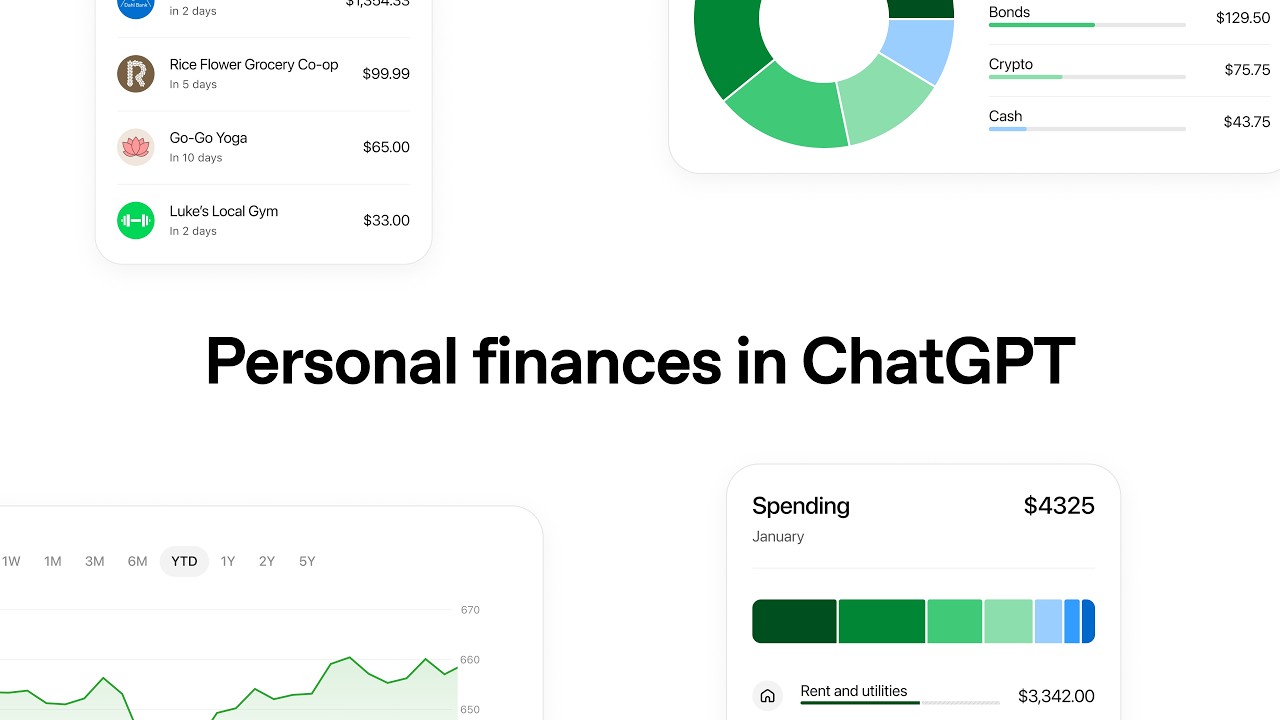
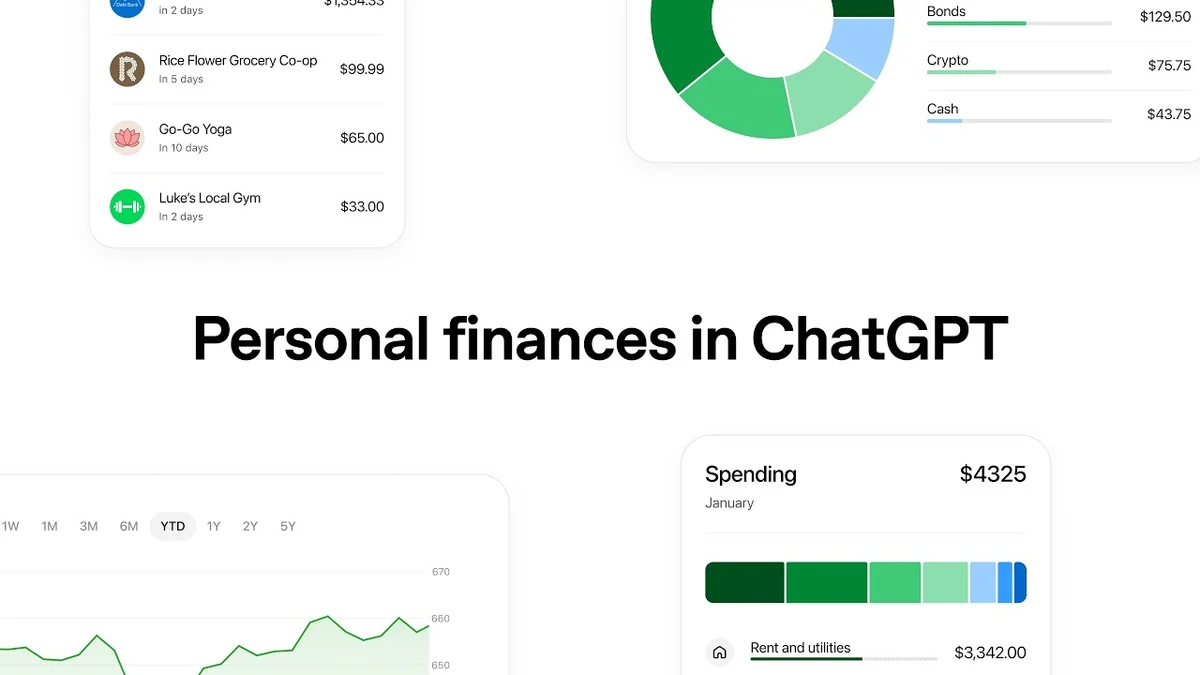
Screenshots showing ChatGPT interface with financial charts, spending breakdowns, and investment portfolio distribution.
OpenAI Youtube
Visual TL;DR
ChatGPT Personal FinanceCore
AI model now handles practical money management tasks
From the article 2 mentionsThe latest demonstration of ChatGPT's capabilities extends beyond conversational AI to practical personal finance management.
Connect Financial AccountsDriver
securely links to banks via Plaid integration
From the articleThe video highlights ChatGPT's ability to securely connect with a user's financial accounts through services like Plaid.
Consolidated Financial ViewEffect
accesses data from Amex, Schwab, Fidelity, Robinhood
From the articleOnce connected, ChatGPT provides a consolidated view of financial activity, enabling users to manage their personal finances more effectively.
Track Spending & SubscriptionsEffect
gain insight into where money is going
From the article 2 mentionsA recent video showcases how the powerful language model can be utilized to track spending, analyze investment portfolios, and even assist in planning for major life goals like purchasing a home.
Analyze Investment PortfolioEffect
assess balance and performance of investments
From the article 2 mentionsA recent video showcases how the powerful language model can be utilized to track spending, analyze investment portfolios, and even assist in planning for major life goals like purchasing a home.
Plan Major GoalsEffect
aid in planning for home buying
From the article 2 mentionsThe AI then suggests a recommended buying target range and outlines a plan, such as paying off credit card balances and allocating funds for a down payment and closing costs, to achieve the goal.
Improved Financial ManagementOutcome
users manage personal finances more effectively
From the articleNevertheless, its ability to process financial data and offer actionable insights represents a significant step forward in leveraging AI for personal financial management.

Contents(5)

The latest demonstration of ChatGPT's capabilities extends beyond conversational AI to practical personal finance management. A recent video showcases how the powerful language model can be utilized to track spending, analyze investment portfolios, and even assist in planning for major life goals like purchasing a home.

StartupHub data

Companies working on this

Profiles of the companies named in this story, with funding and a one-liner from our database.

Bank of America
$4.5B
A multinational investment bank and financial services holding company.
OpenAI
Private / $100B+ est
OpenAI is an AI research and deployment company dedicated to ensuring that artificial general intelligence benefits all of humanity.
Plaid
$13.0B
Plaid provides a data transfer network powering fintech and digital finance products.
Robinhood
$5.6B
Commission-free investing and trading platform for stocks, ETFs, and cryptocurrencies.

Connecting Your Financial World

The video highlights ChatGPT's ability to securely connect with a user's financial accounts through services like Plaid. This integration allows the AI to access data from a wide range of institutions, including American Express, Bank of America, Charles Schwab, Etrade, Fidelity, and Robinhood. Once connected, ChatGPT provides a consolidated view of financial activity, enabling users to manage their personal finances more effectively.

The full discussion can be found on OpenAI Youtube's YouTube channel.

Personal Finance in ChatGPT - OpenAI Youtube
Personal Finance in ChatGPT, from OpenAI Youtube

Gaining Insight into Spending and Subscriptions

One of the key features demonstrated is ChatGPT's capacity to analyze spending patterns. By querying financial data, the AI can categorize expenses and present them in a clear, visual format. For instance, it can break down monthly spending into categories like rent, groceries, subscriptions, and medical expenses. The AI can also identify potential areas for savings. In one scenario, ChatGPT points out that a user is paying for four fitness memberships and suggests consolidating to save money, estimating a monthly saving of $329 by canceling unnecessary subscriptions.

Assessing Investment Portfolio Balance

Beyond day-to-day spending, ChatGPT can also offer insights into investment portfolios. By analyzing holdings across 401(k)s, IRAs, and brokerage accounts, the AI can assess the balance and diversification of an investment strategy. The video shows how ChatGPT can reveal if a portfolio is more heavily weighted towards the U.S. stock market than it appears, potentially reducing true diversification. It identifies issues such as fund overlap, heavy U.S. exposure, and timeline mismatches, offering suggestions for improvement to make the portfolio more resilient.

Planning for Major Financial Goals

The demonstration also illustrates ChatGPT's potential in financial planning for significant objectives. When asked to help create a plan to buy a home, the AI uses the user's location (e.g., Chicago) and financial data to build a practical roadmap. It breaks down the current financial standing, including cash reserves, income, and debt, and considers market conditions like mortgage rates and property taxes. The AI then suggests a recommended buying target range and outlines a plan, such as paying off credit card balances and allocating funds for a down payment and closing costs, to achieve the goal.

The video concludes by emphasizing that while ChatGPT can provide personalized guidance, it is not a replacement for professional financial advice. Nevertheless, its ability to process financial data and offer actionable insights represents a significant step forward in leveraging AI for personal financial management.


© 2026 StartupHub.ai. All rights reserved. You may not republish this article in full without a license. Search engines and AI research tools may crawl and summarize for reference. Bulk reproduction or model training requires a license. See our terms.
Daniel Singer

Written by

Daniel Singer

Editor, StartupHub.ai

Daniel Singer is the editor of StartupHub.ai, a technology expert and thought leader on AI and its applications across sectors, from fintech and healthcare to developer tooling and consumer software. He writes and tests the tools covered here thoroughly and regularly, and built StartupHub.ai to give founders, operators and buyers a clearer read on what they are actually being sold.

More from Daniel Singer