

Bing Adds AI Visibility Tools

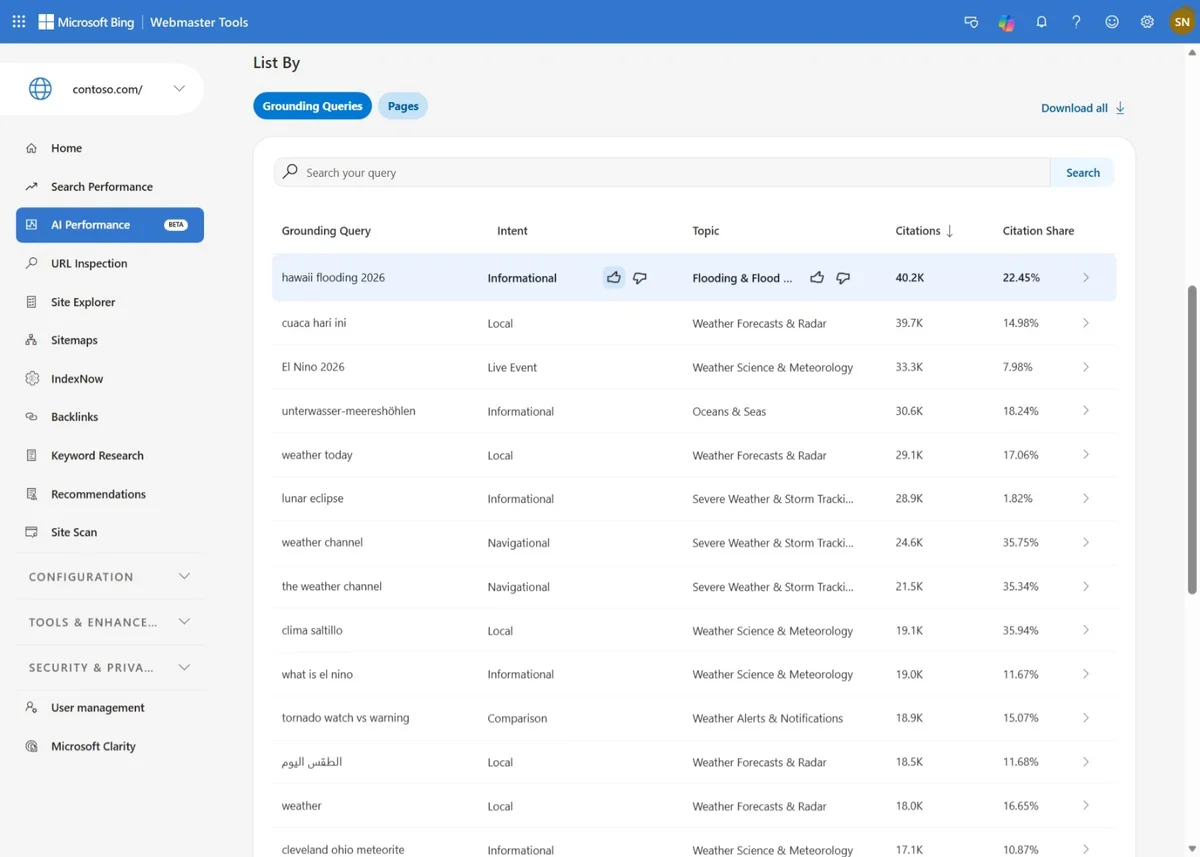
Bing Webmaster Tools introduces AI visibility features: Intents, Topics, Citation Share, and Compare for deeper insights into AI-generated answers.

4 min read
Screenshot of Bing Webmaster Tools dashboard showing AI visibility insights.
Bing Webmaster Tools introduces new features for AI visibility.· blogs.bing.com
Visual TL;DR
AI Answers ChallengeDriver
From the article 5 mentionsThis moves beyond simple citation counts, which are insufficient for dynamic, synthesized AI answers, much like the reporting challenges seen with tools like GitHub's AI Analyst.
Bing AI VisibilityCore
From the article 7 mentionsMicrosoft is expanding Bing Webmaster Tools with new AI visibility features.
New Tools PreviewContext
From the article 5 mentionsIntents, Topics, Citation Share, and Compare are rolling out globally in preview within Bing Webmaster Tools.
Understanding Query IntentContext
classifies grounding queries into Informational, Commercial, Navigational
Thematic VisibilityContext
understand thematic visibility through topics
From the article 8 mentionsThe new features build on this by detailing the 'why' behind content surfacing, thematic visibility, and how a site's presence evolves relative to others.
Citation ShareContext
measure relative visibility compared to competitors
From the article 7 mentionsThe update introduces four preview capabilities: Intents, Topics, Citation Share, and Compare.
Compare Over TimeContext
track changes in visibility over time
From the articleThe Compare feature allows publishers to overlay previous time periods onto current data.
Deeper Publisher InsightsEffect
granular understanding of content surfacing in AI answers

Microsoft is expanding Bing Webmaster Tools with new AI visibility features. The update introduces four preview capabilities: Intents, Topics, Citation Share, and Compare. These tools aim to provide publishers with a more granular understanding of how their content is surfaced in AI-generated answers across Microsoft's AI ecosystem.

Launched earlier this year, the AI Performance Report offered initial visibility into AI-generated answers. The new features build on this by detailing the 'why' behind content surfacing, thematic visibility, and how a site's presence evolves relative to others. This moves beyond simple citation counts, which are insufficient for dynamic, synthesized AI answers, much like the reporting challenges seen with tools like GitHub's AI Analyst.

Understanding Query Intent

The new Intents feature classifies grounding queries into categories such as Informational, Commercial, Navigational, and Learn and Solve. This helps publishers understand the context behind citations, enabling them to better align content with AI experiences. An e-commerce site, for example, might discover strong visibility in comparison-oriented AI answers.

Thematic Visibility Through Topics

Topics group related queries into broader thematic clusters, mirroring how AI systems reason. Instead of analyzing individual keywords, publishers can now understand visibility within subject areas like 'Solar Energy.' This helps identify authority in emerging areas and understand semantic content grouping.

Citation Share: Relative Visibility

Citation Share measures a site's percentage of citations for a specific query against all cited sources. This provides a directional view of evolving visibility, highlighting areas of strong representation or fragmentation. It is an observational metric, not a competitive ranking system.

Compare: Tracking Changes Over Time

The Compare feature allows publishers to overlay previous time periods onto current data. This visual comparison helps track changes in citation activity, correlating shifts with content updates, seasonality, or ecosystem changes. This is crucial for understanding the evolving landscape of AI-generated answers, a challenge also faced by creators navigating systems like Google's AI Search.

These enhancements are part of Microsoft's effort to increase transparency in AI-powered information discovery. Understanding AI citations requires more than raw numbers; it demands context, thematic understanding, and relative presence, much like understanding AI citations in broader agent platforms.

Intents, Topics, Citation Share, and Compare are rolling out globally in preview within Bing Webmaster Tools. Microsoft encourages feedback to refine these capabilities.

© 2026 StartupHub.ai. All rights reserved. Do not enter, scrape, copy, reproduce, or republish this article in whole or in part. Use as input to AI training, fine-tuning, retrieval-augmented generation, or any machine-learning system is prohibited without written license. Substantially-similar derivative works will be pursued to the fullest extent of applicable copyright, database, and computer-misuse laws. See our terms.