AI Boom Triggers Tech Debt Binge

Hyperscalers could add $1.5T in debt before hitting index leverage as J.P. Morgan pegs AI buildout at $5.5T by 2030.

5 min read
Data center servers representing hyperscaler AI infrastructure debt financing
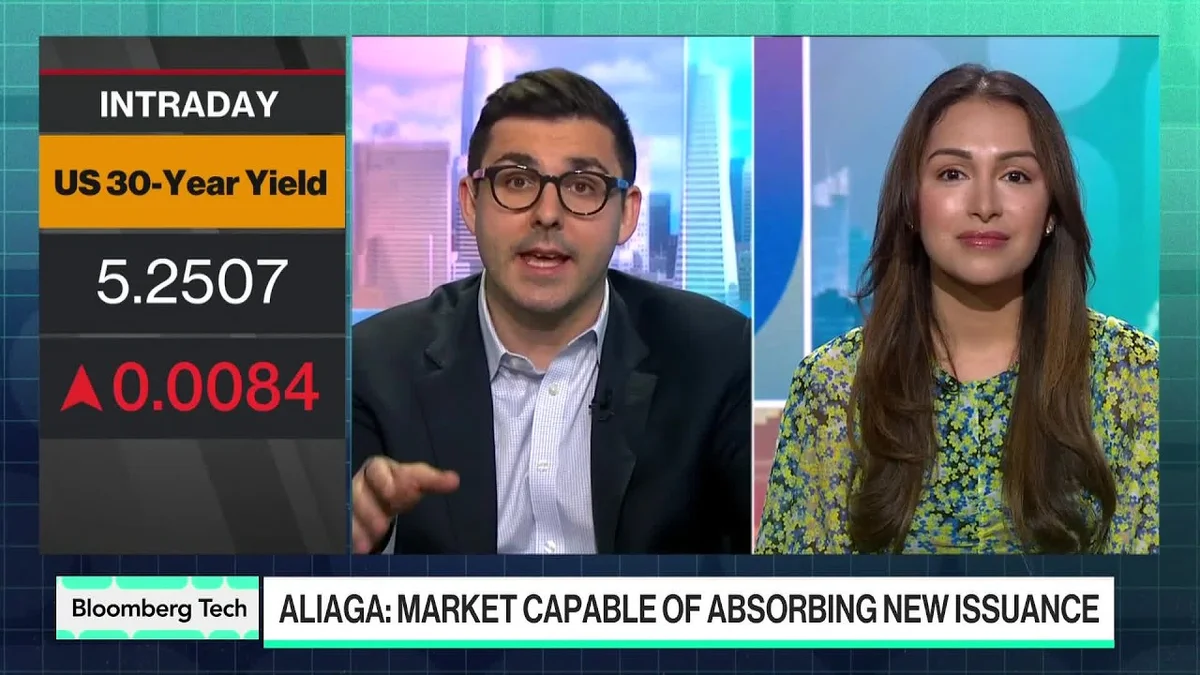
Hyperscaler bond issuance is rising to fund AI data centers, J.P. Morgan says· Bloomberg Technology
Visual TL;DR
AI Buildout SurgeDriver
J.P. Morgan projects $5.5 trillion in AI infrastructure spending by 2030
From the articleIts investment bank estimates the total AI buildout hits $5.5 trillion by 2030, and hyperscaler cash flow covers only a fraction.
Long-End Yields RiseEffect
High-quality hyperscaler debt is one factor lifting long-end yields
From the articleIt's one factor among many lifting long-end yields.
Hyperscalers Pile DebtEffect
From the article 2 mentionsHyperscalers could pile on $1.5 trillion more debt before matching the average lease-adjusted leverage of the investment-grade index, according to Bloomberg Technology.
Nvidia Demand SignalCore
Nvidia earnings flagged as a real-time gauge of hyperscaler capex appetite
AI Buildout SurgeDriver
J.P. Morgan projects $5.5 trillion in AI infrastructure spending by 2030
From the articleIts investment bank estimates the total AI buildout hits $5.5 trillion by 2030, and hyperscaler cash flow covers only a fraction.
Data Center Voter RiskDriver
Local pushback on data centers could slow the multi-year buildout pipeline
From the articleDebt also makes the AI boom more sustainable when matched to data centers built to last five to ten years or more.
Hyperscalers Pile DebtEffect
From the article 2 mentionsHyperscalers could pile on $1.5 trillion more debt before matching the average lease-adjusted leverage of the investment-grade index, according to Bloomberg Technology.
Nvidia Demand SignalCore
Nvidia earnings flagged as a real-time gauge of hyperscaler capex appetite
Tech Share of Issuance GrowsEffect
Tech bond issuance expanding faster than the broader investment-grade market
From the article 2 mentionsTech is still a small share of the overall bond market.
Tech Stocks ImplicationOutcome
Rising debt load and yields could pressure tech valuations into 2026
Long-End Yields RiseEffect
High-quality hyperscaler debt is one factor lifting long-end yields
From the articleIt's one factor among many lifting long-end yields.
Market Absorbs SupplyOutcome
Demand has stayed ample even when spreads widen during heavy issuance windows
From the article 2 mentionsMorgan sees the market as capable of digesting the supply without a sustained dislocation.
Contents(6)

The tech debt binge is accelerating, and the bond market is feeling it. Hyperscalers could pile on $1.5 trillion more debt before matching the average lease-adjusted leverage of the investment-grade index, according to Bloomberg Technology.

Tech is still a small share of the overall bond market.

The full discussion can be found on Bloomberg Technology's YouTube channel.

AI Boom Fuels a New Tech Debt Binge - Bloomberg Technology
AI Boom Fuels a New Tech Debt Binge, from Bloomberg Technology

As a share of new issuance, it's growing fast. J.P. Morgan expects that trend to continue.

How much is tech pushing global yields?

It's one factor among many lifting long-end yields. The debt is high quality, with hyperscaler leverage running well below the broader index average.

Headlines about another multi-billion dollar hyperscaler deal do move spreads intraday, but the broader rate impact so far stays incremental.

Can the market absorb the flood?

Demand has been ample, even when spreads widen during heavy issuance windows. J.P. Morgan sees the market as capable of digesting the supply without a sustained dislocation.

Debt also makes the AI boom more sustainable when matched to data centers built to last five to ten years or more.

Will hyperscalers keep issuing?

Yes. J.P. Morgan expects issuance to continue through year-end and beyond.

Its investment bank estimates the total AI buildout hits $5.5 trillion by 2030, and hyperscaler cash flow covers only a fraction. Public debt, private debt, SPV structures and government capital will fill the gap.

What does this mean for tech stocks?

Operating cash flow is now neck and neck with CapEx this year, so leverage hasn't yet outrun earnings power. More important, backlog growth for the top three hyperscalers is outpacing CapEx growth, with signed cloud commitments stretching years into the future.

That visibility helps justify the spend. CapEx should eventually decelerate, offering relief for margins and free cash flow.

What did Nvidia signal about demand?

Nvidia guided to 70% top-line growth in fiscal 2028, and said it would have been near 100% without supply constraints. That framing matters because it points to supply, not demand, as the limiter.

Customers are scrambling for compute and signing medium to longer-term contracts, which keeps the funding case intact while the market stays supply constrained.

Will voter pushback on data centers derail the buildout?

J.P. Morgan sees it as a headwind that shifts economics rather than halts construction. Negotiations with state and local officials are pushing more cost onto hyperscalers and off taxpayers, with outcomes varying by jurisdiction.

Benefits of AI are diffuse while costs stay local, so policy action may be needed to balance them. Misinformation around who pays and who benefits remains a friction point.

The bottleneck now is not willingness to borrow. It's how fast supply and cost curves can catch up to demand.

© 2026 StartupHub.ai. All rights reserved. You may not republish this article in full without a license. Search engines and AI research tools may crawl and summarize for reference. Bulk reproduction or model training requires a license. See our terms.