

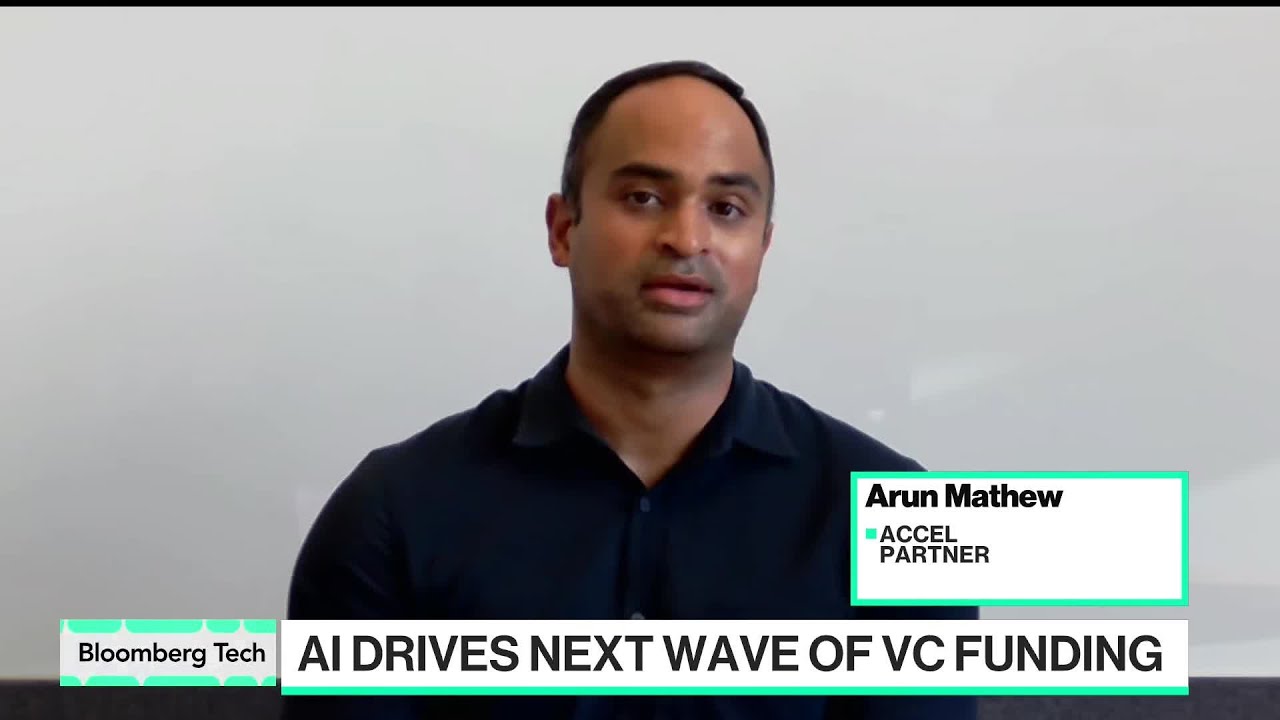
In a recent appearance on Bloomberg Technology, Arun Mathew, an Accel Partner, discussed the significant surge in venture capital funding being directed towards Artificial Intelligence (AI) startups. Mathew, a seasoned investor known for his early-stage investments, highlighted the cyclical nature of technology adoption, noting that AI represents the current frontier for innovation and investment.
The full discussion can be found on Bloomberg Technology's YouTube channel.
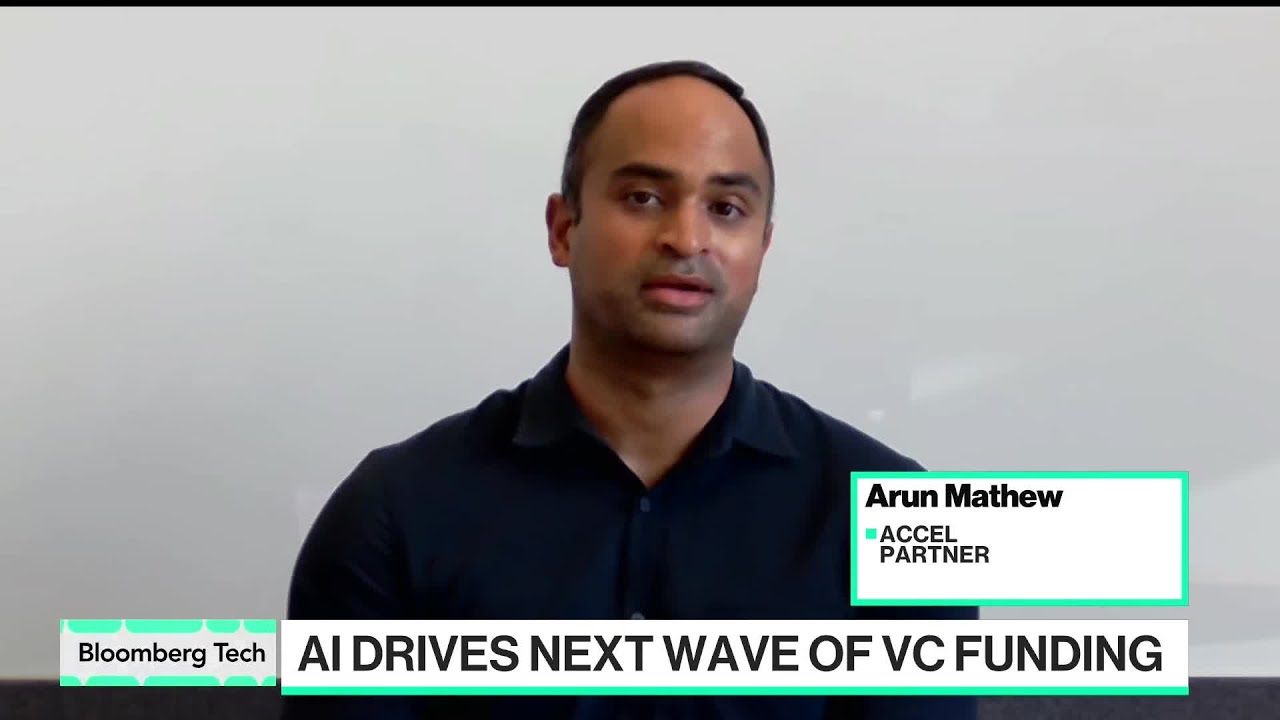
Arun Mathew's Perspective on AI Investment
Arun Mathew, an Accel Partner, is a prominent figure in the venture capital landscape, with a track record of identifying and backing successful technology companies. Accel, a leading venture capital firm, has a robust portfolio that includes companies like Discord, Flipkart, and Slack, demonstrating their ability to spot transformative trends early on. Mathew's insights into the current AI investment climate are particularly valuable given his firm's strategic focus on emerging technologies.
The AI funding landscape: Foundational vs. Application Layer
Mathew elaborated on the current investment trends within AI, drawing a distinction between foundational models and the application layer. He noted that historically, much of the investment in new computing paradigms has focused on the underlying infrastructure. However, he observed a shift where a substantial amount of recent funding is now flowing into the application layer of AI, aiming to leverage these foundational models for practical use cases.
Mathew stated, "If you look at the history of technology and computing, the application layer is actually where most of the value has been created. And if you look at the last three or four years, so much of the investment has gone into foundational models and the infrastructure layer to now power the application layer in AI." This suggests a maturation of the AI ecosystem, moving from pure research and development to tangible productization.
Concerns of a Bubble in Foundational AI
Despite the immense potential, Mathew acknowledged concerns about potential overvaluation in the foundational AI space. He noted that while his firm is actively investing in this area, there is a sentiment among some investors that the current valuations might be approaching bubble territory.
"We've had companies on the show, like Legora, who just raised funds, and they're on the AI legal sector. And thinking about the applications of AI, is that where you're thinking about? There's still room to run in terms of valuation and value add," Mathew remarked, contrasting the perceived sustainability of application-focused AI companies with the more speculative nature of some foundational AI ventures. He further elaborated, "When you speak to other key VCs and look at the massive amounts of funding going into these foundational models, you get the sense that maybe you're not getting it. Like, they're saying, 'you're not getting it,' the value that we're about to see is on the very beginning of this." This indicates a divergence in perspectives on the current market dynamics.
The Power of AI in Reimagining Work
Mathew emphasized that AI's impact extends beyond just creating new software; it's about fundamentally rethinking how work is done. He posited that AI is enabling a reinvention of work, leading to increased productivity and new forms of value creation.
"I think it's a different paradigm. It's the reinvention of work," Mathew stated. "And I think legal is a really good example of this. If you look at legal software, that's a $5-10 billion revenue market globally." He highlighted that a significant portion of this market, estimated to be between 5% and 15%, could be transformed by AI-driven solutions, creating a substantial opportunity for innovation and growth.
He further elaborated on the potential for AI to augment human capabilities: "So, you have this divergence in the market. People that think about this as productivity enhancers, for humans, just as the next evolution of software. And others that think about this as a reinvention of work. And I think that's where you see this divergence in the market."
The Future: Agile AI Agents and Ecosystems
Looking ahead, Mathew envisions a future where AI agents are seamlessly integrated into everyday workflows, both personally and professionally. He anticipates that this will lead to a more distributed and intelligent ecosystem of tools and services.
"We're seeing companies in our portfolio that are growing faster than we've ever seen before. I mean, the numbers are astronomical," Mathew shared, underscoring the rapid adoption and growth potential of successful AI companies. He believes that the future will not be dominated by a single monolithic AI provider, but rather a diverse ecosystem of specialized AI agents.
"It's not going to be one company that owns it all, soup to nuts. It's not going to be the model companies, it's not going to be the hardware players, it's not going to be one single application company," Mathew predicted. "There are going to be a number of players that are in agile AI platforms that are going to provide this, this agent for personal and professional use cases. And I think that's where the future is going."
Addressing the "Bubble" Narrative
When questioned about the possibility of a bubble, particularly in relation to companies like Nvidia and their role in AI, Mathew acknowledged the common critique that some AI companies might be perceived as mere wrappers for underlying technologies.
"The criticism to that is that they're just wrappers for something more substantive underneath, usually Anthropic at this moment in time," Mathew explained. "What's the point?" he questioned, reflecting the skepticism some investors might have about the true innovation and value creation in certain AI startups.
Mathew countered this by emphasizing the tangible value and demonstrable progress of many AI companies. "I think that's where the future is going. I think it's an awakening moment for the entire industry," he asserted. "And this is one way I think that you can look at it: will there be a fallout? Yes. There are going to be bubbles, there are going to be companies that are not winners. But the actual winners are going to be incredibly successful."
He concluded by highlighting the importance of rigorous execution and genuine value creation: "I think there are going to be fewer companies that are actually winners in this next era. And you invest in companies that are doing incredibly well, innovating at a rapid pace, intelligence is increasing at an exponential curve, even faster than what we anticipated. At the same time, the last mile of delivering real value to the end customer is really hard. It's security, there's compliance. We talked about deploying forward engineers into a lot of these organizations. That's going to transform how management works." Mathew's outlook suggests a belief in the transformative power of AI, with the caveat that successful companies will be those that can effectively navigate the complexities of implementation and deliver tangible value.
