

AI Agents: CLI vs. MCP for Tool Selection

IBM's Martin Keen explains how AI agents use CLI commands or the more descriptive Model Context Protocol (MCP) to select and utilize tools, highlighting the benefits of structured data for AI.

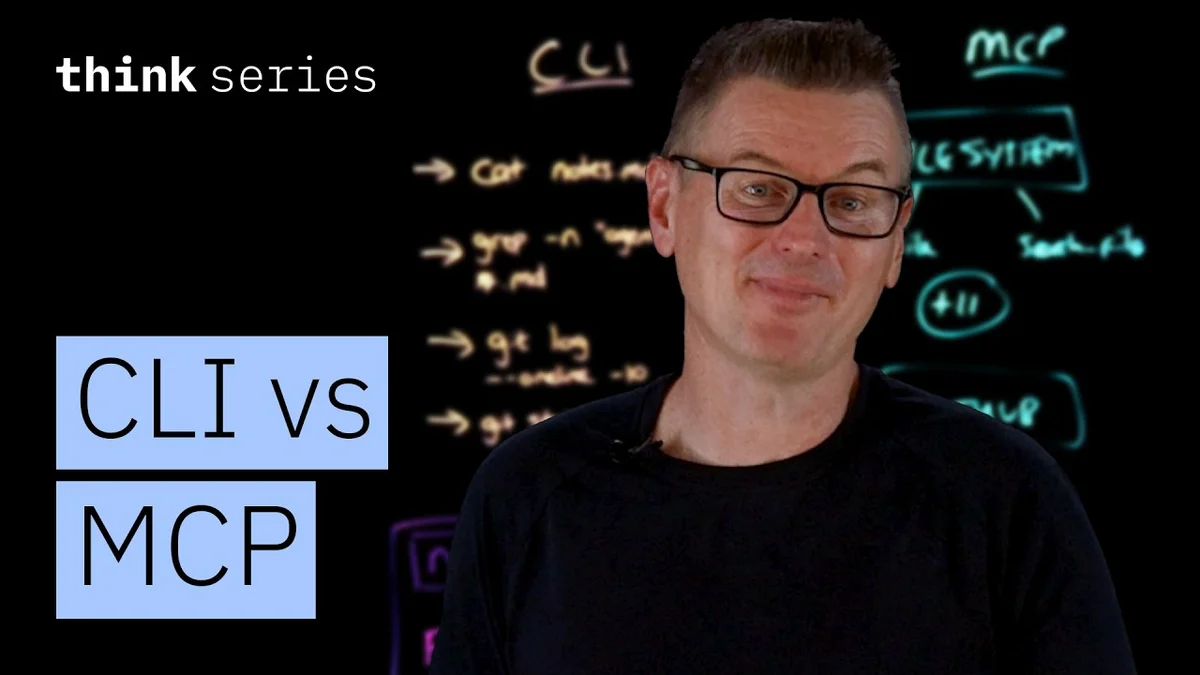
Martin Keen from IBM explaining CLI vs MCP for AI agents.
Image credit: IBM· IBM

In the rapidly evolving world of AI agents, the ability to effectively select and utilize tools is paramount. A recent video titled "CLI vs MCP: How AI Agents Choose the Right Tool for the Job" delves into the distinct methods AI agents employ to interact with the outside world. The presentation, featuring Martin Keen, a Master Inventor at IBM, highlights the fundamental differences between Command Line Interface (CLI) and Model Context Protocol (MCP) approaches to tool selection.

Understanding the Interfaces

Keen begins by defining the Command Line Interface (CLI) as a way for AI agents to interact with the outside world by running commands. He illustrates this with examples of common CLI commands like 'ls', 'cat', 'grep', and 'curl', explaining that these commands are what a developer would typically type into a terminal.

In contrast, the Model Context Protocol (MCP) is presented as a more structured and descriptive method. An MCP tool, Keen explains, has a name and a description that clearly outlines what the tool does. Crucially, it also includes a schema that precisely defines the expected inputs and outputs of the tool. This structured information allows AI agents to understand and utilize tools with greater accuracy and less ambiguity.

The full discussion can be found on IBM's YouTube channel.
CLI vs MCP: How AI Agents Choose the Right Tool for the Job - IBM
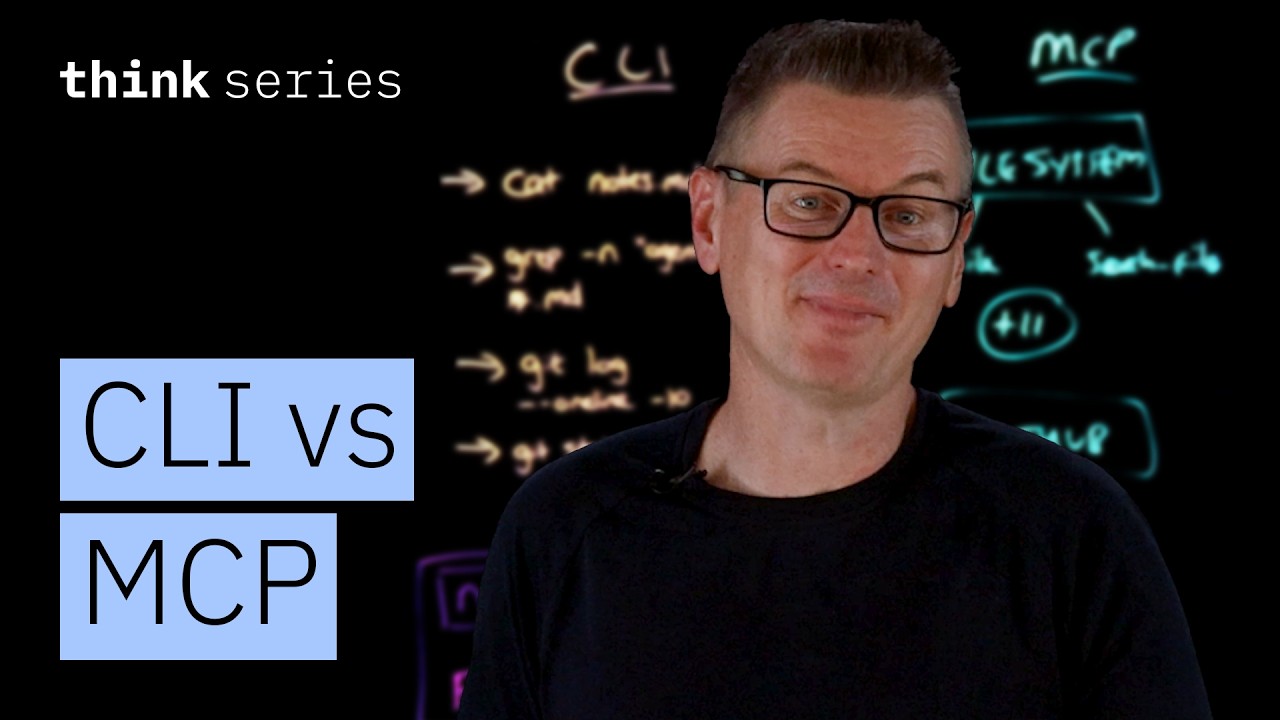
CLI vs MCP: How AI Agents Choose the Right Tool for the Job — from IBM

The Trade-offs: Simplicity vs. Richness

The core of Keen's explanation centers on the trade-offs between these two approaches. With CLI tools, the AI agent relies on its pre-existing training data, which includes countless examples of CLI commands and their usage. This allows agents to infer the correct command and its associated flags based on the task at hand. Keen notes that while this method is efficient and can often be more concise, it can also lead to a "gap in the tools" if the agent's training data doesn't cover a specific command or its nuances.

MCP, on the other hand, provides explicit definitions for each tool. This means the AI agent doesn't need to infer as much; the information is readily available. Keen demonstrates this by showing how an MCP tool like a 'fetcher' might have a 'fetch-url' input and provide the fetched content as output. This explicit definition helps to reduce errors and improve the reliability of the agent's tool usage, especially for more complex or novel tasks.

Demonstrating the Difference

Keen illustrates these concepts with practical examples. He shows how an AI agent might attempt to read and search files using basic CLI commands like 'cat notes.md' and 'grep -n "agent" *.md'. He then contrasts this with the MCP approach, where the agent uses a 'read-file' and 'search-file' tool, each with defined schemas. The demonstration highlights how the MCP approach provides a richer context for the AI, allowing it to more reliably perform tasks like fetching and processing web pages.

A key takeaway from Keen's examples is the efficiency and robustness that MCP offers. While CLI commands are often more succinct, the explicit nature of MCP tools, including their names, descriptions, and JSON schemas, provides a more comprehensive understanding for the AI. This can be particularly beneficial when dealing with a wide array of tools or when the task requires precise input and output handling.

The Future of AI Agent Tooling

Keen concludes by emphasizing that while CLI commands have been the traditional way for agents to interact with tools, the increasing complexity of AI tasks points towards the growing importance of structured protocols like MCP. The ability of MCP to provide explicit, machine-readable definitions for tools can lead to more reliable, efficient, and less error-prone AI agent behavior. The choice, ultimately, depends on the specific application and the desired level of precision and control.

© 2026 StartupHub.ai. All rights reserved. Do not enter, scrape, copy, reproduce, or republish this article in whole or in part. Use as input to AI training, fine-tuning, retrieval-augmented generation, or any machine-learning system is prohibited without written license. Substantially-similar derivative works will be pursued to the fullest extent of applicable copyright, database, and computer-misuse laws. See our terms.