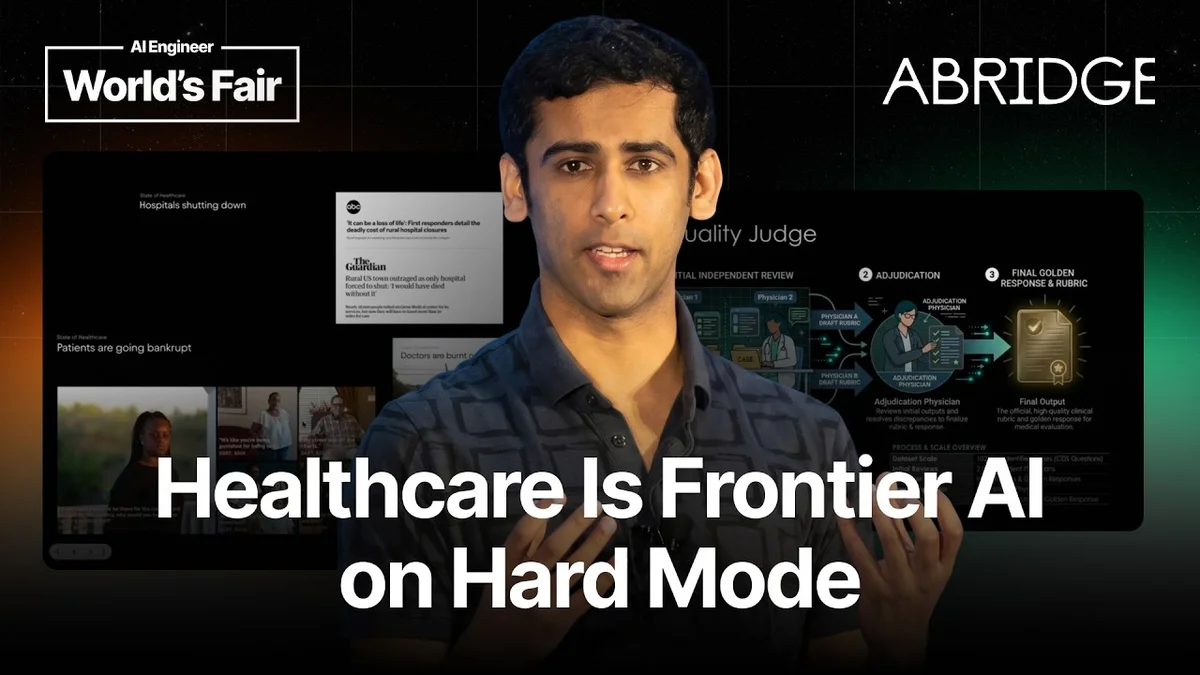
Abridge's Chai Asawa on AI's High-Stakes Role in Healthcare

Abridge's Chai Asawa discusses the challenges and opportunities of AI in healthcare, focusing on clinical documentation, intelligence, and high-stakes evaluation.

Chaitanya Asawa speaking at a podium with Abridge's 'AI Engineer World's Fair' logo.
AI Engineer
Visual TL;DR
Clinician BurnoutDriver
spending up to two hours daily on notes, often during 'pajama time'
From the article 4 mentionsSpeaking at an AI Engineer World's Fair event, Asawa detailed how Abridge is tackling challenging problems to improve patient care and reduce clinician burnout.
High-Stakes AIContext
AI in healthcare requires rigorous evaluation due to critical patient impact
From the article 3 mentionsAbridge's work demonstrates that applying AI in this high-stakes environment is not only possible but also essential for driving progress and improving outcomes.
Cost & LatencyDriver
addressing challenges of making AI solutions affordable and fast
From the article 3 mentionsOperating at the scale of 100 million medical conversations annually requires careful consideration of cost and latency.
Abridge's AI DocumentationCore
automating note-taking process, scaling to over 300 health systems
From the article 9+ mentionsAbridge started by addressing the critical need for efficient clinical documentation.
Improved Provider SatisfactionOutcome
reducing documentation burden, enabling more patient interactions
From the articleAbridge's initial product successfully scaled to over 300 health systems by automating this process, improving provider satisfaction and enabling them to see more patients.
Clinical IntelligenceEffect
moving beyond notes to derive deeper insights for patient care
From the article 8 mentionsBy capturing and analyzing these conversations, Abridge aims to automate administrative tasks and unlock clinical intelligence for various applications, including clinical trial matching, care management, and clinical decision support.
Better Patient CareOutcome
ultimate goal of Abridge's AI applications in healthcare
From the articleSpeaking at an AI Engineer World's Fair event, Asawa detailed how Abridge is tackling challenging problems to improve patient care and reduce clinician burnout.
Contents(5)

Chaitanya Asawa, a leader in engineering teams at Abridge, recently shared insights into the company's journey from clinical documentation to clinical intelligence, highlighting the complex and high-stakes nature of applying AI in healthcare. Speaking at an AI Engineer World's Fair event, Asawa detailed how Abridge is tackling challenging problems to improve patient care and reduce clinician burnout.

Abridge's Chai Asawa on AI's High-Stakes Role in Healthcare - AI Engineer
Abridge's Chai Asawa on AI's High-Stakes Role in Healthcare, AI Engineer

The Abridge Mission: From Documentation to Intelligence

Abridge started by addressing the critical need for efficient clinical documentation. Asawa explained that clinicians often spend up to two hours daily writing notes, frequently during "pajama time" after work, a significant contributor to burnout. These notes are vital, serving as the basis for billing and providing crucial context for future care. Abridge's initial product successfully scaled to over 300 health systems by automating this process, improving provider satisfaction and enabling them to see more patients.

The company's vision extends beyond documentation. Asawa outlined Abridge's core thesis: that every aspect of healthcare revolves around the conversation between doctors and patients. By capturing and analyzing these conversations, Abridge aims to automate administrative tasks and unlock clinical intelligence for various applications, including clinical trial matching, care management, and clinical decision support.

Healthcare's Unique AI Challenges

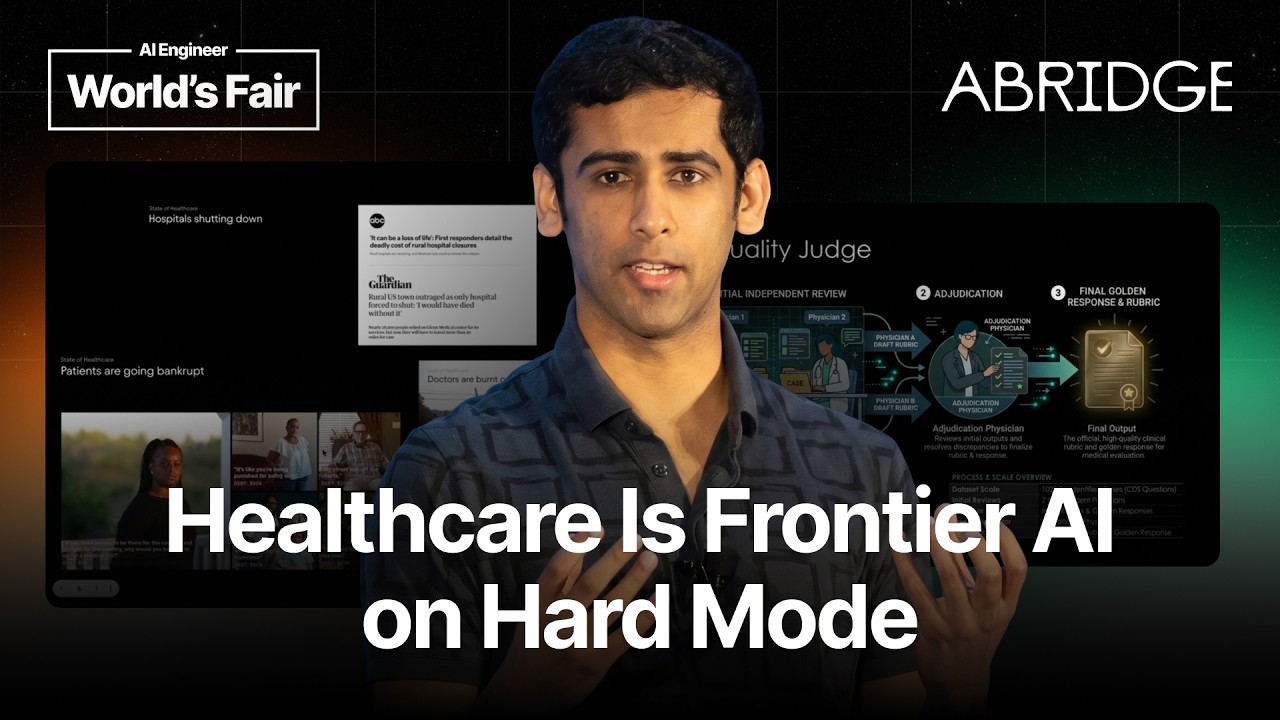
Asawa emphasized that healthcare presents a particularly challenging environment for AI development, likening it to playing on "hard mode." Key performance indicators (KPIs) such as quality, latency, and cost are all critical, especially in high-stakes scenarios like clinical decision support. Unlike other fields where an incorrect answer might be a minor inconvenience, in healthcare, errors can have severe consequences, eroding trust. Asawa stated, "Quality needs to be absolutely high and I'll talk a little about how we keep that bar high."

The industry also faces systemic issues. Asawa pointed to the rising administrative costs and stagnant productivity in healthcare, a phenomenon often described as "Baumol's cost disease." He noted that while other industries have seen costs decrease due to technological advancements and increased productivity, healthcare has struggled to keep pace. This disparity is partly because technology has not been as deeply integrated into healthcare as in other sectors.

Rigorous Evaluation for High-Stakes AI

Maintaining the highest quality standards is paramount for Abridge. Asawa highlighted that "evals are the operating system, the life's blood of the company." This process begins with internal benchmarks and offline evaluation before any product is deployed. Following this, a staged rollout is implemented, starting with alpha groups of trusted clinicians. This phased approach allows for contact with real-world scenarios, acknowledging that offline testing may not perfectly capture practical complexities. Even after full deployment, continuous monitoring is essential.

A key element of Abridge's evaluation strategy involves "expert-calibrated LLM judges." Since not all team members are clinicians, the company encodes clinician judgment into AI judges. This system is designed to reflect desired product behaviors, ensuring that the AI meets the needs of its end-users, healthcare providers. Online signals, such as user edits to notes and feedback ratings, further refine the models.

From Clinical Notes to Clinical Intelligence

Asawa provided a glimpse into Abridge's future, showcasing how the platform is evolving to offer more advanced clinical intelligence. He demonstrated a scenario where a physician could ask Abridge, "Hey Abridge, is Neaten eligible for any clinical trials?" The AI then analyzes EHR data, live conversation, and medical literature to provide a contextual answer, even identifying the need for further tests like an echocardiogram and offering to place the order.

The company is also working on agentic experiences that can revolutionize the entire patient visit, from pre-visit suggested topics to post-visit summaries and order penning. This is enabled by integrating various data sources: EHR context, the live doctor-patient conversation, and world medical literature. This holistic approach allows Abridge to provide highly accurate and contextually relevant support.

Addressing Cost and Latency

Operating at the scale of 100 million medical conversations annually requires careful consideration of cost and latency. Abridge addresses this by breaking down complex problems into smaller workflows and post-training specialized models. Asawa explained, "Healthcare is actually many specific workflows. You don't need, you know, Fable 5 to actually solve all of your clinical notes. We we don't need frontier level intelligence for every problem." This strategy allows for the use of smaller, more cost-effective models, while the unique dataset of medical conversations provides a competitive edge in training specialized models that can potentially outperform general frontier models on specific healthcare tasks.

Ultimately, Asawa conveyed a powerful message: healthcare is a domain that not only needs frontier AI but also rigorously tests its capabilities. Abridge's work demonstrates that applying AI in this high-stakes environment is not only possible but also essential for driving progress and improving outcomes.

© 2026 StartupHub.ai. All rights reserved. You may not republish this article in full without a license. Search engines and AI research tools may crawl and summarize for reference. Bulk reproduction or model training requires a license. See our terms.

Watch

The videos behind the news, one flip at a time

The feed mixes the videos from our articles with startup demos and you flip through them like TV channels for free with no signup.

Daniel Singer

Written by

Daniel Singer

Editor, StartupHub.ai

Daniel Singer is the editor of StartupHub.ai, a technology expert and thought leader on AI and its applications across sectors, from fintech and healthcare to developer tooling and consumer software. He writes and tests the tools covered here thoroughly and regularly, and built StartupHub.ai to give founders, operators and buyers a clearer read on what they are actually being sold.