

70% Automated Means Nothing Without a Boundary

Soukaïna Abelhad told AI Engineer that 70% automated claims fail unless they survive arithmetic, definition and quality checks.

Speaker presenting technical due diligence checks on AI automation claims
AI Engineer

Soukaïna Abelhad told AI Engineer that a deck claiming 70 percent automated collapses unless it survives arithmetic, definition and evaluation checks, and as of no major prediction venue prices that claim so there is no volume, no odds and no move to trade on, which leaves buyers without market signal.
70% Automated Means Nothing Without a Boundary - AI Engineer
70% Automated Means Nothing Without a Boundary, AI Engineer

She argued the dangerous number is often a real measurement stretched beyond its boundary, citing a controlled experiment where 95 developers built a JavaScript HTTP server against 12 tests that showed 55 point 8 percent faster completion but does not support an enterprise automation rate.

Her first check is arithmetic from Faros telemetry on more than 10,000 developers across 1,255 teams, where high AI adoption teams merged 98 percent more pull requests while review time rose 91 percent and pull request size grew 154 percent, so workload and human review tracked together rather than showing labor removal.

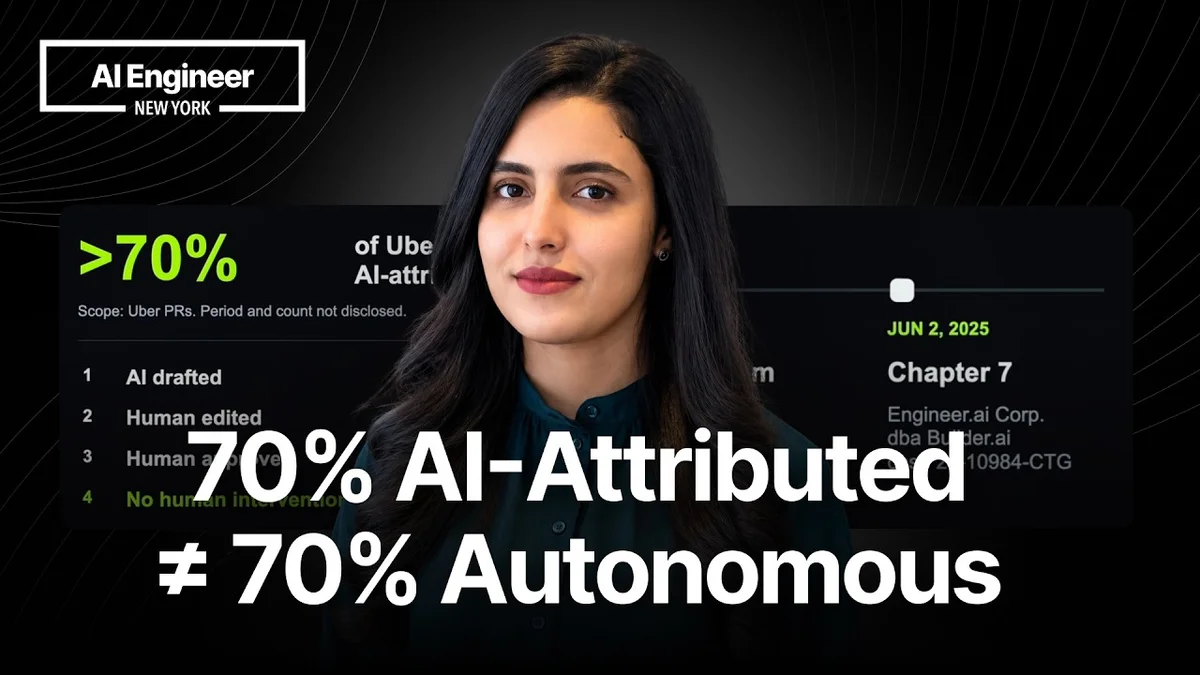
Her second check separates AI attributed from autonomous, noting Uber said 70 percent of pull requests are AI attributed but disclosed no period or total count and no straight-through processing boundary from draft to production, the finance term she uses for end to end without human hands.

Her third check is who judges quality, pointing to a Meta review where four maintainers blindly reviewed 296 AI generated pull requests and found a 24 point gap between the automated grader and human merge decisions, a mismatch she said she has seen when 10 of 10 automated passes barely survive expert review.


The gap echoes beyond code, as Abelhad noted Builder.ai saw its 2024 revenue estimate revised from 220 million dollars to roughly 55 million dollars per the Financial Times before its June 2 Chapter 7 filing, while the vLLM disclosure that 48 percent of contributions were AI attributed but not 48 percent automated shows the same attribution confusion persists in open source per Towards AI.

Not financial advice.

Markets move fast.

© 2026 StartupHub.ai. All rights reserved. You may not republish this article in full without a license. Search engines and AI research tools may crawl and summarize for reference. Bulk reproduction or model training requires a license. See our terms.

Watch

The videos behind the news, one flip at a time

The feed mixes the videos from our articles with startup demos and you flip through them like TV channels for free with no signup.

Daniel Singer

Written by

Daniel Singer

Editor, StartupHub.ai

Daniel Singer is the editor of StartupHub.ai, a technology expert and thought leader on AI and its applications across sectors, from fintech and healthcare to developer tooling and consumer software. He writes and tests the tools covered here thoroughly and regularly, and built StartupHub.ai to give founders, operators and buyers a clearer read on what they are actually being sold.