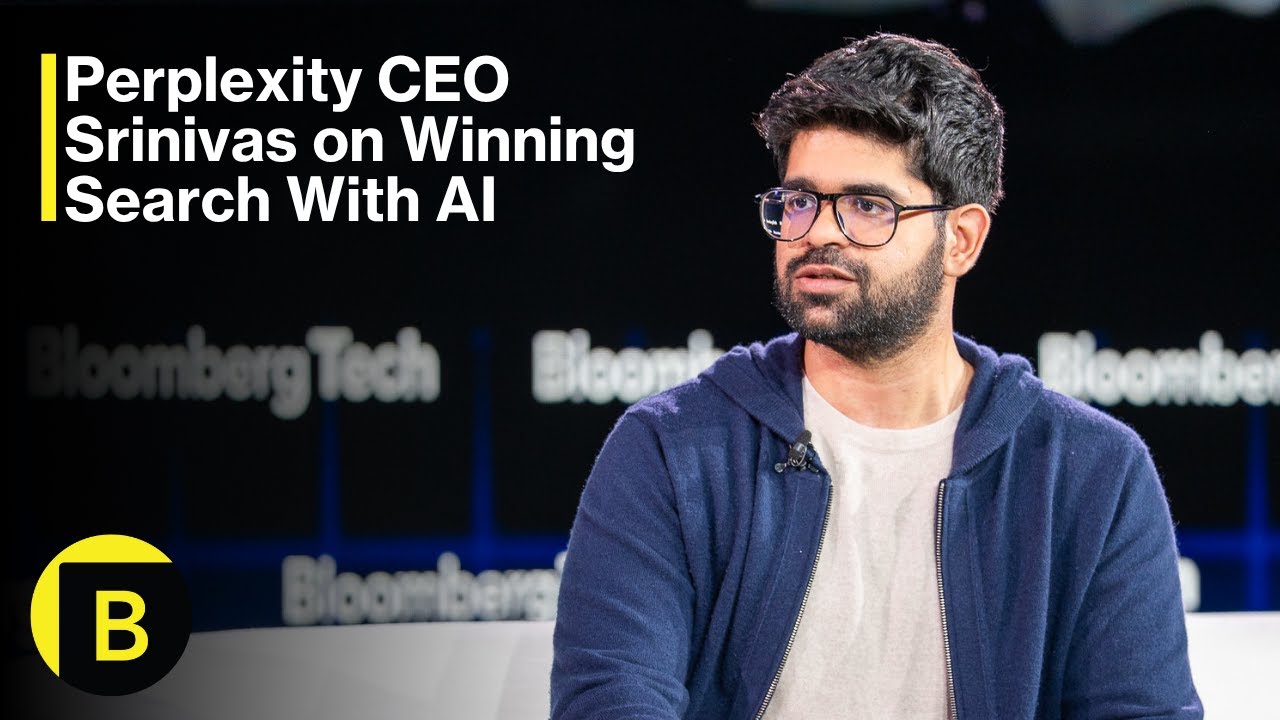
"People made fun of us saying in AI, hallucination is meant to be a feature, not a bug." So declared Aravind Srinivas, co-founder and CEO of Perplexity, cutting through the prevailing industry narrative with a characteristic blend of frankness and conviction. His statement, delivered during a candid conversation at Bloomberg Tech with AI reporter Shirin Ghaffary, wasn't just a quip; it was a foundational insight into Perplexity’s audacious mission to redefine how we interact with information online, directly challenging the entrenched behemoth that is Google.
Srinivas, himself a former intern at Google DeepMind and an early employee at OpenAI, offered a unique perspective from inside and outside the AI giants. He recounted his time at DeepMind in 2019, describing it as "almost like a different company," focused on "crazy visions of how AI will just be a scientist by itself." This pursuit of Artificial General Intelligence, he noted, stood in stark contrast to Google’s product-oriented approach at the time. After a stint at OpenAI, Srinivas and his co-founders decided to build Perplexity, not as a direct Google replacement, but as a tool they themselves desperately needed. “We just built it because it was really useful to us,” he explained, recounting a personal anecdote about navigating health insurance as a new CEO, a task Google’s ad-laden search couldn’t simplify. This deeply personal origin story underlines Perplexity’s core insight: the internet needs an “answer machine,” not just a list of links.
This vision of an "answer machine" is Perplexity's first core insight and its fundamental differentiator. Srinivas proudly asserted, "We were the first to reimagine search... in the form of conversations and answers with trusted sources." He pointed out that while "everybody else has integrated search too," Perplexity pioneered the model where AI doesn't hallucinate but instead "pulls sources and summarizing what humans are saying." This commitment to verifiability and transparency, a stark contrast to the early "hallucination as a feature" mindset, became the blueprint for subsequent chatbots, including those from the very companies that initially doubted Perplexity’s approach. The implication is clear: Perplexity set the standard for trustworthy AI search, forcing others to follow suit.
The second, and perhaps most critical, insight from Srinivas is his sharp analysis of Google's strategic paralysis. He contends that Google, despite its immense resources, including the "best models," "best index," "best infrastructure," and even its "own hardware", is inherently constrained by its advertising-driven business model. "Every year it's the same feature announced... the feature never gets shipped to the user," Srinivas observed, referring to Google's annual AI announcements. He highlighted how Google's need for ad revenue prevents it from truly transforming its search experience. "If you can go and ask like, what are the best sneakers for you to buy... how are you going to charge all these people for money?" he challenged, pointing out that Google's current search model prioritizes monetizable clicks over direct, unbiased answers. "They have literally zero incentive to tell you like which plan to pick or which provider to go for." This deep-seated conflict, Srinivas argues, means Google "cannot ship it," referring to a truly AI-native search experience that prioritizes user answers over ad placements.
Perplexity’s audacious next step, and Srinivas’s third core insight, is its pivot towards the browser as the ultimate battleground for AI. Recognizing that "most people are just using Google as a navigational tool" for simple, one-word queries like "weather" or "Amazon," Srinivas believes the future lies in blending navigation, information, and activity into a single, seamless interface. "If you can blend navigation, information, and activity... all in like one clean interface... you can actually like go for it all," he explained. This led to the development of Comet, Perplexity’s new browser, which Srinivas envisions not merely as "yet another browser" but as a "cognitive operating system." This ambitious move is predicated on the idea that "people are increasingly living on the internet," and for a "proactive personalized AI" to truly assist, "it needs to live together with you." The browser, as the primary front-end to the internet, offers the ideal platform for such a pervasive, intelligent assistant.