Microsoft Research introduces CollabLLM, a novel training framework. This initiative significantly enhances LLM AI collaboration capabilities. CollabLLM addresses critical shortcomings in current large language model interactions. Existing LLMs often struggle with multi-turn conversations. They make assumptions and overlook nuance due to single-turn training methods. This approach optimizes for immediate responses, not successful, dynamic exchanges. Consequently, trust erodes and real-world interactions derail.
CollabLLM adopts a user-centric training paradigm. It places models in simulated, back-and-forth conversational environments. Through reinforcement learning, models improve via trial and error. They learn when to ask clarifying questions and how to adapt tone. This bridges the gap between typical LLM training and actual user interaction. CollabLLM received an ICML Outstanding Paper Award for its innovative approach, validating its significance.
Advancing LLM AI Collaboration Through Simulation
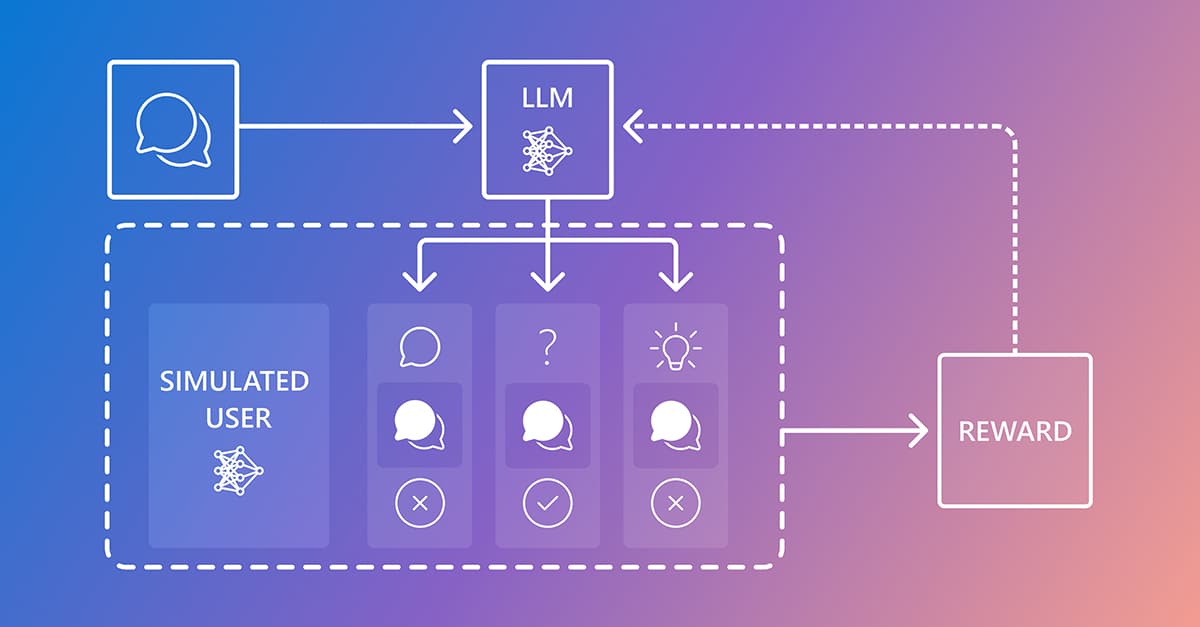
The core insight behind CollabLLM is simple: a response's value lies in its contribution to overall conversation success. A clarifying question, while seemingly a delay, often leads to better outcomes. Conversely, a quick, unverified answer can create confusion or derail the interaction. CollabLLM implements this through a simulation-based training loop. The model generates multiple possible next turns by engaging with a simulated user. This system uses a sampling method to extend conversations turn by turn. It chooses likely responses for both the AI agent and the simulated user, adding randomness to vary conversational paths. This exposes the model to diverse conversational scenarios, enabling it to learn more effective collaboration strategies.
CollabLLM applies multi-turn-aware reward (MR) functions. These functions assess how a model's response influences the entire conversation trajectory. The system samples multiple conversational follow-ups, such as statements or questions. It assigns rewards based on later performance. Automated metrics quantify goal completion, conversational efficiency, and user engagement. An LLM-as-a-judge framework supports efficient and scalable evaluation. Judge models rate each sampled conversation. The MR for each model response averages these scores. The model updates its parameters using established reinforcement learning algorithms like Proximal Policy Optimization (PPO) or Direct Preference Optimization (DPO).
Evaluations confirm CollabLLM's efficacy. A user study involved 201 participants in a document co-creation task. CollabLLM outperformed baselines trained with single-turn rewards. It also surpassed a second, more proactive baseline. CollabLLM produced higher-quality documents, achieved better interaction ratings, and facilitated faster task completion times. This work underscores a core belief: AI's future depends on effective collaboration. Designing AI systems that treat user input not as a constraint, but as essential, builds more accurate, helpful, and trustworthy systems. CollabLLM represents a significant step towards AI designed to work *with* people, not around them.