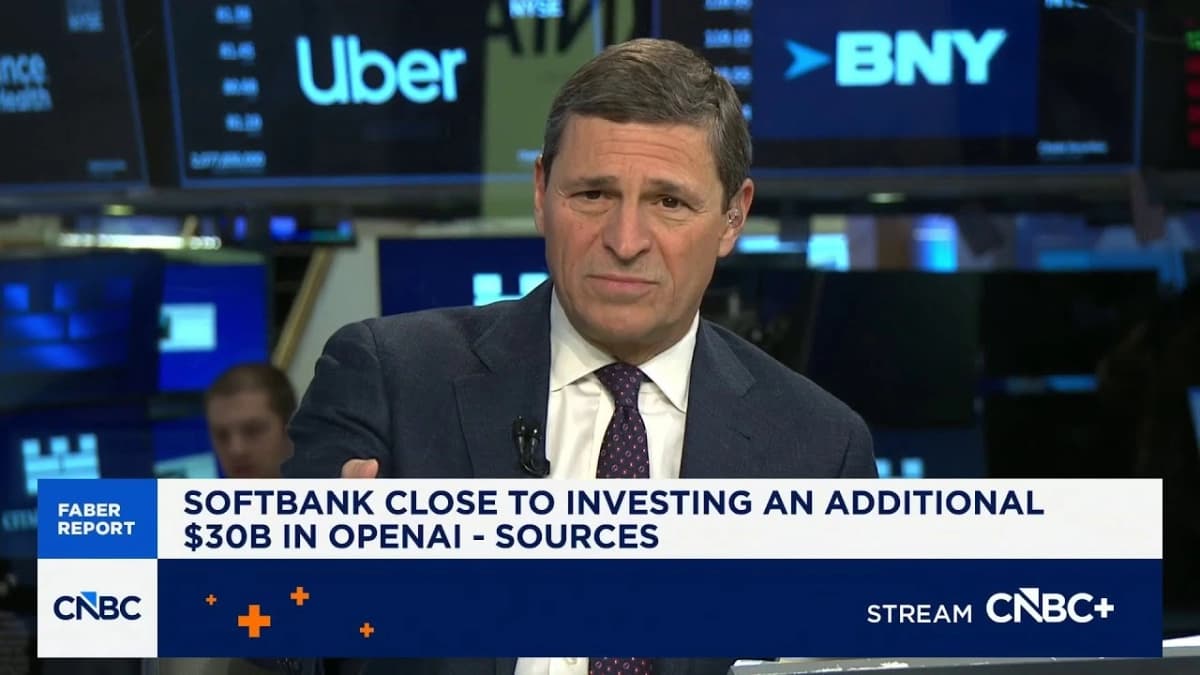
The unparalleled scale of capital formation in artificial intelligence is reaching almost unimaginable heights, underscored by reports that SoftBank is poised to commit an additional $30 billion to OpenAI. This commitment is not merely a significant venture capital deployment; it is a profound declaration regarding the anticipated trillion-dollar value of foundational AI models. It signals a new era of mega-funding rounds, where the resources required for AGI development dwarf traditional tech financing.
David Faber, delivering his "Faber Report" on CNBC, discussed the status of OpenAI’s highly anticipated funding round with co-host Jim Cramer, confirming that the Japanese conglomerate is deepening its commitment to the generative AI leader. This latest infusion would contribute to a reported $100 billion total fundraising effort, cementing OpenAI’s status as the most aggressively capitalized private technology company in history, all while operating at a staggering $830 billion to $850 billion post-money valuation. Faber noted that this new tranche is "in addition to the $30 billion that SoftBank provided previously and has already closed on," highlighting the sheer cumulative commitment SoftBank is making to the AI frontrunner.
The magnitude of these figures forces a recalibration of what constitutes a successful private technology company. For founders and venture capitalists tracking the pace of the AI race, this investment confirms that scale is the paramount defensive moat. Training the next generation of large language models requires astronomical computational resources, and the firms that can command the deepest capital pools—whether from institutional investors or strategic corporate partners—will define the competitive landscape for the foreseeable future.
Crucially, the funding is not coming solely from pure financial players. Faber emphasized the strategic nature of the round, noting that both NVIDIA and Amazon “may be a part of this fundraise round,” alongside Microsoft, which already holds a significant stake. This participation by key infrastructure providers underscores a fundamental shift in the AI investment thesis. These investors are not simply buying equity for future returns; they are investing to secure vital supply chains and lock in massive future consumption contracts.
This creates what Faber referred to as a "circular nature" to the investment—a dynamic where hardware and cloud providers invest capital into OpenAI, which then turns around and spends that capital buying GPUs (from NVIDIA) or cloud services (from Amazon Web Services or Microsoft Azure). For NVIDIA, which has seen its market valuation skyrocket on the back of GPU demand, investing in a leading AI customer guarantees the sustainability of its dominant position. For Amazon, which is competing fiercely with Microsoft for AI cloud dominance, securing a piece of OpenAI’s growth ensures that a portion of the massive compute spend flows directly back into AWS.
The confidence demonstrated by these giants is further bolstered by OpenAI’s demonstrable financial traction. While many high-valuation startups struggle to translate user adoption into revenue, OpenAI is proving the commercial viability of its models at an unprecedented pace. The company recently confirmed a $20 billion annual revenue run rate, a figure that provides critical validation for the valuations being ascribed to it. Moreover, the company is not capital constrained for immediate operations; Faber pointed out that OpenAI already has "$40 billion or so in cash on the balance sheet already." This suggests the $100 billion target is less about survival and more about securing generational resources—a massive war chest dedicated to maintaining their lead in the pursuit of AGI, insulating them from market fluctuations, and enabling massive, long-term compute commitments.
The discussion also briefly touched upon the historical context of such colossal, potentially transformative tech plays. Jim Cramer, captivated by the scale, called it "the greatest story of all time," comparing the investment frenzy to previous telecom bubbles, though Faber quickly countered that the current narrative is based on demonstrable revenue growth and strategic necessity, not just speculation. The fact that the most dominant tech companies in the world—Microsoft, Amazon, and NVIDIA—are strategically aligned with OpenAI through ownership, partnership, or both, illustrates that the race to control foundational AI is now the central preoccupation of global technology leadership.
The potential closing of this $100 billion round, heavily anchored by SoftBank's additional commitment, is more than a financial headline; it is a structural event. It validates the current trajectory of the AI economy, where unprecedented capital is concentrated in the hands of the few companies deemed capable of achieving true general intelligence, forcing competitors and strategic partners alike to participate in a circular economy designed to fund the infrastructure of the future.