
Record OpenAI User Growth Deflects Musk Lawsuit Claims

4 min read
Record OpenAI User Growth Deflects Musk Lawsuit Claims

OpenAI is demonstrating that the initial wave of generative AI adoption was not a fleeting trend, but a fundamental shift in user behavior, according to a recent investor letter obtained by CNBC. The core message emanating from the company’s leadership is one of sustained operational momentum, coupled with a calculated dismissal of the legal distractions currently occupying headlines. This dual narrative—unprecedented user engagement meeting high-stakes legal defense—provides essential context for investors and competitors navigating the hyper-competitive AI ecosystem.

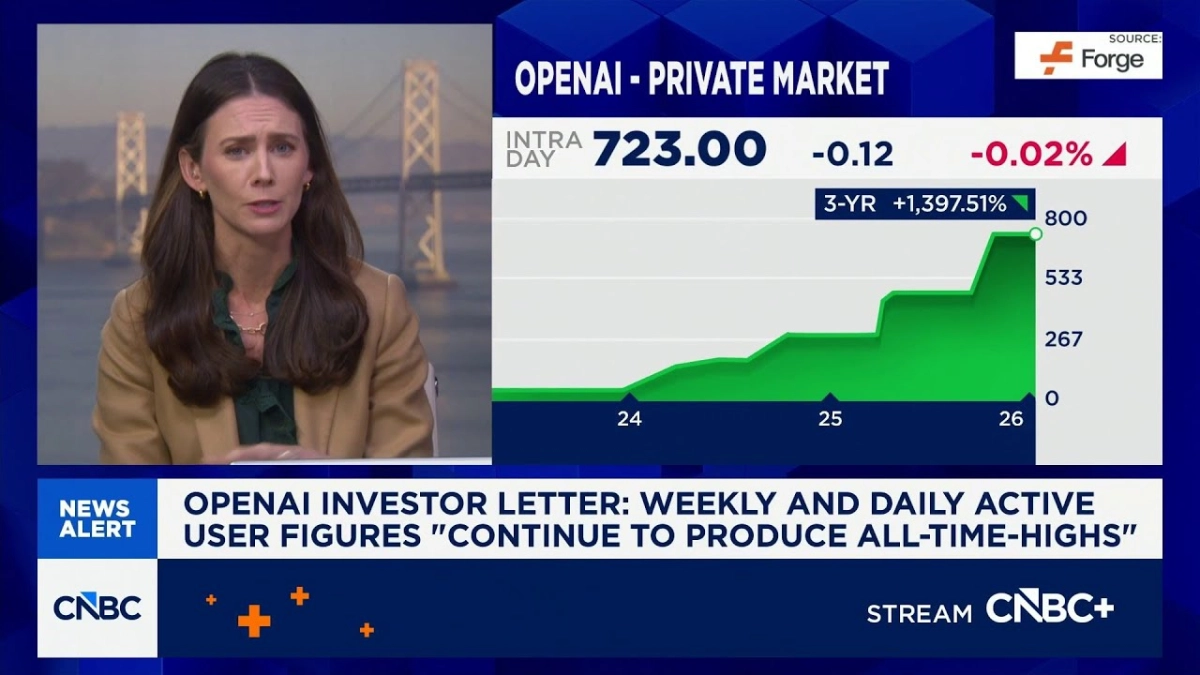
CNBC's Kate Rooney delivered a critical news update on Fast Money, summarizing a confidential OpenAI investor letter addressed to stakeholders and bankers. The letter detailed several key operational metrics, including record-breaking user adoption, significant growth in its coding assistance product, and the company's confident legal stance against the ongoing high-profile lawsuit initiated by co-founder Elon Musk. The report underscores that in the battle for AI dominance, maintaining growth trajectory and managing reputation risk are equally paramount.


Related startups

The headline operational success revolves around the consumer-facing product, ChatGPT. While competitors like Anthropic push their own models, OpenAI’s foundational offering continues to solidify its market position. The letter explicitly stated that weekly and daily active user figures "continue to produce all-time highs" in January. For venture capitalists and founders, this metric is perhaps the most crucial signal: it validates that the initial viral success has translated into sticky, habit-forming utility, suggesting strong retention and a growing moat against rivals. This sustained engagement is the bedrock supporting the company’s staggering private market valuation, which, as the graphic displayed during the segment showed, continues its aggressive ascent.

Beyond the consumer interface, the investor letter highlighted remarkable momentum in specialized tools, specifically Codex—the system designed to write code. The report noted that Codex usage is "roughly up 25% week over week." This specific data point speaks volumes about the commercialization strategy. While ChatGPT captures the public imagination, tools like Codex deliver direct, quantifiable productivity gains for high-value enterprise users—software developers. A 25% weekly increase in usage suggests that professional adoption is accelerating rapidly, indicating that OpenAI is successfully penetrating mission-critical workflows where switching costs will eventually become prohibitive. This validates the thesis that the most valuable AI applications will be those integrated deeply into the engineering stack.

The operational victories, however, are shadowed by the ongoing legal saga involving Elon Musk. The former OpenAI founder is currently suing the company, alleging a breach of its original non-profit mission to develop AI for the benefit of humanity, rather than for profit. The investor letter sought to preemptively mitigate investor concerns regarding this high-profile legal exposure. OpenAI leadership told investors it feels "confident in its legal defenses." This declaration is critical for maintaining financial stability and investor calm, particularly given the potential for the lawsuit to derail focus and resources.

Crucially, OpenAI attempted to financially quantify the potential liability, stating it believes the case is worth "no more than $38 million." This figure is strategically tied to the amount Musk had previously donated to the non-profit entity. By anchoring the potential financial exposure to this historical donation amount, OpenAI is attempting to frame the dispute narrowly as a disagreement over past contributions rather than a fundamental challenge to its current structure or future intellectual property. For sophisticated investors, this move provides a tangible ceiling on risk, contrasting sharply with the potentially limitless claims associated with a breach of fiduciary duty or mission.

The letter also offered a pointed warning regarding the public nature of the impending legal battle, which is set to approach trial in April. OpenAI advised investors to expect "attention-grabbing claims" from Musk. This pre-emptive communication is a necessary piece of strategic insulation. It anticipates that Musk, known for his aggressive and public legal tactics, will utilize the court proceedings as a platform to generate negative publicity. By warning stakeholders ahead of time, OpenAI is managing expectations, encouraging investors to filter public noise and focus instead on the underlying operational metrics and the company's legal defense strategy, which it continues to characterize as viewing the lawsuit as "baseless." The combination of record user growth and a calculated, confident legal counter-narrative forms the current foundation of OpenAI's pitch to the financial community.

© 2026 StartupHub.ai. All rights reserved. Do not enter, scrape, copy, reproduce, or republish this article in whole or in part. Use as input to AI training, fine-tuning, retrieval-augmented generation, or any machine-learning system is prohibited without written license. Substantially-similar derivative works will be pursued to the fullest extent of applicable copyright, database, and computer-misuse laws. See our terms.