
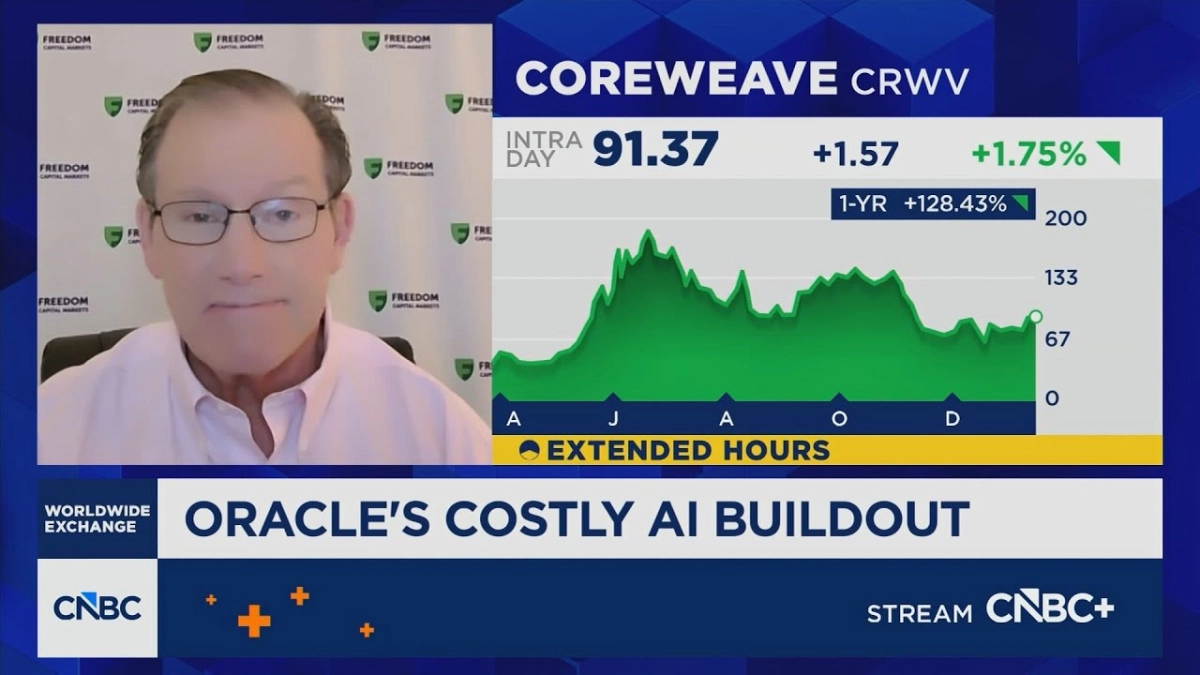
The collision between aggressive artificial intelligence expansion and traditional corporate finance is creating unprecedented friction in the market, exemplified by Oracle’s recent legal and financial maneuvers. The massive capital expenditures required to fuel the AI boom—particularly in data center buildouts—are testing the limits of balance sheets, leading to investor anxiety and, in Oracle’s case, a bondholder lawsuit. This controversy forces a crucial question: how long can established tech giants fund the hyper-growth of generative AI pioneers before their own financial stability comes into question?
Paul Meeks, Head of Tech Research at Freedom Capital Markets, addressed this specific tension in a recent CNBC interview, focusing on the lawsuit filed by bondholders who claim they were misled about Oracle’s intention to borrow heavily for AI infrastructure. Meeks spoke about the legal implications of the debt covenants, the financial outlook for Oracle’s significant exposure to OpenAI, and the broader implications for AI infrastructure investment.
Meeks quickly dismissed the legal merits of the bondholders’ case, suggesting they have a weak argument based on the established framework of corporate debt. In his view, the very purpose of debt covenants is to manage the risk associated with subsequent borrowing. Paul Meeks articulated his skepticism, stating, "I don't think the bondholders have much of a case because in any kind of debt raise, you have to be careful when you write debt covenants, and debt covenants are expressly for the reason to protect current bondholders from adding more debt to the balance sheet." This perspective suggests that while the bondholders may feel blindsided by the scale of Oracle's borrowing—an $18 billion bond sale followed by a $38 billion debt package—the legal protections they seek are already defined within the financing structure, regardless of the underlying business purpose (AI buildout).

The real story, however, is not the legal technicality but the staggering financial commitment Oracle has made to the AI revolution, transforming the company’s risk profile. Oracle, long recognized as a powerful free cash flow generator, is now stretching its financial capacity to become a core infrastructure provider for the generative AI ecosystem. This aggressive capital expenditure (CapEx) program is largely driven by its deep relationship with OpenAI, whose plans for infrastructure spending are rumored to reach $1.4 trillion by 2030. This level of commitment means Oracle is effectively "over their skis," as Meeks put it, with the bulk of their revenue backlog now tied directly to a hyper-growth, cash-burning AI startup.
For investors, Oracle has thus become an unexpected proxy for OpenAI’s success in the public markets. When concerns arise about the feasibility of OpenAI’s long-term business model or its massive CapEx plans, the market reacts by pricing risk into Oracle’s stock and, critically, its bonds. The confidence in Oracle's ability to sustain this debt load is intrinsically linked to OpenAI’s future ability to generate capital and ultimately turn a profit.
Meeks highlighted that the resolution of Oracle’s AI-debt dilemma rests heavily on external financing events for OpenAI. A successful resolution would require significant equity infusion into the AI partner. Meeks emphasized that it will be "incumbent upon OpenAI to do either a big private equity raise, rumored, or in fact a very successful and large IPO later in 2026," to instill confidence in Oracle's debt holders and stabilize the market’s perception of Oracle’s exposure. Should OpenAI successfully execute a large private equity raise or a highly valued IPO, the equity on its balance sheet would provide the necessary security, alleviating the fear that Oracle is solely underwriting a venture with astronomical capital needs and uncertain profitability timelines.
The market’s reaction reflects the inherent unpredictability of financing a technological shift this profound. Investors are grappling with the fact that AI infrastructure requires capital expenditures that dwarf previous tech cycles, demanding new models of financing and risk assessment. For tech insiders and VCs, this scenario underscores the massive financial drag that even the most innovative AI companies place on their partners. The sheer scale of the investment required means that traditional metrics of profitability and free cash flow generation are temporarily suspended in favor of market share and technological dominance, a gamble that puts immediate pressure on the infrastructure providers.
Looking beyond Oracle, Meeks suggested that investors seeking opportunities in the AI infrastructure space might find better risk-adjusted returns in smaller, rapidly diversifying players. He pointed specifically to CoreWeave, which, while also having significant revenue backlog tied to OpenAI (around 35%), is actively diversifying its client base. CoreWeave’s bonds have reportedly traded at a substantial discount, potentially offering a more attractive setup for investors betting on the broader growth of AI cloud infrastructure without the concentration risk currently burdening Oracle.
The current financial turbulence surrounding Oracle serves as a stark reminder that the AI revolution is not just a technological race but a capital arms race. The success of legacy providers like Oracle is now inextricably tied to the financial maturity of their AI partners, forcing a radical re-evaluation of debt, equity, and strategic exposure in the high-stakes world of generative AI infrastructure.