

Langflow Demystifies AI Workflow Orchestration with Drag-and-Drop Simplicity

4 min read
Langflow Demystifies AI Workflow Orchestration with Drag-and-Drop Simplicity

David Jones-Gilardi, Developer Relations Engineer at IBM, provided a comprehensive overview of Langflow, an open-source visual studio designed to simplify the creation of complex AI workflows. His presentation focused on moving beyond rigid, code-driven approaches toward a more intuitive, modular system for integrating Generative AI, RAG (Retrieval-Augmented Generation), and custom tooling. The core message is that Langflow democratizes AI workflow construction, allowing developers to iterate rapidly without being locked into a single vendor or language stack.

[David Jones-Gilardi] spoke with IBM representatives about building Agentic RAG, Generative AI, and MCP workflows, emphasizing the shift from traditional programming paradigms to visual orchestration. Early in the discussion, Jones-Gilardi framed the current state of AI application development as presenting developers with a binary choice: either take a code-driven approach using languages like Java, Python, or JS, or opt for a UI-driven solution. He immediately positioned Langflow as the bridge over this divide.


The central problem Langflow addresses is the complexity inherent in chaining together various AI components—Large Language Models (LLMs), vector databases, and custom tools. As Jones-Gilardi illustrated with his whiteboard sketches, traditional methods often require significant boilerplate code to manage data flow, state, and error handling between these disparate elements. Langflow aims to abstract this complexity into a visual, node-based environment. He noted, "It is completely model and vector store agnostic... You can use local models or stick with a particular model vendor." This agnostic nature is a critical feature, suggesting that users are not beholden to any specific LLM provider, fostering flexibility and avoiding vendor lock-in—a key concern for enterprise architects.

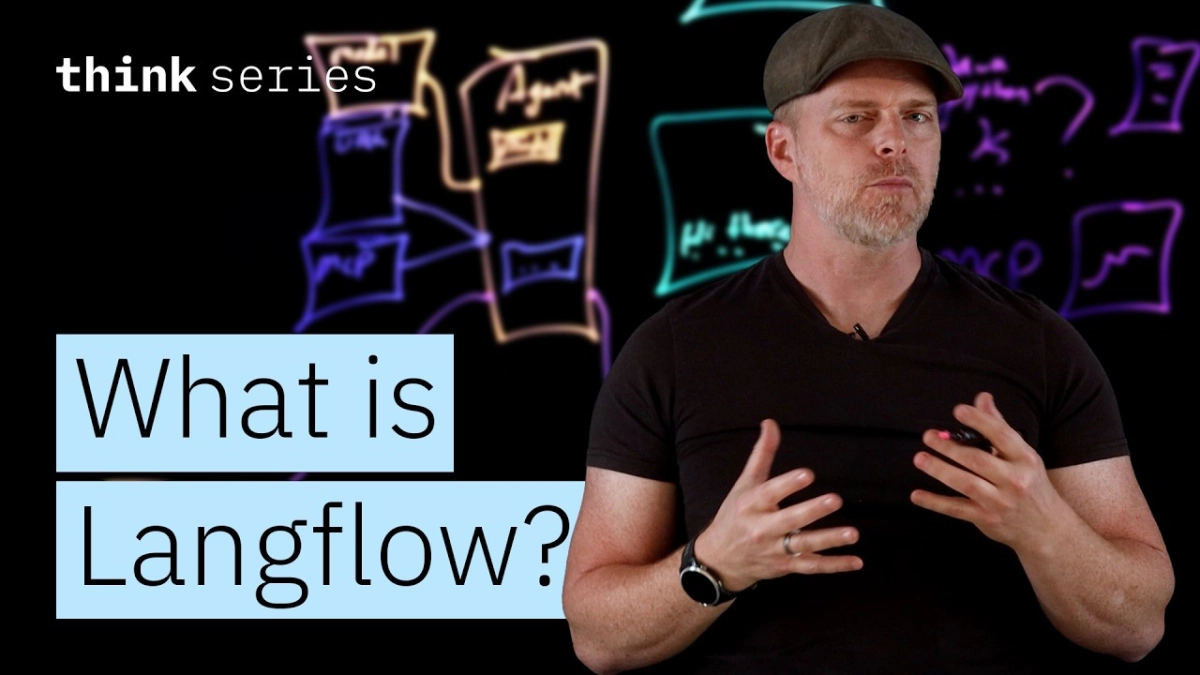
A significant advantage highlighted by the demonstration is Langflow's low-code/no-code approach to building sophisticated Agentic workflows. Jones-Gilardi sketched out a flow involving an input, an agent containing a model, and an output, illustrating how data moves sequentially. He further elaborated on the agent structure, showing how components like URL retrieval tools and custom MCP (Model Custom Component) tools can be integrated. The visual representation emphasized that these components connect via intuitive lines, representing data flow, which drastically simplifies debugging and modification compared to tracing logic through extensive Python scripts.

The flexibility extends to tool integration. Jones-Gilardi pointed out that because Langflow is open source, developers have full transparency and control. He stated, "Because it's open source, you can inspect and modify any component or contribute your own back to the community." This commitment to open standards and extensibility is vital for adoption among sophisticated AI practitioners who often require bespoke functionality not available in closed systems. This modularity means that if a specific vector database or a proprietary tool is needed, it can be incorporated directly into the visual canvas.

Furthermore, Langflow provides robust observability. Jones-Gilardi explained that when testing an agent in the "Play" mode, users can see the flow of data and logic in real-time. He mentioned that when an agent decides to use a tool, the tool's parameters and the resulting data are visible. This level of introspection is crucial for debugging complex, non-deterministic AI systems. He emphasized this point by saying, "You'll find... nodes have these nice little colors on them and they denote the type, right? So in the case of like these inputs and outputs, maybe there are message or some other types of components... and you can tweak any of the parameters you see in components." This feature transforms the typically opaque process of agent reasoning into a transparent, traceable sequence of operations.

The platform supports both standard RAG and more complex agentic logic, allowing for conditional routing and complex decision-making within the flow. This capability allows users to build applications that conform precisely to specific business requirements, rather than being constrained by the limitations of pre-packaged solutions. The ability to easily switch out underlying models or vector stores without rewriting the entire orchestration layer represents a major efficiency gain for engineering teams focused on AI deployment. Langflow, therefore, serves not just as a visualizer but as a powerful orchestration engine that abstracts away the language and vendor dependencies that plague rapid AI prototyping.

