The recent, rapid solution of a famously difficult open mathematics problem, attributed to the Hungarian polymath Paul Erdős, serves as a stark metric for the accelerating capabilities of artificial intelligence. Quant researcher Neel Somani recently announced a "Weekend win: The proof I submitted for Erdos Problem #397 was accepted by Terence Tao." The critical detail, however, was that the proof itself was generated by GPT 5.2 Pro, a powerful language model, and formalized using the verification tool Harmonic. This event, discussed by commentator Matthew Berman, highlights not just a singular achievement but the profound implications of AI models crossing the threshold into automated scientific discovery, shifting the focus from mere optimization to genuine, self-directed intellectual progress.
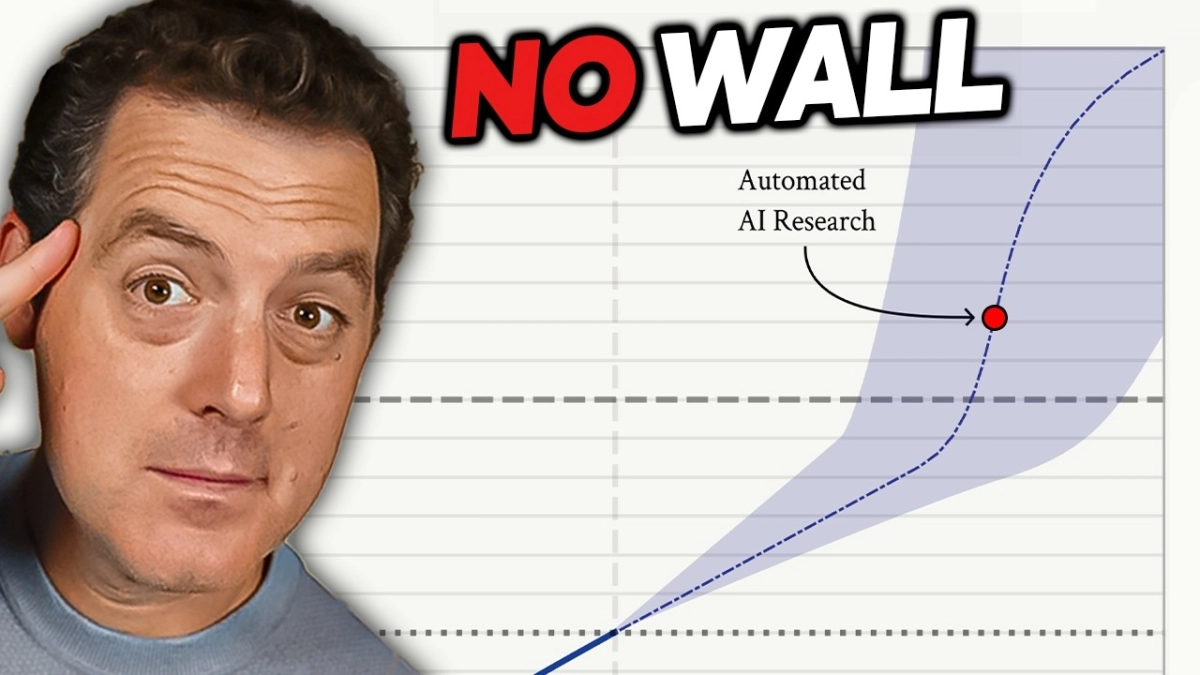
Berman’s commentary framed this breakthrough as a key indicator of the long-theorized "Intelligence Explosion," a scenario where AI systems become capable of recursively improving themselves, leading to exponential gains in capability. The Erdos problem solved—one of hundreds of open problems in number theory and combinatorics—had resisted human efforts for decades. When asked how long it took the AI to find the solution, Somani replied, "Around 15 minutes." The staggering brevity of this timeline, juxtaposed against the decades of human effort, underscores the qualitative leap now occurring in algorithmic reasoning. This capability is fundamentally different from pattern recognition; it requires generating novel proofs and abstract mathematical constructions, a domain long considered exclusively human.

The true significance for founders and tech analysts lies in the nature of this discovery loop: human input (prompting) yields a novel solution (AI generation), which is then verified and formalized (Harmonic/Lean). This workflow dramatically compresses the cycle of research and discovery. As Berman noted, "Many open problems are sitting there, waiting for someone to prompt ChatGPT to solve them." This is the core insight: the bottleneck has shifted from intellectual capacity to the speed of iteration and the availability of computational resources. Once AI can reliably perform automated research, it can then apply those discoveries to improve its own architecture and efficiency, creating a compounding feedback loop that drives the intelligence curve upward exponentially.
This recursive self-improvement is not limited to abstract mathematics. Google’s DeepMind demonstrated a similarly crucial breakthrough with AlphaEvolve, which improved the foundational matrix multiplication algorithm—a cornerstone of modern computing and, ironically, the engine of AI itself. The previous best algorithm, Strassen’s, had stood for over fifty years. AlphaEvolve improved the number of scalar multiplications required for complex-valued matrices, a seemingly minor tweak that, when scaled across Google’s vast data centers, results in massive global efficiency gains. Berman highlighted that this small algorithmic improvement, "scaled over the entirety of the artificial intelligence ecosystem, actually results in massive gains." These gains translate directly into reduced computational cost and faster training times for the next generation of AI models, thus speeding up the intelligence explosion itself.
The trend of AI-driven scientific discovery is now systemic, extending beyond the major players. OpenAI’s experimental reasoning LLM achieved gold-medal level performance on the 2025 International Mathematical Olympiad (IMO), a competition notorious for requiring deep, non-standard thinking. Furthermore, Sakana AI, a Japanese firm, recently published work on "The AI Scientist," detailing a system designed for fully automated, open-ended scientific discovery. These examples collectively confirm that AI is not merely optimizing existing processes; it is becoming a proactive agent in creating new knowledge. The various AI tools—AlphaEvolve, AlphaProof, Aristotle, and the GPT/Claude models—are collectively tackling problems in number theory, combinatorics, and computer science, often yielding results previously unknown or confirming decades-old conjectures.
For venture capitalists and technology leaders, the implications are clear: the value chain of scientific and technical discovery is being fundamentally restructured. The ability of AI to accelerate the rate of discovery, especially in areas that feed back into improved compute efficiency (like data center scheduling optimization achieved by AlphaEvolve), means that the timeline for technological advancement is collapsing. The constraint is rapidly moving away from human ingenuity and towards hardware availability and energy capacity. The proliferation of AI-generated full solutions to previously open problems—many formalized using verification tools like Lean—validates the thesis that we are entering a phase of automated intellectual acceleration. The era of human-paced foundational research is drawing to a close, replaced by a machine-driven, self-improving cascade of breakthroughs.