

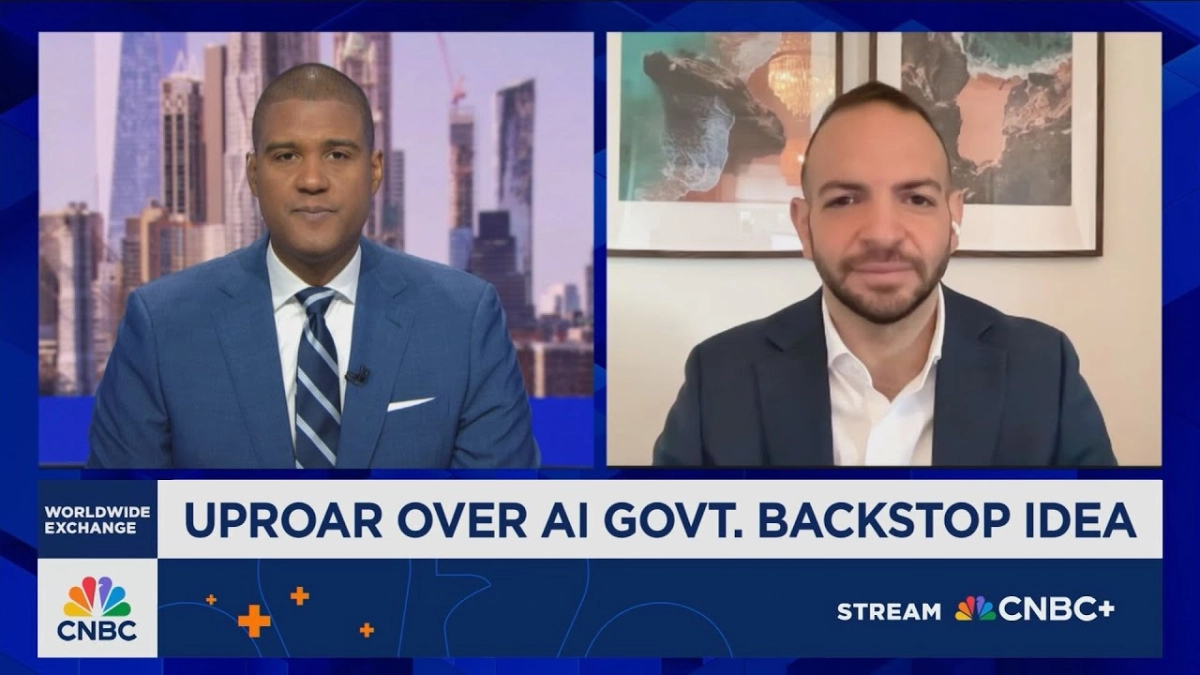
The United States faces a pivotal choice in the burgeoning AI landscape: whether to directly fund private sector pioneers or strategically invest in its own national AI infrastructure. Alex Kantrowitz, Founder of Big Technology and a CNBC contributor, recently articulated a compelling argument for the latter, suggesting that while government intervention in the private AI market is ill-advised, a federal initiative to build sovereign AI models is not only warranted but essential for national security and innovation.
Kantrowitz spoke with CNBC anchor Frank Holland on "Worldwide Exchange" about the contentious idea of government backstops for leading AI companies like OpenAI and the broader implications of AI for global power dynamics. His commentary highlighted a distinct dichotomy between market-driven innovation and strategic national interest.
The notion of the U.S. government backstopping private AI ventures, such as OpenAI, strikes Kantrowitz as fundamentally unsound. He argues that the private market is already robust and competitive enough to foster innovation without taxpayer guarantees. "It wouldn't make sense at all for the United States government to backstop any financing to OpenAI," he asserted, pointing out that the failure of one player would not signify a broader industry collapse given the multitude of other companies, including tech giants like Google, actively developing AI. This perspective underscores a belief in the inherent dynamism of the American entrepreneurial spirit, where market forces, rather than government safety nets, should dictate success and failure.
However, Kantrowitz's opposition to corporate bailouts does not extend to a complete disengagement of the government from AI development. On the contrary, he strongly advocates for the U.S. to cultivate its own "sovereign AI models." This involves a federal initiative to build proprietary large language models and robust data centers, a move he believes is critical for maintaining geopolitical advantage. "Artificial intelligence technology does have a chance to be powerful and potentially change the scales of power in the globe," Kantrowitz stated, emphasizing the strategic imperative for national self-reliance in this transformative technology.
This stance is rooted in a historical understanding of government’s role in pioneering technological frontiers. The U.S. government has a long legacy of investing in foundational research and development that later spurred massive private sector growth, from the internet to GPS. AI, in Kantrowitz’s view, represents the next frontier where such strategic public investment is necessary to ensure national interests are protected and advanced.
Related Reading
- David Sacks Rejects AI Bailouts, Emphasizing Market Competition Over Government Backstops
- OpenAI's Trillion-Dollar Bet on AI Dominance
- AI Hyperscalers Fuel Debt Surge, Offering Unique Investor Opportunity
The implementation of such a sovereign AI strategy would likely manifest as either an entirely internal government entity or a public-private partnership. A significant hurdle, Kantrowitz notes, is the current state of U.S. government data infrastructure. He highlighted the fragmentation and inefficiency: "You can have one department that has 70 or 100 different systems with disparate data. That's part of the reason why the government is so ineffective." Modernizing and unifying this vast, disparate data landscape would be a foundational step, enabling the government to leverage its own information effectively with AI, thereby improving public services and national capabilities.
This initiative would involve syncing up data across various federal systems and layering AI capabilities on top, ultimately aiming to enhance governmental efficiency and citizen services. While acknowledging that such an undertaking would be a significant bet with no guaranteed immediate payoff, Kantrowitz believes the potential for long-term strategic benefits makes it a worthwhile endeavor for the United States. It's a pragmatic approach to ensure the nation's technological sovereignty and competitive edge in an increasingly AI-driven world, distinct from subsidizing individual private companies.



