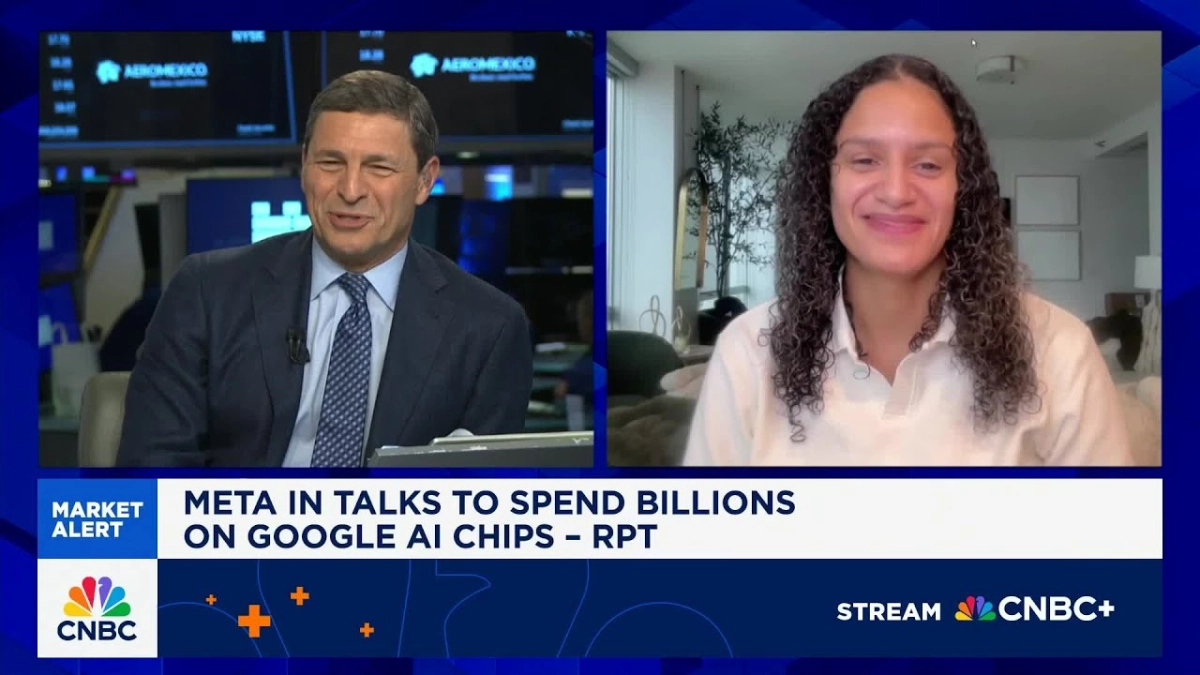
The current AI race is a dynamic sprint, where yesterday's state-of-the-art becomes today's benchmark to be surpassed within a mere 48 hours. This relentless pace was a central theme in X. Eyeé's recent discussion on 'Squawk on the Street,' where the CEO of AI consulting firm Malo Santo, and a former Global Strategy Lead for Responsible Innovation at Google, offered a sharp analysis of the evolving artificial intelligence landscape. Eyeé engaged with the interviewer on Google's latest model, Gemini 3, and critically, the broader implications for the AI race, the enterprise, and the future workforce, highlighting a profound shift in focus.
Eyeé immediately addressed the rapid advancements, stating, "Gemini was state of the art up until last night. In the AI race, we are seeing models go ahead within 48 hours where they’re taking over each other, and last night Claude Opus 4.5 was just released, which actually outperforms Gemini 3 on benchmarks." This observation underscores the hyper-competitive nature of the AI development cycle, where even monumental leaps are quickly overshadowed. Gemini 3, as Eyeé noted, had itself made "massive leaps" in its ability for coding and reasoning, demonstrating over a 10% improvement on certain benchmarks—a significant advancement that, in another era, might have held the top spot for far longer.

This breakneck competition, however, reveals a deeper, more fundamental shift in the AI paradigm. The race is no longer solely about the "raw intelligence of models," as Eyeé articulated. Instead, companies are increasingly optimizing their AI models for "agentic use." This means moving beyond simply making models smarter or more capable of human-like conversation. The focus is now on developing large language models that can be effectively deployed within various systems to autonomously execute complex tasks on behalf of a human user.
The implications for the enterprise are substantial. Rather than simply serving as advanced tools for data analysis or content generation, these agentic AI systems are designed to integrate seamlessly into existing workflows, acting as intelligent assistants that can perform multi-step operations. Eyeé explained, "It made a model that was so good that it could be applied across all of these different contexts to bring applications to life in domain." This signifies a move towards specialized AI agents tailored to specific industry verticals—a coding agent deployed in a scientific research environment, for instance, would be distinct from one operating within a web development framework. The power lies in their ability to generalize across diverse contexts and domains, making them versatile assets for businesses looking to enhance efficiency and productivity.
Despite the excitement, Eyeé cautioned that these agentic systems are still "very nascent" and "very new." Their full potential is yet to be realized, and their integration into existing enterprise structures will require careful planning and development. However, the trajectory is clear: AI is moving from being a passive intelligence to an active, autonomous partner in the workplace.
This shift necessitates a re-evaluation of traditional workflow structures. The future of work will see human expertise amplified by bespoke AI assistants.
Related Reading
- Gemini's Ascent: Google's Existential Challenge to OpenAI
- AI Market Maturation Driven by Broadening Competition
- AI Industry's Ascendant Influence in Washington
The prevailing narrative of AI replacing human workers, while a valid concern, is likely to be superseded by a more nuanced reality of augmentation. Eyeé pointedly stated, "It’s not going to be AI that replaces you, it’s going to be a person using AI." This perspective highlights a future where individual human workers are "augmented by a team of synthetic humans, or what we’re calling agents, to be able to execute tasks on their behalf so that they can get more work done within a smaller span of time." These agents will be highly customized to individual needs and preferences, effectively creating personalized AI cohorts that enhance human capabilities across a spectrum of tasks, from email management to complex coding projects.
The current stage of the AI race is less about crowning a single, universally "smartest" model and more about fostering a competitive landscape where models are rapidly evolving to become highly capable, specialized agents. This ongoing transformation promises not just efficiency gains but a fundamental reshaping of how work is conceived and executed, with human ingenuity and AI agency forming powerful, synergistic partnerships.